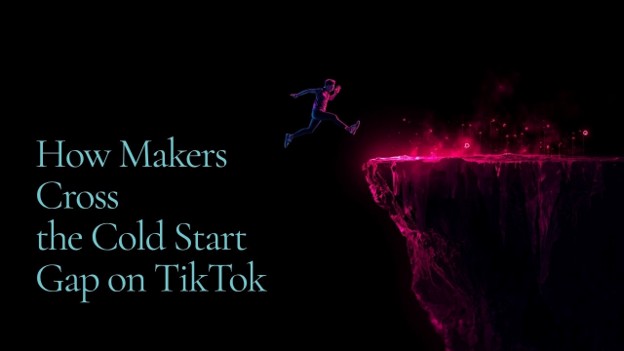
How Makers Cross the Cold Start Gap on TikTok
Most people who ship a digital product treat TikTok as a marketing afterthought, then wonder why the first videos reach almost no one. For makers, solo founders, and freelancers, the app works less like a stage and more like a distribution channel, one that decides how far each upload travels before anyone chooses to watch. The hard part is the beginning. A brand new account starts with no audience and no track record, which is the moment the cold start problem shows up. Borrowed from recommendation systems, the cold start problem describes what happens when software has to rank something it knows nothing about yet. The gap is real, but it is short, and there are sensible ways to move an account through it.
What the Cold Start Gap Means for a New Account
The cold start gap is the early window when a new TikTok account has too little watch history for the recommendation system to place its videos confidently. To cold start an account means to publish into that gap, and the cold start gap itself is the state of low certainty the account sits in until enough behavior accumulates. During this window the account competes for reach with no behavioral record, so distribution stays narrow and hard to predict.
A new account carries two kinds of doubt at the same time, one from the machine and one from the people who land on the profile. The recommendation system lacks watch time data, and first visitors lack any social proof, since follower count is one of the few trust signals a person can read before a single video is watched. For that reason, some makers choose to buy tiktok followers safely, from a provider that adds them gradually rather than in one obvious spike, giving a launch account an opening layer of social proof that looks credible while their own content starts to earn watch time. Views4You is one of the providers makers turn to for exactly this kind of gradual, credible growth. The account still has to prove itself through real views, yet it no longer looks abandoned on arrival.
How TikTok Reads a New Account’s First Signals
TikTok ranks a video by how people respond to it, not by who posted it. On a zero history account the system leans on a small set of early signals to decide whether to widen distribution. Watch time comes first, since the app measures how long viewers stay before scrolling away. Completion rate matters next, because a short clip watched to the end signals that the content delivered on its hook. Early engagement rate, meaning likes, comments, saves, and shares relative to views, tells the system whether the small first audience found the video worth a reaction.
These signals compound. A video that holds attention gets shown to a slightly larger group, and if that group responds well, the reach widens again. The first few hundred viewers therefore carry more weight than their number suggests, because they set the direction for everything that follows.
Why Early Follower Counts Shape First Impressions
People read a profile faster than any algorithm. When someone taps through to an account, the follower count is one of the first things they see, and it works as a quick shortcut for whether the account is worth their time. An account with a visible base reads as established, while one sitting near zero invites hesitation. This is a human judgment, separate from ranking, and it shapes whether a curious viewer taps follow or leaves.
Turning a Product Launch Into a TikTok Channel
A product launch is a single moment, but a TikTok account is a channel that has to keep producing. The makers who do well treat the launch as the first episode rather than the whole story. Instead of one announcement video, they break the product into a running series of small ideas, the problem it solves, the process behind it, the mistakes made along the way, and the questions customers keep asking. Each of these becomes several short videos.
This shift turns a one time event into a repeatable format. A repeatable format is easier to sustain, and consistency is exactly what a new account needs while the recommendation system learns what the account is about.
A Lean Content Stack for Solo Founders
A solo founder does not need a studio to stay consistent. A workable setup covers four jobs, capture, edit, schedule, and track. For capture, a phone and a small light are enough. For editing, a single mobile app that handles captions and trims. For scheduling, a planner that sends a week of videos out without daily effort. For tracking, the native analytics view, read once a week to see which hooks held attention. Four categories, one tool each, nothing more until the account earns it.
Signals That Move a New Account Past Zero
Crossing the cold start gap comes down to a handful of signals the account can influence directly. The order matters less than the habit of feeding all of them.
- Consistency, posting on a steady schedule so the system gets regular data.
- Watch time, opening each video with a hook that earns the first three seconds.
- Engagement, asking one clear question so viewers have a reason to comment.
- Follower growth, since crossing 1,000 followers unlocks features such as going live.
None of these work in isolation. Together they give both the algorithm and new visitors enough evidence to treat the account as active rather than untested.
Frequently Asked Questions
How long does the cold start phase usually last
It typically runs through the first few weeks of steady posting, until the account has enough videos for the system to read a pattern. Accounts that post consistently tend to move through it faster than those that post once in a while.
Do follower counts change how a video is ranked
Follower count is not a direct ranking factor, since TikTok pushes individual videos based on viewer response. It still shapes human trust, which affects whether new visitors follow after they watch.
How many followers does a TikTok account need to go live
An account generally needs 1,000 followers before the live feature becomes available. Some accounts see it at different thresholds as the app tests changes.
What content works best for a brand new product account
Short videos that show the product solving a real problem tend to perform better than polished announcements. A running series around one theme gives the account a clear identity while the system learns what it is about.

I am James, a UK-based tech enthusiast and the Editor and Owner of Mighty Gadget, which I’ve proudly run since 2007. Passionate about all things technology, my expertise spans from computers and networking to mobile, wearables, and smart home devices.
As a fitness fanatic who loves running and cycling, I also have a keen interest in fitness-related technology, and I take every opportunity to cover this niche on my blog. My diverse interests allow me to bring a unique perspective to tech blogging, merging lifestyle, fitness, and the latest tech trends.
In my academic pursuits, I earned a BSc in Information Systems Design from UCLAN, before advancing my learning with a Master’s Degree in Computing.
I’m proud to share that Vuelio has consistently ranked Mighty Gadget as one of the top technology blogs in the UK. With my dedication to technology and drive to share my insights, I aim to continue providing my readers with engaging and informative content.
I work directly with the companies he reviews products for or their chosen PR agency.
For Social Media, you can find me on: