Best Wireless Speakers for Home 2026
There is no easy answer to what the best wireless speaker for the home is. There are so many variables that you could break this down into multiple posts.
Before you try to decide on a speaker, you will want to think about your budget and specific needs.
A wireless speaker is a bit of an ambiguous term. Is it something like Sonos, where it is plugged into the mains but connects to your network with Wi-Fi, allowing you to stream music? Or is it battery-powered, allowing you to move it around? Does it have to have Wi-Fi, or is Bluetooth fine?
For example, the Anker Soundcore Boom 2 is wildly different to the Audio Pro A48 floor-standing speaker.
This post aims to point you in the right direction and suggest some excellent speakers for different needs.
Most recommendations here will be fairly broad, but the speakers selected are typically the go-to options in each category. Once you know what sort of speaker you want, it is worth researching the options further to see if there is anything more suitable for your particular needs.
What Should You Consider Before Buying?
Before spending your money, it is worth clarifying exactly what you need from a wireless speaker. The main questions to ask yourself are:
Do you want something that stays in one place? Mains-powered Wi-Fi speakers like those from Sonos or KEF generally offer better sound quality and multi-room capability but require a power socket. If you want to move the speaker between rooms or take it outside, you will need a battery-powered Bluetooth model instead.
How big is the room? A small Bluetooth speaker might be ideal for a bedroom or kitchen, but it will struggle to fill a large living room. Floor-standing or larger bookshelf speakers are a better fit for open-plan spaces.
Do you care about a multi-room system? Platforms like Sonos allow you to group speakers together and play the same music throughout the house. This is harder to achieve with standalone Bluetooth speakers.
What is your budget? The range here is vast. You can pick up a solid Bluetooth speaker for under £100, or spend well over £1,000 on a premium wireless bookshelf system. There are good options at every price point, though the quality jump between budget and mid-range is often significant.
Best Brand – Sonos
I will get Sonos out of the way first. Rather than say the Sonos Era 100 is the best overall speaker, I will suggest that they are the best overall brand. They have a wide range of speakers at different budgets, catering to different needs. Most are mains-powered, but they also have the Sonos Move 2 for portable use.
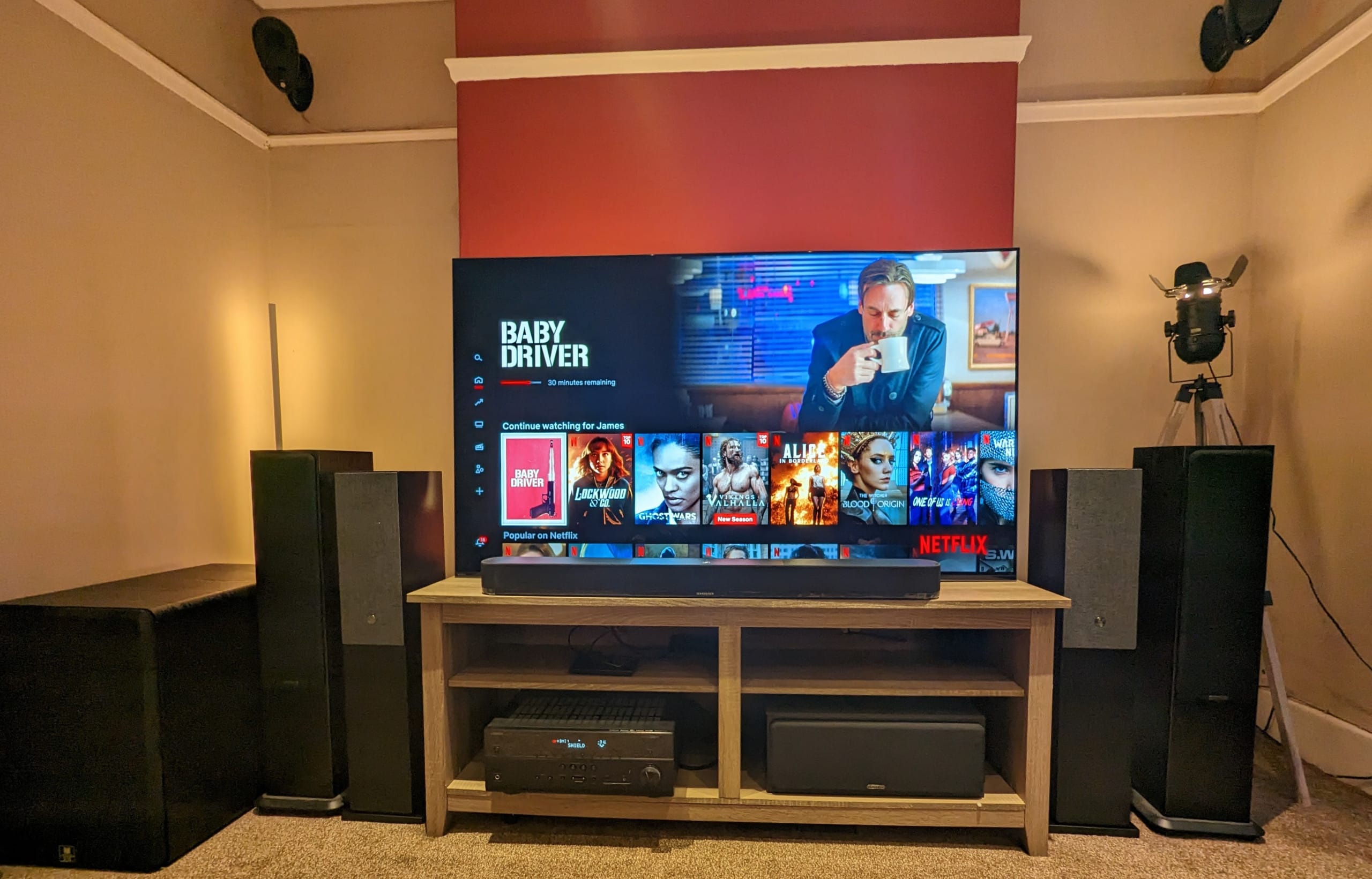
I say they are the best brand because you can expand the system over time. I started with a Sonos One, but later added a Sonos Beam for a TV speaker.
As much as I love Sonos, I have had a lot of issues with my system. Sonos is particularly finicky with Unifi access points, especially when you mix wired Ethernet and wireless connections, and I regularly have issues with the app connecting properly.
Sonos also has a bit of a bad reputation for stopping support for their products. Some older generation speakers are not compatible with the new app, which caused an uproar at the time. If you are planning to invest heavily in the ecosystem, it is worth being aware of this.
That said, for sheer flexibility, sound quality at various price points, and a genuinely polished multi-room experience, Sonos remains the most complete offering available in the UK.
Sonos Era 100
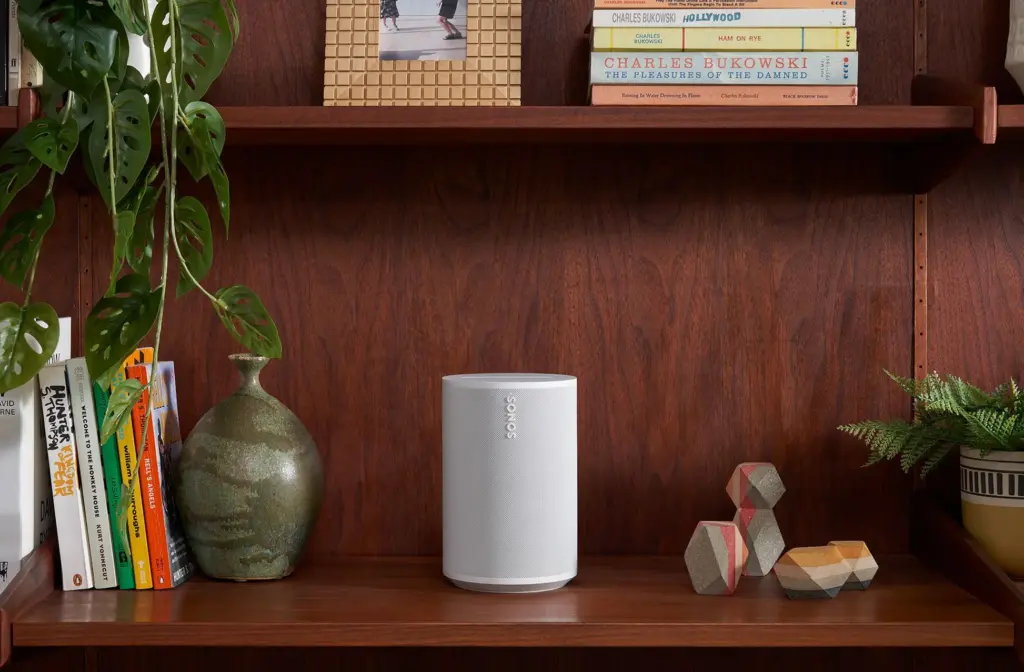
The Sonos Era 100 is the successor to the Sonos One and represents a solid all-round option for a single room. It sits at around £249 and offers stereo sound from a compact unit, which is something the original One never managed. It supports Wi-Fi, Bluetooth, and AirPlay 2, meaning it works well regardless of whether you are an Apple household or not.
The sound is well-balanced and controlled, with good mid-range clarity and more bass than you would expect from the size. It is not going to challenge a proper pair of bookshelf speakers, but for casual listening in a bedroom, kitchen or home office, it is an excellent option. The Era 100 also pairs with a Sonos Sub Mini or full Sub if you want to add bass later, and can be used as a stereo pair by buying two units.
One minor frustration is the continued lack of an analogue input. There is a line-in via a USB-C adapter, but this costs extra. At £249, it would be reasonable to expect that to be included in the box.
Sonos Era 300
The Era 300 is a more ambitious speaker, priced at around £399. It is built specifically around spatial audio, with upward- and side-firing drivers designed to make the most of Dolby Atmos Music content. When the content is there, the effect is genuinely impressive – it creates a sense of height and space that a traditional speaker simply cannot match.
The catch is that Dolby Atmos Music is still a fairly limited catalogue. If you spend most of your time streaming standard stereo content from Spotify or Apple Music, the Era 300 delivers excellent results regardless, but you may question whether the spatial audio capability justifies the extra £150 over the Era 100. For most people, a pair of Era 100s in stereo would be the better spend.
The Era 300 also works exceptionally well as a rear surround speaker when paired with the Sonos Arc or Arc Ultra soundbar.
Sonos Move 2
The Move 2 is Sonos’s portable offering, priced at around £399. It is a fairly chunky unit – this is not something you will slip into a bag – but the combination of Wi-Fi streaming at home and Bluetooth on the move is genuinely useful. Battery life is rated at 24 hours, which is solid for a speaker of this size.
The sound quality is excellent for a portable speaker, with deep bass and a wide soundstage. The charging dock makes it easy to keep topped up at home, and the design is robust enough to handle outdoor use.
The price is on the high side relative to the competition, and you can get comparable Bluetooth audio performance for considerably less from the likes of JBL or Bose. The premium here is for the Sonos ecosystem integration, so if you are already invested in Sonos, the Move 2 makes a great deal of sense. If you are buying it as a standalone portable speaker, there are better value options.
Best Looking Speakers – Marshall
Marshall makes some of the best-looking speakers available, and the combination of retro aesthetic and genuine sonic performance makes them a compelling choice for anyone who wants their speaker to double as a piece of furniture.
Marshall Woburn III

I reviewed the Marshall Woburn III back in 2023 and loved it. I consistently chose it over my Sonos Beam, which I had in the room at the same time. It looks excellent and sounds excellent. It is capable of going very loud with no distortion and fantastic bass. It also has an HDMI ARC input, allowing you to use it with a TV. It was perfect in the kitchen for me, where my partner watches TV when cooking, but I prefer music.
The Woburn III retails at around £449.99 and connects via Wi-Fi, Bluetooth, AirPlay, and Chromecast. The multi-room capability is solid, though it works through Marshall’s own app rather than a wider ecosystem like Sonos. The analogue inputs – including a proper phono input – are a nice touch for anyone with a turntable.
The main downside is that it is a one-box stereo speaker rather than a true stereo pair. The wide cabinet helps, but it cannot quite replicate the soundstage of separated bookshelf speakers. For most living rooms and kitchens, though, this is not a deal-breaker.
Heston 120 + Heston Sub
The Majority Heston 120 and matching Heston Sub is probably not the most technically accomplished system on this list, but it earns its place purely on looks. The combination gives a great retro aesthetic that will appeal to anyone who is a music fan. The walnut-effect finish and classic proportions make it feel like a genuine piece of furniture rather than just a speaker.
For the money, the sound is reasonable. It is not going to compete with the KEF or Sonos options at similar price points when it comes to raw audio performance, but if style is a priority and you do not want to spend serious audiophile money, it is worth a look.
Best Bookshelf Wireless Speakers
For serious listening in a home setting, a pair of active wireless bookshelf speakers will outperform any single-box speaker at the same price point. They create genuine stereo separation, which makes a significant difference to the sense of space and instrument placement in music.
KEF LSX II LT – Best Overall Bookshelf Pick
The KEF LSX II LT is the strongest all-round recommendation in this category. It retails at £899, though it is frequently available for around £699 during sales, which represents genuinely strong value for what you get.
The LSX II LT uses KEF’s 11th-generation Uni-Q driver array, which positions the tweeter at the acoustic centre of the woofer. The practical result of this is an unusually wide listening area – there is no single sweet spot, so the sound holds up well whether you are sat directly in front or off to one side. Total system power is 200 watts, with dedicated Class D amplifiers for the tweeter and woofer in each speaker.
Connectivity is comprehensive. You get HDMI ARC for TV use, a USB-C input for a laptop or computer, optical digital input, and Wi-Fi streaming via AirPlay 2, Google Chromecast, Bluetooth 5.0, Spotify Connect, and Tidal Connect. The KEF Connect app handles setup and lets you tailor the sound to your room.
The main sacrifice over the standard LSX II (which costs £1,199) is the removal of the wireless speaker link – the LT uses a physical cable between the two speakers instead. There is also no analogue auxiliary input, which is worth checking if you have a turntable. For most users, though, these omissions will not matter.
The sound quality is excellent for the size. Bass is fuller and better-defined than you would expect from speakers this compact, and the midrange and treble are clean and well-extended. Critically, it sounds convincing with all genres – classical, electronic, rock and jazz all benefit from the controlled, accurate presentation.
KEF LSX II – The Premium Step-Up
If budget allows, the full KEF LSX II at £1,199 adds a wireless link between the speakers (removing the inter-speaker cable), an analogue auxiliary input, more colour options including fabric finishes, and a few additional refinements. The core sound character is essentially the same, but the extra connectivity and the convenience of the wireless link are worth having if you can stretch to it.
Edifier S3000 Pro Active Stereo Speaker / S3000MKII

I reviewed the Edifier S3000 Pro Active Stereo Speaker back in 2022 and have kept it as my main speaker since. It appears the model I reviewed is no longer available, but the S3000MKII is the successor and should provide a better overall sound. With an RRP of £700, they are £100 cheaper than the KEF LSX II LT while being substantially larger and heavier.
In the context of this article, the main issue is that they only support Balanced XLR, Optical, Coaxial, USB Type-B receptacle, Line In, and Bluetooth. In comparison, the Kef has HDMI and RJ45. The network connectivity then supports Chromecast, Spotify and more. So the KEF speakers are substantially better for connectivity.
Best Portable Wireless Speakers
Portable wireless speakers cover a broad range, from compact pocketable options up to large battery-powered units that can serve as the centrepiece of a garden party. The key considerations are battery life, build quality, water resistance, and how the sound holds up at higher volumes.
Most portable speakers connect via Bluetooth rather than Wi-Fi, which limits some multi-room functionality but keeps setup simple. Modern Bluetooth 5.x connections are generally reliable within normal room distances.
The sections below split these into three size categories – large, medium and small – to help narrow down the options.
Best Budget Home Speaker
Not everyone wants to spend several hundred pounds on a wireless speaker. At the budget end of the market, the quality has improved significantly in recent years, particularly from brands like Anker’s Soundcore range.
Anker Soundcore Motion X600

The Anker Soundcore Motion X600 retails at around £149.99 and is one of the better value propositions in the budget-to-mid-range space. It uses a five-driver setup including an upward-firing driver that activates a spatial audio mode, adding noticeable depth to the presentation. Total output is rated at 50 watts.
The build quality is solid for the price, with an IPX7 waterproof rating meaning it can handle splashes and brief immersion without issue. The aluminium grille and overall design look appreciably more premium than the price would suggest.
Bass performance is good, helped by the passive radiators, and the Soundcore app offers EQ adjustments including a BassUp mode. Battery life is rated at 12 hours, which is acceptable without being exceptional.
The main limitations are connectivity – there is no HDMI ARC or Wi-Fi, so this is purely a Bluetooth speaker – and the spatial audio mode works better on some content than others. For the living room or garden, it is an honest performer that punches above its price.
Anker Soundcore Boom 2
If you are on an even tighter budget, the Soundcore Boom 2 at around £89-£129 is worth considering. It delivers 80 watts of output from a 2.1-channel configuration with a built-in subwoofer, and the LED lighting on the passive radiators is something of a party trick. It floats, which is either useful or a feature you will never use, but the IPX7 rating at least means it is genuinely waterproof.
Battery life is rated at over 20 hours, and the nine-band EQ in the Soundcore app gives you a fair degree of control over the sound. It is a decent choice if you want something that sounds big at parties without spending serious money.
Best Small Wireless Speaker
For bedrooms, studies, or kitchens where space is limited, a compact wireless speaker needs to balance size against sound quality. The smaller the cabinet, the harder it becomes to produce meaningful bass, so managing expectations is sensible here.
Audio Pro C20
The Audio Pro C20 is a single-room Wi-Fi speaker that retails at around £299. It sits somewhere between a traditional multi-room Wi-Fi speaker and a standalone unit – it supports AirPlay 2, Chromecast, Bluetooth and Spotify Connect, and integrates with the Audio Pro app for multi-room playback alongside other Audio Pro speakers.
The sound quality is notably good for a speaker this size. Audio Pro has a reputation for engineering that prioritises musicality over flashy specifications, and the C20 reflects that. Bass is better than you would expect from the compact cabinet, and the overall balance is warm and engaging rather than clinical.
It is not the cheapest option in the small speaker category, but for a Wi-Fi speaker that sounds genuinely good and fits neatly on a shelf or worktop, the Audio Pro C20 is one of the better picks.
Sonos Era 100 – Also Relevant Here
It is worth mentioning again that the Sonos Era 100 fits this category well. At £249, it is compact, sounds better than its size suggests, and integrates with the wider Sonos ecosystem if you decide to expand later. For anyone already invested in Sonos, it is the obvious choice.
Best Soundbar
A soundbar sits in a slightly different category from a traditional wireless speaker, but it serves a similar purpose – improving audio quality from a television without the complexity of a full surround sound setup. Most modern soundbars connect wirelessly to the TV via HDMI ARC or eARC and can handle Dolby Atmos content.
Sonos Arc Ultra – Best Overall Soundbar
The Sonos Arc Ultra is Sonos’s flagship soundbar, launched in 2024 and priced at around £999, though it has been regularly available for closer to £849 in the UK. It is the most accomplished single-box soundbar available for most people’s needs.
The Arc Ultra packs 14 Sonos-engineered drivers including upward- and side-firing tweeters, delivering a 9.1.4 Dolby Atmos presentation from a single unit. The headline technology is Sonos’s Sound Motion system – essentially a redesigned bass driver that extracts significantly more low-end output from the slim cabinet compared to the outgoing Arc.
The improvement over the original Arc is genuine and audible. The bass is more controlled and better-defined rather than simply louder, and the overall presentation has more detail and spatial precision. It is not a seismic difference, but the Arc Ultra does justify its position as an upgrade.
Where the Arc Ultra performs particularly well is in dialogue clarity. The dedicated centre channel focus and AI-powered speech enhancement make it appreciably easier to follow conversation on screen compared to most TV speakers, which is often the primary motivation for buying a soundbar in the first place.
For Sonos users, the integration with the wider ecosystem is seamless. You can add a Sonos Sub 4 and a pair of Era 300s as rear speakers to build a full surround system, and the soundbar works as a music speaker when the TV is off.
If £999 is too much, the Sonos Ray at around £279 is the entry-level option, though it lacks Dolby Atmos support and HDMI ARC – it uses optical instead. For a step up, the Sonos Beam Gen 2 at around £499 adds Dolby Atmos and HDMI ARC and is a strong mid-range option for smaller rooms.
Samsung HW-Q990D – For Those Outside the Sonos Ecosystem
If you are not invested in Sonos and want a complete all-in-one surround sound experience, the Samsung HW-Q990D is worth considering. It comes with rear wireless speakers and a subwoofer in the box, delivering a genuine 11.1.4 channel Dolby Atmos setup without any separate speaker purchasing required. Pricing sits around £1,299 for the full bundle.
The sound is impressive for a bundled system, though the soundbar itself does not quite match the Arc Ultra for overall quality when compared directly. The advantage is convenience – everything you need comes in one box with no additional outlay required.
Best Large Bluetooth Portable Speaker
Large portable Bluetooth speakers are aimed at outdoor use, parties, and situations where you need genuine volume. The JBL Boombox series has long dominated this category.
JBL Boombox 4
The JBL Boombox 4 retails at around £399 and is one of the most capable large portable speakers available. It is genuinely large and heavy – this is not something you will carry to the park on a whim – but the battery life is rated at 24 hours, and the sound output is substantial.
JBL has tuned the Boombox 4 for maximum bass impact, and it delivers this convincingly. The dual passive radiators, dual woofers, and dual tweeters combine to create a lively, room-filling sound that works well outdoors where a smaller speaker would be swallowed by open space.
The IP67 rating means it is dust-proof and waterproof, making it well-suited to poolside or beach use. The USB-A port allows you to charge your phone from the speaker’s battery, which is a useful feature during extended outdoor use.
The Boombox 4 also supports JBL’s Auracast feature, which allows you to connect multiple compatible speakers together for louder playback. If you pair two Boombox 4s in stereo mode, the results are genuinely impressive.
The sound character leans heavily towards bass, which suits most outdoor party use but may feel slightly unrefined for critical listening. At the price, though, it is hard to fault as a dedicated outdoor speaker.
Best Medium Bluetooth Portable Speaker
Medium-sized portable speakers are the sweet spot for most buyers. They offer better sound quality than pocket-sized options while remaining genuinely portable, with battery life typically in the 20-24-hour range.
JBL Charge 6
The JBL Charge 6 is the strongest recommendation in this category. It retails at around £179 in the UK and builds on the already-strong Charge 5 with meaningful upgrades rather than token refinements.
The most notable improvement is the IP68 rating – fully dustproof and waterproof to a depth of 1.5 metres for up to 30 minutes. The rubber bumpers around the passive radiators are beefier, giving the Charge 6 a more robust feel that should translate to better durability over time.
Battery life is rated at 24 hours (up from 20 hours on the Charge 5), and the USB-C charging port can also charge other devices, which is a genuinely useful feature to have. The JBL Portable app offers a seven-band customisable EQ, which is a significant upgrade over the basic controls available on most competing speakers.
The sound has notably better bass than its predecessor, which was already strong in this area. Clarity at high volumes remains good, and the speaker handles everything from podcasts to bass-heavy electronic music without getting congested.
One thing worth noting is that the Charge 6 uses JBL’s new Auracast system rather than the older Party Boost, meaning it will not connect to older JBL speakers that used the previous protocol.
Bose SoundLink Flex 2nd Generation
The Bose SoundLink Flex 2nd Generation is a strong alternative at around £149. It is more compact than the Charge 6 and has a built-in strap attachment that makes it easy to attach to a bag or bike. The IP67 rating is solid, though not quite the IP68 of the Charge 6.
Sound quality is excellent – arguably slightly more refined and balanced than the JBL, with Bose’s characteristic emphasis on controlled bass rather than outright thump. Battery life is rated at 12 hours, which is noticeably shorter than the Charge 6. If battery life is a priority, the JBL is the better choice.
Best Small Bluetooth Portable Speaker
Small Bluetooth speakers are about convenience. They fit in a bag, work as a travel companion, and deliver audio that is meaningfully better than a phone speaker. The expectation should be set accordingly – none of these will fill a large room, but for personal listening or a small kitchen, they are perfectly capable.
Ultimate Ears Wonderboom 4
The Ultimate Ears Wonderboom 4 retails at around £89 and is the go-to recommendation for a small, rugged, affordable speaker. It has an IP67 waterproof and dustproof rating and floats, making it genuinely usable near water without worry.
The sound is omnidirectional, which is both a strength and a limitation. It works well in the centre of a table where multiple people want to listen equally, but it will not produce the directed sound of a speaker aimed at you. Bass is limited given the compact cabinet, but midrange clarity is reasonable for the price.
Battery life is rated at 14 hours. The compact, rounded shape and carabiner hook make it easy to attach to a bag. It is not a speaker for critical listening, but for the gym, camping, or travelling light, it is a solid choice.
JBL Flip 7
If you can stretch to around £149, the JBL Flip 7 offers a step up in both sound quality and output over the Wonderboom 4. It is still compact enough to fit in a bag, but the cylindrical design houses a more capable driver configuration that delivers noticeably better bass extension and overall volume.
The Flip 7 has an IP67 rating and supports Bluetooth 5.4 with Auracast for connecting multiple speakers together. Battery life is rated at 12 hours. It is one of the most balanced options in the small-to-medium category – not as pocketable as the Wonderboom 4, but considerably more capable acoustically.
Overall
The honest answer is that the best wireless speaker for you depends entirely on what you actually need it to do. If you are building a serious home audio setup, the KEF LSX II LT at around £699-£899 is exceptional value and will genuinely transform how music sounds in your home. If you want a brand that grows with you over time and integrates with a TV speaker, Sonos remains the most complete ecosystem available.
For a looker that also sounds great without requiring a second mortgage, the Marshall Woburn III sits in an interesting position – it is not the most technically accomplished speaker at £449.99, but it is one of the few options that also functions as a piece of room decoration.
At the portable end, the JBL Charge 6 is the sweet spot for most people – waterproof, 24-hour battery, good sound, and a functional phone-charging USB port. For something smaller, the Wonderboom 4 is hard to fault at under £100. For sheer outdoor volume, the JBL Boombox 4 is the natural choice.
For TV use, the Sonos Arc Ultra is the most recommended single-box Dolby Atmos soundbar available in the UK right now. The sound quality improvement over cheaper options is tangible, and the ecosystem integration with other Sonos products is a bonus for existing users.
If budget is tight across the board, the Anker Soundcore range offers more than respectable performance for the money, particularly the Motion X600 as a home speaker. The gap between budget and premium has narrowed considerably in recent years.
Whatever you end up with, it is worth buying from a retailer that offers a good return policy. Speaker sound is subjective, and no amount of reading reviews will tell you whether a particular character suits your taste and your room. Buying from somewhere like Richer Sounds or Sevenoaks Sound and Vision means you can return or exchange if something does not work for you.

I am James, a UK-based tech enthusiast and the Editor and Owner of Mighty Gadget, which I’ve proudly run since 2007. Passionate about all things technology, my expertise spans from computers and networking to mobile, wearables, and smart home devices.
As a fitness fanatic who loves running and cycling, I also have a keen interest in fitness-related technology, and I take every opportunity to cover this niche on my blog. My diverse interests allow me to bring a unique perspective to tech blogging, merging lifestyle, fitness, and the latest tech trends.
In my academic pursuits, I earned a BSc in Information Systems Design from UCLAN, before advancing my learning with a Master’s Degree in Computing.
I’m proud to share that Vuelio has consistently ranked Mighty Gadget as one of the top technology blogs in the UK. With my dedication to technology and drive to share my insights, I aim to continue providing my readers with engaging and informative content.
I work directly with the companies he reviews products for or their chosen PR agency.
For Social Media, you can find me on: