

Ugreen MagFlow Air 5K Qi2 Power Bank Review
Ugreen announced its latest range of charging peripherals a few days ago with the new Nexode and MagFlow Air editions. These are all designed to be as small and portable as possible for convenient charging while on the move.
The lineup includes the Nexode Air 65W, an ultra-small single-port 65W plug with retractable pins. There is also the Nexode Air 65W Charger Slim, a flat card-style charger with three ports. Finally, there are two Qi2 wireless power banks, a 10K model and the 5K Ugreen MagFlow Air I am reviewing today.
I have used and tested a good number of magnetic power banks over the past year, and I still have the Xiaomi 5K Ultrathin, which I need to review.

- Ultra-Slim 8.6mm, Barely-There Feel: Experience true pocket freedom. At just 8.6mm thin and weighing only 117g, this magnetic power bank disappears into your palm or pocket. The compact design sits flush against your iPhone without blocking the cameras, perfect for charging on the go without the bulk
- Qi2 Certified Wireless Speed: Enjoy the official Qi2 standard for a more efficient charge. The magnets lock instantly to your iPhone (12-17 series), delivering full 15W of high-speed wireless power. Need a quick top-up? Charge your iPhone 17 Pro Max to 32% in just 30 minutes, no cables, just snap and go
- Emergency Power for Your Busiest Days: This 5000mAh portable charger boosts your iPhone 17 around 80%, enough to get you through the evening commute, a late-night ride home, or that extra hour of GPS navigation. It's about having a reliable backup precisely when your battery hits red
- Premium Build, Safe Charging: Built with high-quality ion cells and an intelligent temperature control system, the wireless charger keeps remarkably heat dissipation performance even during rapid charging. Multi-layer protection (overcharge, over-voltage, short circuit) gives you total peace of mind
- 20W Dual Charging: UGREEN USB-C battery pack supports up to 20W output via C port, iPhone 16 Pro can be fueled to 54% in 30 minutes. Charge two devices simultaneously without compromise. Also allowing 20W fast recharge, refills in just 1.5 hours. One compact device, charging freedom for your daily essentials

Specification
Here are the headline specifications for the 5K model.
| Feature | Detail |
| Capacity | 19.6Wh (5,000mAh) |
| Input | USB-C (20W) |
| Output | Wireless (15W) and USB-C (20W) |
| Weight | 127g |
| Dimensions | 105 x 70 x 8.6mm |
| Colours | Grey, Blue, White |
There is no PPS or QC3 support, which I will come back to, but the wired protocol list is otherwise sensible for a pack of this size: PD3.0, QC2, FCP, SCP, AFC, Apple 2.4A and DCP. Passthrough charging is supported, so you can charge the pack and a phone from the single USB-C port at the same time.
Features
The claims below come from Ugreen. I have repeated them here for reference and then tested the ones that matter in the performance sections further down.
Ultra-Slim 8.6mm, Barely-There Feel
At 8.6mm thick and weighing 127g, this magnetic power bank slips into a pocket without much notice. The compact body sits flush against an iPhone without covering the cameras, which makes it practical for topping up while you are out and about rather than something that adds noticeable bulk.
Qi2 Certified Wireless Speed
The pack uses the official Qi2 standard, with magnets that align to an iPhone (12 to 17 series) and hold position for wireless charging at up to 15W. Ugreen claims a charge from flat to 32% on an iPhone 17 Pro Max in 30 minutes, so a short session is enough for a useful top-up without needing a cable.
Emergency Power for Your Busiest Days
The 5,000mAh capacity adds roughly 80% to an iPhone 17, which is generally enough to cover an evening commute, a late ride home, or an extra stretch of GPS navigation. It works as a backup for the point in the day when the battery is running low rather than a full second charge.
Premium Build, Safe Charging
The pack uses lithium-ion cells and a temperature control system intended to manage heat during faster charging. Multi-layer protection covers overcharge, over-voltage, and short circuit, which are the standard safeguards you would expect on a product of this type.
20W Dual Charging
The USB-C port outputs up to 20W, and Ugreen states this brings an iPhone 16 Pro to 54% in 30 minutes. You can charge two devices at once, and the same 20W input refills the pack itself in around 1.5 hours.
Design
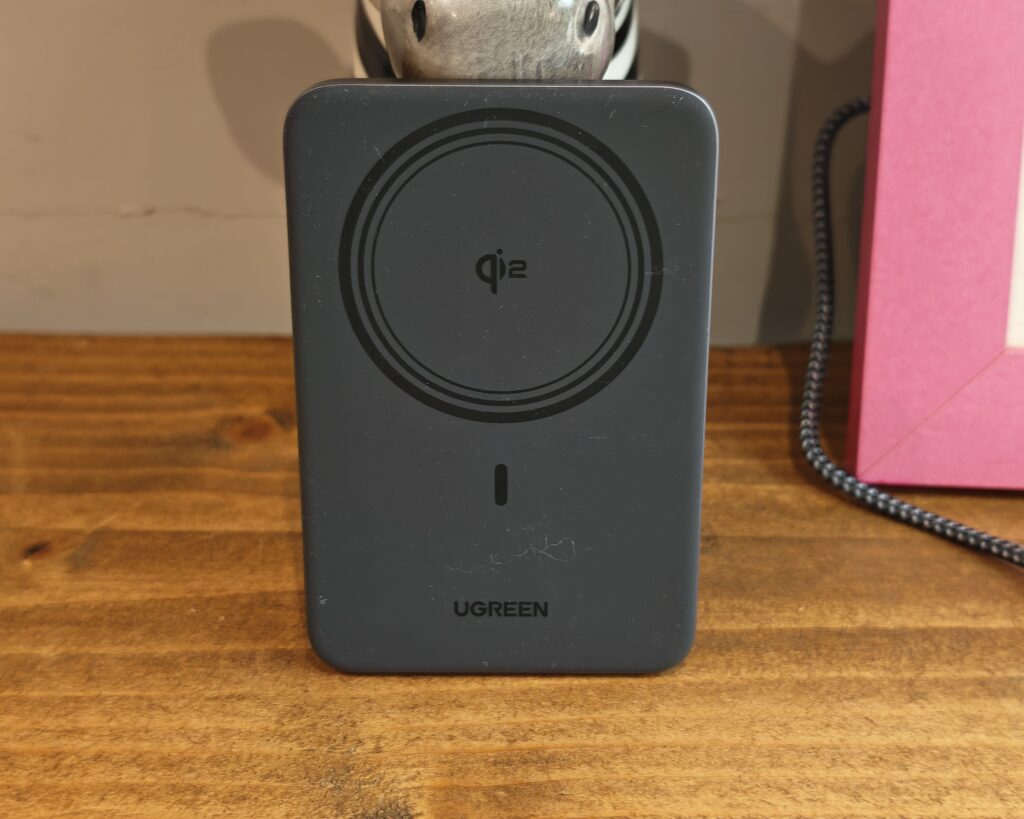
The MagFlow Air is genuinely slim. At 8.6mm it matches the Anker MagGo Nano Slim, the pack that held the slimmest-5K title for a long time.
Build quality is a strong point. The shell feels solid, the silicone interior grips the back of the phone without leaving marks, and the magnet alignment is firm enough that the pack stays put when you pick the phone up one-handed. Side by side with the Anker, the Ugreen feels every bit as premium, even if the Anker’s rounded back is marginally nicer to hold.
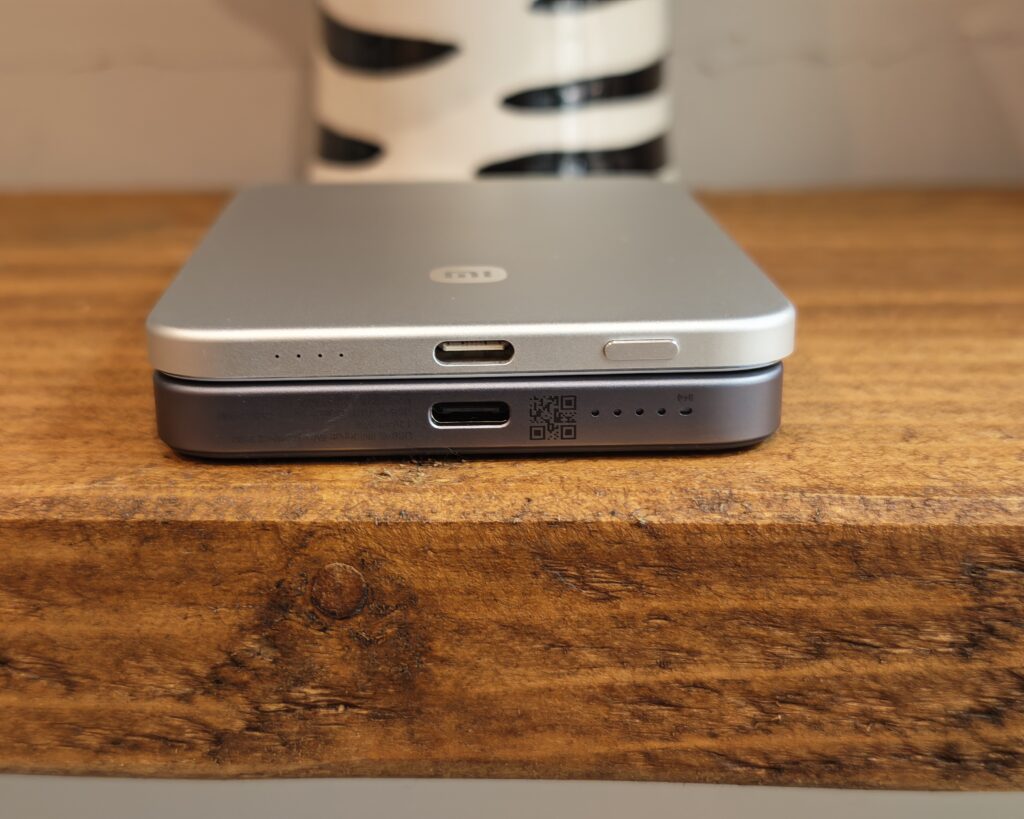
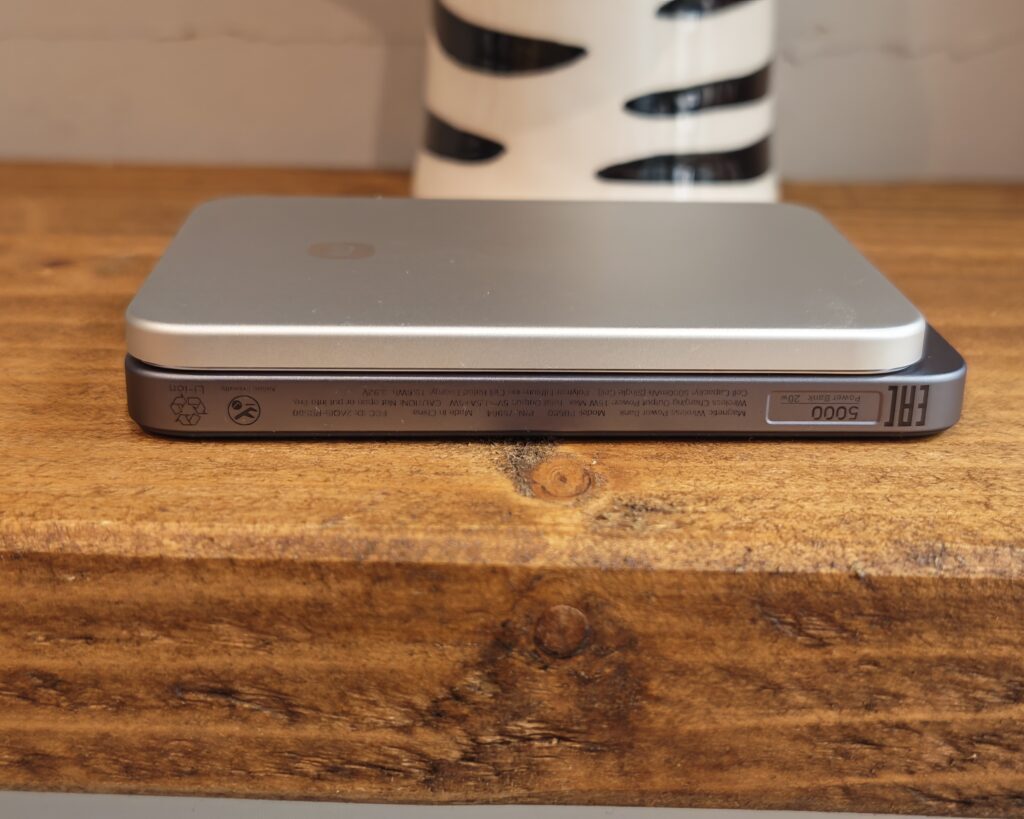
The catch is length. The MagFlow Air is 105mm long, against roughly 102mm for the Anker, so it overhangs slightly at the bottom of an iPhone 17 Pro. With a case fitted, the difference all but disappears, but on a bare phone, it is noticeable. Weight is competitive at 127g, close to the Anker’s 121g and the INIU’s 116g, and a touch under the category average.
Ugreen offers the pack in grey, blue and white. There is a single USB-C port and a power button on the side, with the status LEDs on the bottom edge. Neither MagFlow Air model includes a pull-out kickstand, which some rivals such as the EcoFlow Rapid do offer. It is not something I miss on a 5K pack, but it is worth flagging if you like to prop the phone up while it charges.
Wireless Charging Performance
As these chargers are technically designed for an iPhone, I was able to borrow a friend’s phone for a day to get some realistic testing done rather than on one of my Android phones. I charged an iPhone 17 Pro from 5% up to 80%, with no case, at a room temperature of around 18 to 19 degrees Celsius, with the phone cooled to room temperature and not in use. Each run was repeated several times and averaged.
These numbers are a guideline rather than a promise of real-world results. 5G use, ambient heat, a thick case or simply using the phone while it charges will all slow things down, because anything that warms the phone reduces wireless charging speed.
| Elapsed time | iPhone 17 Pro |
| 10 minutes | 20% |
| 20 minutes | 34% |
| 30 minutes | 43% |
| 40 minutes | 52% |
| 50 minutes | 60% |
| 60 minutes | 67% |
| Time to reach 80% | 79 minutes |
Temperature is the main thing to watch. Both the Anker and the Ugreen become warm after about 20 minutes of wireless charging. Neither got uncomfortably hot in my tests, and neither exceeded 40 degrees Celsius, but that warmth is part of why the smaller packs eventually throttle.
It is worth being clear about the ceiling. The MagFlow Air is a 15W Qi2 pack, not one of the newer 25W designs. A 25W bank can take an iPhone 16 or later from flat to 50% in a little over 30 minutes, against roughly 45 minutes for a 15W pack. If you own an iPhone 15 or earlier, the point is moot, since those phones cap wireless charging at 15W anyway, but on the latest models, a 25W pack will be quicker over a short session. The MagFlow Air’s answer is sustained output rather than peak speed, and over a longer charge that strategy clearly works.
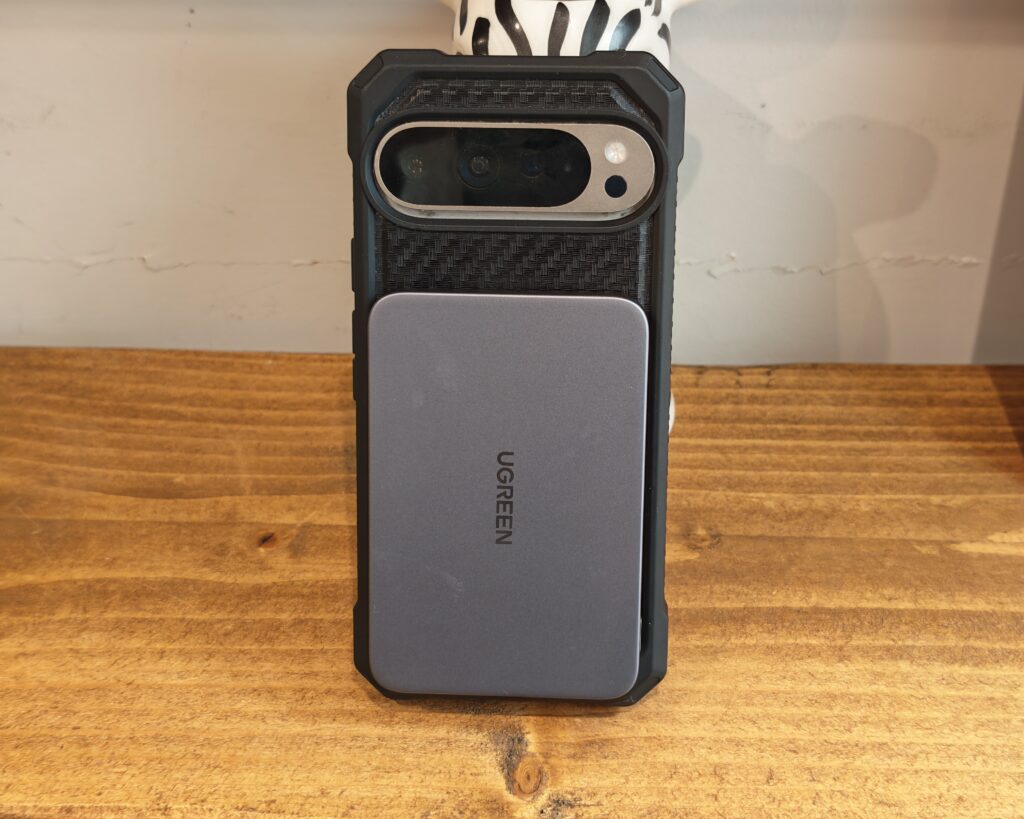
Charging also works perfectly well with Android if you have a magnetic case. I assume efficiency will be reduced a little with the plastic case, but it works fine on my Pixel 9 XL Pro (pictured) and my Honor Magic 8 Pro.
Wired Charging and Recharge Times
Net capacity is where a lot of slim packs quietly disappoint, because squeezing cells into a thin shell costs efficiency. The MagFlow Air did well here. At a 20W draw I measured 15.97Wh of usable output from the rated 19.6Wh, which works out at around 81%. The Anker only achieved 13.81Wh (75%). Anything over 80% is a good result for a pack this small.
No small power bank will sustain 20W over the cable indefinitely, but the Ugreen sustained it longer than expected. It ran at a full 20W for 45 minutes before stepping down to 10W. The Anker managed 30 minutes before dropping to 12W.
| Model | Held 20W for | Then stepped down to |
| Ugreen MagFlow Air | 45 minutes | 10W |
| Anker MagGo Nano Slim | 30 minutes | 12W |
Recharging the pack itself takes around 1 hour 40 minutes from a 20W source. The input stays close to 20W for the bulk of the charge, and the pack is around 95% full after about an hour, with the last stretch spent trickling at 2 to 3W. That is reasonable for a 5K pack, although the 10K MagFlow Air’s 30W input and built-in cable make it the faster option to top up if recharge speed matters to you.
The one technical gap is the lack of PPS and QC3. The protocol list still covers PD3.0, QC2, FCP, SCP, AFC and Apple’s 2.4A profile, so the pack will charge almost anything sensibly, but without PPS it cannot reach the variable-voltage fast-charging modes that some Android phones rely on for their highest wired speeds. For an iPhone-focused pack that is a minor issue, but it is worth knowing if you intend to use it with a recent Samsung or Pixel.
Battery Indicator and Ports
The MagFlow Air reports its charge with a row of four LEDs on the bottom edge, plus a fifth that indicates wireless charging is active. Each of the four dots represents 25%, which is the same approach most packs in this class use and the same imprecision. Three lit LEDs might mean 75% or it might be closer to 50%, and you only find out as it drains. A full digital percentage readout, of the sort found on the Anker MagGo 10K, is far more useful, and its absence here is a fair criticism even if it is not a deal-breaker on a pack this cheap.
There is a single USB-C port at the base, which handles both 20W output and 20W input, and passthrough is supported. With two devices charging at once the pack splits its output to 7.5W each, so it is best thought of as a one-device-at-a-time pack with an occasional second port rather than a true dual charger.
Price and Alternative Options
- Ultra-Slim 8.6mm, Barely-There Feel: Experience true pocket freedom. At just 8.6mm thin and weighing only 117g, this magnetic power bank disappears into your palm or pocket. The compact design sits flush against your iPhone without blocking the cameras, perfect for charging on the go without the bulk
- Qi2 Certified Wireless Speed: Enjoy the official Qi2 standard for a more efficient charge. The magnets lock instantly to your iPhone (12-17 series), delivering full 15W of high-speed wireless power. Need a quick top-up? Charge your iPhone 17 Pro Max to 32% in just 30 minutes, no cables, just snap and go
- Emergency Power for Your Busiest Days: This 5000mAh portable charger boosts your iPhone 17 around 80%, enough to get you through the evening commute, a late-night ride home, or that extra hour of GPS navigation. It's about having a reliable backup precisely when your battery hits red
- Premium Build, Safe Charging: Built with high-quality ion cells and an intelligent temperature control system, the wireless charger keeps remarkably heat dissipation performance even during rapid charging. Multi-layer protection (overcharge, over-voltage, short circuit) gives you total peace of mind
- 20W Dual Charging: UGREEN USB-C battery pack supports up to 20W output via C port, iPhone 16 Pro can be fueled to 54% in 30 minutes. Charge two devices simultaneously without compromise. Also allowing 20W fast recharge, refills in just 1.5 hours. One compact device, charging freedom for your daily essentials
The Ugreen MagFlow Air Ultra-Slim 5,000mAh Magnetic Power Bank is available now from Amazon UK. It has an RRP of £45, but at the time of writing it was already discounted to £35.
The obvious rivals sit slightly higher. Anker has its 5K MagSafe Power Bank at £50 RRP, available for around £40. Xiaomi has the 5K Ultrathin Magnetic Power Bank at £60 RRP, available for around £53. I have the Xiaomi, and it is a little smaller than the Ugreen but appears not to charge quite as much, which matches the efficiency gap I measured against the Anker.
The INIU P71-E1 is the other established option and is a touch smaller again, though it throttles its wired output sooner than the Ugreen does. It is not a brand that is well known as Anker, Ugreen or Xioami, but I have used them before and been happy. You can get this for £30 on Amazon.
Overall
The MagFlow Air is the best slim 5K Qi2 power bank I have used. Its strengths are practical ones rather than spec-sheet headlines. It charges faster wirelessly than the Anker because it maintains its output instead of backing off early; it sustains 20W over the cable longer than either; and it returns more of its rated capacity than both. Build quality is high, it is properly slim, and the £35 street price is sensible (and a touch cheaper than Anker).
The criticisms are real but minor. It is a 15W pack rather than a 25W one, so a short top-up on the latest iPhones will be quicker on a faster rival. The four-LED display is vague. It is slightly longer than the Anker, so it overhangs a bare iPhone 17 Pro, and it is also larger than the Xiaomi 5K Ultrathin Magnetic Power Bank. It runs warm under load, as almost all magnetic packs do, and the lack of PPS limits its appeal for fast wired charging on Android. None of these undoes the basics.
For a slim battery you keep in a pocket or bag to get through the rest of the day, the MagFlow Air is the one I would buy. If you need a genuine second full charge, step up to the 10K model with its 30W built-in cable.
Overall, the MagFlow air is a well-made 5K top-up pack that is ideal for days out to provide a significant top-up charge, and something I often need on holidays when taking lots of photos and using Google Maps all day.
Ugreen MagFlow Air 5K Qi2 Power Bank Review
-
Overall - 85%85%
Summary
The Ugreen MagFlow Air 5K gets the basics right with a genuinely slim design, strong build quality and better-than-expected efficiency. It avoids chasing headline specifications and instead delivers reliable real-world performance, maintaining charging speeds well and providing more usable capacity than several key rivals. While the lack of PPS, basic LED indicators and 15W Qi2 ceiling limit it slightly, it is one of the most practical magnetic power banks currently available for everyday carry.
Pros
- Slim and lightweight design
- Strong charging efficiency
- Sustains output very well
- Premium build quality
- Competitive pricing
Cons
- No PPS support
- Basic LED battery indicators
- Slight iPhone overhang
- No integrated kickstand
- Limited Android fast charging

I am James, a UK-based tech enthusiast and the Editor and Owner of Mighty Gadget, which I’ve proudly run since 2007. Passionate about all things technology, my expertise spans from computers and networking to mobile, wearables, and smart home devices.
As a fitness fanatic who loves running and cycling, I also have a keen interest in fitness-related technology, and I take every opportunity to cover this niche on my blog. My diverse interests allow me to bring a unique perspective to tech blogging, merging lifestyle, fitness, and the latest tech trends.
In my academic pursuits, I earned a BSc in Information Systems Design from UCLAN, before advancing my learning with a Master’s Degree in Computing.
I’m proud to share that Vuelio has consistently ranked Mighty Gadget as one of the top technology blogs in the UK. With my dedication to technology and drive to share my insights, I aim to continue providing my readers with engaging and informative content.
I work directly with the companies he reviews products for or their chosen PR agency.
For Social Media, you can find me on:


0 Comments