Xiaomi UltraThin Magnetic Power Bank 5000 Review vs Ugreen MagFlow Air 5K
I recently reviewed the excellent Ugreen MagFlow Air 5K Power Bank, which is an incredibly thin 5,000mAh power bank that is compatible with Qi2 charging up to 15W. It is perfect for days out where you may not have a bag. You can easily charge your phone in your pocket with very little noticeable added bulk.
The Xiaomi UltraThin Magnetic Power Bank 5000 takes the slim design to the next level, being just 6mm thick, 30% thinner than the Ugreen and 33% smaller by volume, as the Ugreen is quite a bit longer by 6.5mm.
So, at a passing glance, the Xiaomi seems superior, but the 33% reduction in size doesn’t make up for its shortcomings, namely, the slow iPhone charging and higher price point. After living with both for a while, the gap between the two is less about which battery is better and more about which compromise suits you.

- UltraThin Magnetic Magsafe Power Bank— Just 100–120g, about the weight of two eggs. This 5000mAh magnetic battery pack snaps onto your phone and disappears into your pocket — the ultimate slim portable charger for daily carry.
- 15W Wireless Fast Charging— Supports 15W wireless fast charging on Xiaomi 17 Series and all Qi-compatible devices. No cables, no fuss — just snap, charge, and go.
- 5000mAh, Flight-Safe— 18.58Wh battery energy, well under the 100Wh aviation limit. Take this magsafe power bank on any flight without worry — perfect travel companion.
- Strong Magnetic Attachment— Secure magnetic alignment keeps the power bank firmly attached to your phone. Works with iPhone Magsafe and any magnetic-compatible phone case.
- Smart Design & Wide Compatibility— Glacier Silver / Graphite Black / GL Orange finishes match your style. Compatible with iPhone, Samsung, Xiaomi, and all Qi wireless charging devices.
Specification
Here are the headline figures for the Xiaomi UltraThin Magnetic Power Bank 5000 15W.
| Specification | Xiaomi UltraThin Magnetic Power Bank 5000 15W |
| Model | MDY-20-EB |
| Battery Type | Lithium-ion |
| Typical Capacity | 5,000mAh |
| Rated Capacity | 3,000mAh (5V/2A) |
| Typical Energy | 18.95Wh |
| Rated Energy | 18.58Wh |
| Wireless Charging | Up to 15W |
| iPhone Wireless Charging | Up to 7.5W |
| USB-C Output | Up to 22.5W |
| USB-C Output Profiles | 5V/3A, 9V/2.5A |
| Simultaneous Output | USB-C: 7.5W + Wireless: 5W |
| Wireless Charging Method | Magnetic induction |
| Operating Frequency | 120-147kHz |
| Dimensions | 98.5 x 71.5 x 6.0mm |
| Weight | 98g |
The number that matters most here is the 15W wireless figure, because it comes with an asterisk. Xiaomi rates the full 15W for its own Xiaomi 17 Series. Other Android phones land somewhere below that, and iPhones are capped at 7.5W. The 22.5W USB-C output is the faster way to charge from this pack, and it is the route I would use if I were in a hurry.
Design
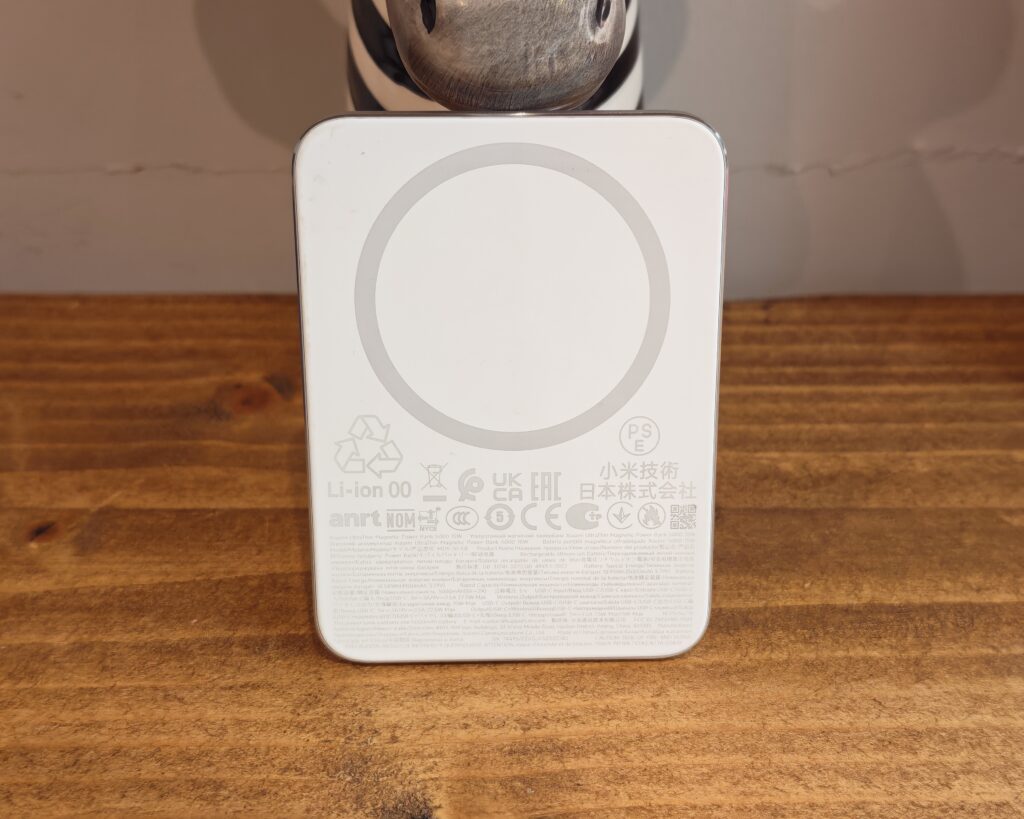
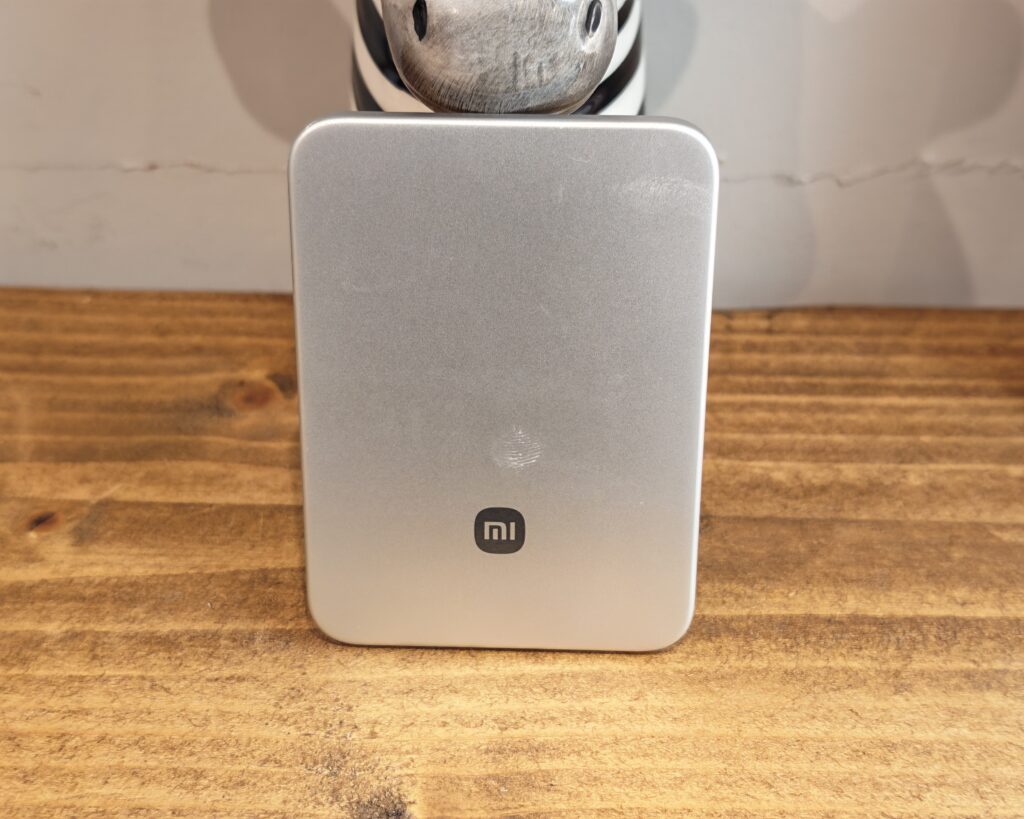
The defining feature is the thickness, or rather the lack of it. At 6mm, the Xiaomi is thinner than almost any phone you would attach it to, and in the hand it feels closer to a thick coaster than a battery. The shell is aluminium alloy with a photolithographically etched Mi logo, and the finish has a fine matte texture that picks up the odd fingerprint but generally looks tidy. Xiaomi quotes a weight of 98g, which is genuinely light for a 5,000mAh magnetic pack.
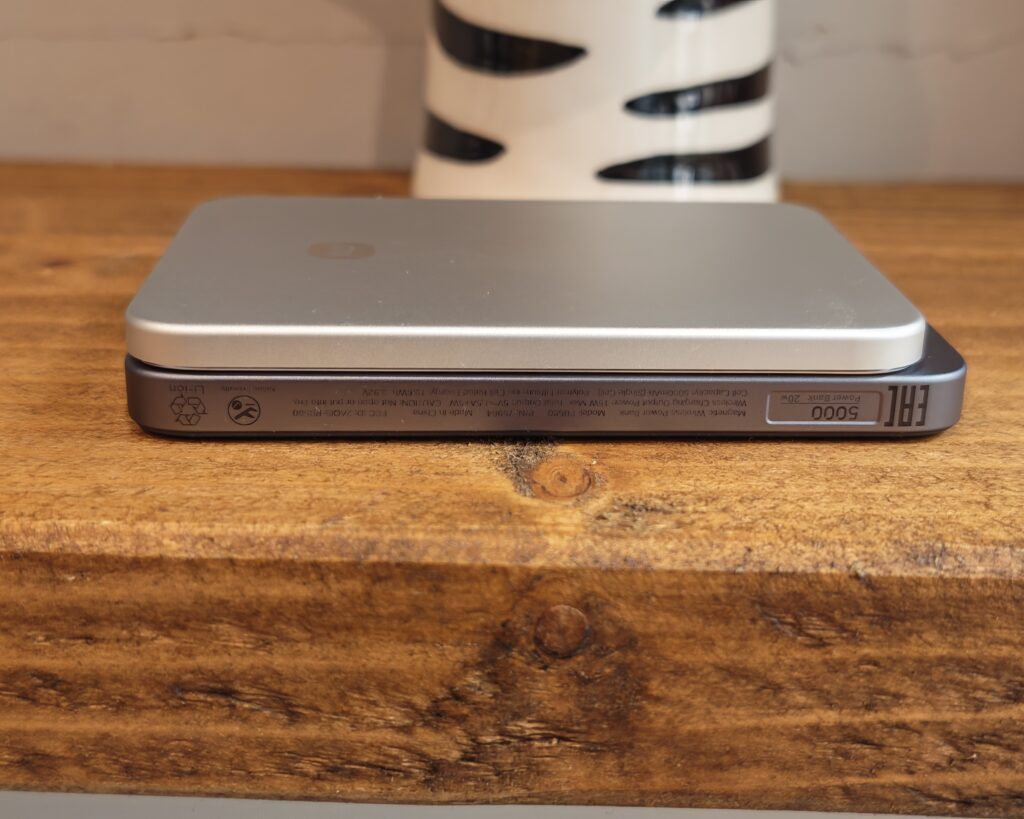
Stacked against the Ugreen MagFlow Air, the size difference is clear but not dramatic in everyday use. The Xiaomi is 6mm thick against the Ugreen’s 8.6mm, and it is the shorter of the two by around 6.5mm. Both slip into a pocket attached to a phone without much fuss. Where the Xiaomi pulls ahead is when you are holding the phone to your ear or shooting a photo, as the thinner profile is less likely to get knocked out of alignment. It is a small thing, but it is the sort of small thing you notice repeatedly.
The magnets are strong enough to hold the pack in place through normal handling, though as with every magnetic battery, a thick or non-magnetic case will weaken the bond or break it entirely. Xiaomi notes that cases thicker than 2.5mm may compromise the connection, which is worth keeping in mind if you run a rugged case.
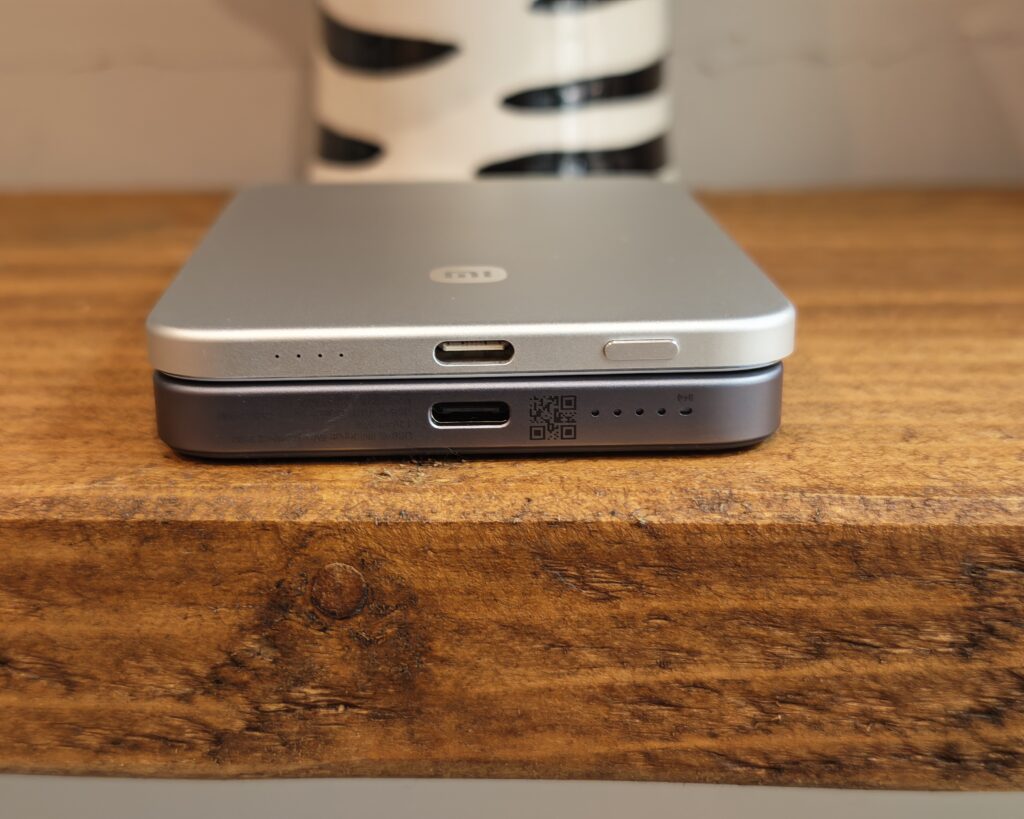
On the bottom edge you get a single USB-C port, a power button and a four-LED charge indicator. The four-light display is the same vague system used on most packs in this class, including the Ugreen, so you get a rough quarter-by-quarter idea of remaining charge rather than a precise percentage. It does the job, but a digital readout would be more useful.
Performance
In practice, the wireless side behaves exactly as the spec sheet suggests. On compatible Android handsets, it sits at the higher wireless rate and tops the phone up at a sensible pace. Put it on an iPhone, and you are limited to 7.5W, which is slow enough that you would often be better off reaching for the USB-C cable instead. This is the core problem with the Xiaomi for Apple users, and it is the single biggest reason I would steer iPhone owners towards a Qi2-certified rival.
Wired is obviously faster. Over USB-C the pack will push up to 22.5W, and that is the mode to use when you want a meaningful top-up quickly. Charging a Google Pixel 9 Pro from 20%, saw it reach 50% in 20 minutes over the cable, which is respectable for a pack this size.
You can also run wired and wireless together, with the pack rated for 7.5W over the cable plus 5W wireless at the same time. It is handy in a pinch for topping up earbuds while charging a phone, but the reduced rates mean it is a convenience feature rather than a fast one.
Thermals and safety
Like every slim magnetic pack, the Xiaomi gets warm under load. The metal shell doubles as part of the heatsink, so you will feel the heat rather than it being hidden away, but it never became uncomfortable in my testing. Xiaomi lists dual-NTC temperature control and a fibreglass surface with a heat-resistant coating, along with the usual run of protections covering overvoltage, overcurrent, over-temperature, short-circuit and foreign object detection. None of this is unusual for the category, but it is reassuring on a device this thin.
Price and Alternative Options
- UltraThin Magnetic Magsafe Power Bank— Just 100–120g, about the weight of two eggs. This 5000mAh magnetic battery pack snaps onto your phone and disappears into your pocket — the ultimate slim portable charger for daily carry.
- 15W Wireless Fast Charging— Supports 15W wireless fast charging on Xiaomi 17 Series and all Qi-compatible devices. No cables, no fuss — just snap, charge, and go.
- 5000mAh, Flight-Safe— 18.58Wh battery energy, well under the 100Wh aviation limit. Take this magsafe power bank on any flight without worry — perfect travel companion.
- Strong Magnetic Attachment— Secure magnetic alignment keeps the power bank firmly attached to your phone. Works with iPhone Magsafe and any magnetic-compatible phone case.
- Smart Design & Wide Compatibility— Glacier Silver / Graphite Black / GL Orange finishes match your style. Compatible with iPhone, Samsung, Xiaomi, and all Qi wireless charging devices.
The Xiaomi UltraThin Magnetic Power Bank 5000 has an RRP of £50 and is available directly from mi.com. Amazon UK has it, but at the time of writing it was more expensive at £52.25, likely due to it being shipped from Amazon EU.
I recently reviewed the Ugreen MagFlow Air Ultra-Slim 5,000mAh. It is not as thin as the Xiaomi at 8.6 mm vs 6 mm, but it is rated for Qi2, so it will charge an iPhone at 15W. This has an RRP of £45, and at the time of writing, it is available for just £37.
Anker has the MagGo Nano Slim 5,000mAh Power Bank, which again is not as slim as the Xiaomi, being 8.6mm thick vs 6mm thick, but it is 15W Qi2 certified, so better suited for iPhones. The RRP is the same as the Xiaomi, but it is discounted to £40 on Amazon.
While not quite as established as Ugreen or Anker, INIU are reasonably reputable for power banks. They have the SnapGo P71, which is 15W Qi2, 9mm thick and available for just £30.
You then have the usual random brands. The LISEN Qi2 MagSafe Power Bank Slim is listed as 0.39 inches thick, which translates to 9.9mm. This is only £24.
Laid out side by side, the pattern is hard to miss. Every one of those alternatives is thicker than the Xiaomi by between 2.6mm and 3.9mm, and every one of them is cheaper, in most cases by £10 or more. They are also all properly Qi2 certified, so they charge iPhones at the full 15W rather than the Xiaomi’s 7.5W. The Xiaomi is buying you thinness, and you are paying a clear premium for it.
| Power bank | Thickness | Price | iPhone wireless |
| Xiaomi UltraThin 5000 | 6mm | £50 RRP | 7.5W |
| Ugreen MagFlow Air 5K | 8.6mm | £37 | 15W (Qi2) |
| Anker MagGo Nano Slim 5K | 8.6mm | £40 | 15W (Qi2) |
| INIU SnapGo P71 | 9mm | £30 | 15W (Qi2) |
| LISEN Qi2 Slim | 9.9mm | £24 | 15W (Qi2) |
Overall
Looking at the Xiaomi UltraThin Magnetic Power Bank 5000 in a bubble, it is a decent 5,000mAh charger, with the main selling point being its thinness. It easily slips into your pocket with your phone, adding little to no noticeable bulk.
It performs as expected based on the specs, and due to the lack of MagSafe or Qi2, it is best used with Android phones. On a compatible Xiaomi or Honor handset it charges at a reasonable rate, the wired output is quick enough for a useful top-up, and the build quality and usable capacity are both strong. As an everyday carry battery for an Android user who cares about pocketability above all else, there is a lot to like.
Looking at the wider market, the Xiaomi UltraThin Magnetic Power Bank 5000 loses its appeal due to the comparatively high price. While the Xiaomi may be the thinnest on the market, I am not sure most people care about saving 2.6mm of thickness for a £10+ premium, especially when the cheaper rivals also charge iPhones twice as fast.
Therefore, while I like the Xiaomi UltraThin Magnetic, and continue to use it, it is hard for me to recommend. If you own a recent Xiaomi phone, value slimness over everything and are not bothered about iPhone charging speeds, it makes sense. For everyone else, the Ugreen MagFlow Air 5K does the important things just as well, charges iPhones at the full 15W, and costs less. The 2.6mm you save with the Xiaomi is real, but it is hard to argue it is worth the extra money.
Xiaomi UltraThin Magnetic Power Bank 5000 Review
-
Overall - 65%65%
Summary
The Xiaomi UltraThin Magnetic Power Bank 5000 succeeds in its primary goal of being exceptionally slim. At just 6mm thick and 98g, it is one of the most pocket-friendly magnetic power banks available and feels almost invisible when attached to a phone. Build quality is excellent, wired charging is reasonably fast at up to 22.5W, and it pairs particularly well with recent Xiaomi and other Android handsets.
The problem is value. While the ultra-thin design is genuinely impressive, Xiaomi charges a premium for it, yet omits Qi2 certification and limits iPhone wireless charging to 7.5W. Competing options from Ugreen, Anker and INIU are only a few millimetres thicker, cost less, and provide full 15W Qi2 charging for iPhones. Unless minimising thickness is your absolute priority, those alternatives represent better overall value.
For Android users who prioritise portability above all else, the Xiaomi UltraThin Magnetic Power Bank 5000 is an appealing everyday carry accessory. For most buyers, however, the Ugreen MagFlow Air 5K strikes a more sensible balance of performance, compatibility and price.
Pros
- Exceptionally thin 6mm design
- Lightweight and pocket-friendly
- Fast 22.5W wired charging
- Premium aluminium build quality
- Strong magnetic attachment
Cons
- Expensive for its capacity
- No Qi2 certification
- iPhone charging limited to 7.5W
- Rivals offer better value
- LED indicators lack precision

I am James, a UK-based tech enthusiast and the Editor and Owner of Mighty Gadget, which I’ve proudly run since 2007. Passionate about all things technology, my expertise spans from computers and networking to mobile, wearables, and smart home devices.
As a fitness fanatic who loves running and cycling, I also have a keen interest in fitness-related technology, and I take every opportunity to cover this niche on my blog. My diverse interests allow me to bring a unique perspective to tech blogging, merging lifestyle, fitness, and the latest tech trends.
In my academic pursuits, I earned a BSc in Information Systems Design from UCLAN, before advancing my learning with a Master’s Degree in Computing.
I’m proud to share that Vuelio has consistently ranked Mighty Gadget as one of the top technology blogs in the UK. With my dedication to technology and drive to share my insights, I aim to continue providing my readers with engaging and informative content.
I work directly with the companies he reviews products for or their chosen PR agency.
For Social Media, you can find me on: