Tozo NC20 Pro Wireless Earbuds Review
I have previously reviewed a few Tozo earbuds and headphones such as the Tozo OpenBuds, Tozo HT3 and the Tozo Tonal Dots T12. They have generally been excellent, and they appear to be a decent brand for affordable earbuds that often undercuts more established budget brands such as Soundpeats and EarFun.
The Tozo NC20 is their latest launch, coming in two models: the Pro model with an integrated LCD display on the case to control all earbud functions, or the non-Pro, which has a basic monochromatic LED display with simple functions such as music control.
The Pro model is available for around £66, while the non-Pro model is available for £50.
No products found.
Specification
| Category | Specification |
| Driver | 12mm large dynamic driver with DLC-coated diaphragm |
| Frequency response | 12Hz to 40kHz per the acoustic tech graphic |
| Audio codecs | LDAC, Hi-Res Audio Wireless certified, TOZO OriGX Pro |
| Active noise cancellation | Adaptive Hybrid ANC, up to 52dB reduction, continuous ambient monitoring |
| Call noise reduction | 6 microphones total (feedforward, feedback and talk mic per earbud), AI-based wind and crowd noise filtering |
| Bluetooth version | Bluetooth 6.0 |
| Multipoint connectivity | Dual-device connection (phone, PC or tablet simultaneously) |
| Latency (gaming mode) | Quoted as 0.05s (50ms) |
| Water resistance | IPX8 |
| In-ear detection | Automatic play/pause on removal and insertion, toggle via app or case |
| Voice assistant | TOZO AI, activated by double-pressing the power button |
| AI translation | Real-time multi-language translation for calls, speeches and meetings; premium feature with a 3-month free trial for registered users, presumably subscription-gated after that |
| Battery (earbuds), ANC off | 16.5 hours |
| Battery (earbuds), ANC off + LDAC | 8.5 hours |
| Battery (earbuds), ANC on | 12.5 hours |
| Battery (earbuds), ANC on + LDAC | 7 hours |
| Total battery with case, ANC off | 80 hours |
| Total battery with case, ANC off + LDAC | 50 hours |
| Total battery with case, ANC on | 63 hours |
| Total battery with case, ANC on + LDAC | 40 hours |
| Charging case | Touchscreen display, double-tap to unlock touch controls (play/pause, volume, ANC mode, scene settings, gaming/low-latency mode); real-time lyrics display during playback |
| Charging methods | USB-C wired fast charging and Qi wireless charging |
| Power management | TOZO SmartPow intelligent power management |
| Reset | One-click factory reset from the case |
| Companion app | TOZO app: EQ, sound mode, ANC level, personalised hearing test (Earprint), scene sound |
Design


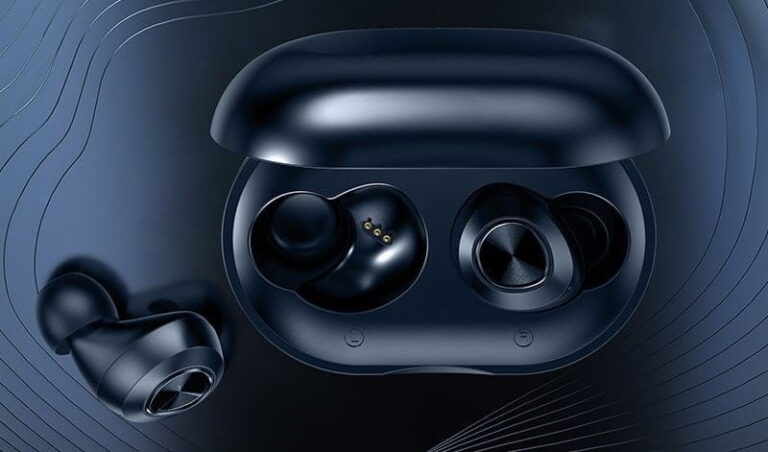
The Tozo NC20 Pro is a stem-style true wireless earbud, and it is a well-built one at that. Both the earbuds and the case are made from hard plastic, which is standard for this price bracket, but nothing about the finish feels cheap or hollow. Tozo has clearly put some thought into the shaping too, with a clean, streamlined stem that is not overly long, which I always appreciate given how gangly some competitors’ designs can look sat in the ear.

Build quality sits comfortably alongside other names competing in the sub-£100 bracket, such as Soundpeats, Earfun and Soundcore. Tozo’s own Hydroguard coating gives the earbuds an IPX8 rating, so they should survive a proper soaking or an accidental dunk, not just the odd spot of rain or sweat on a run. For anyone using these for exercise or cycling, that is a useful bit of reassurance rather than just a number on a spec sheet. IPX ratings like this are earned under controlled lab conditions at a specific depth and duration, so while I would not hesitate to run or cycle in the rain with these, I would stop short of going swimming with them.
Fit is always subjective, and I would stress that what works for my ears will not necessarily work for yours, but I found the NC20 Pro sat securely and comfortably over extended listening sessions. Tozo includes ten pairs of eartips in the box, running from small to large, all in the same slotted silicone style. That is a decent spread, though it is worth spending time finding the right size, since a poor seal will hurt both the noise cancelling and the low end response. If none of the bundled tips feel quite right, aftermarket shallow fit tips are worth trying, as long as they are compact enough to still close into the case.
The earbuds themselves come in four colourways: black, champagne, rose gold and titanium grey. It is a sensible spread that should suit most tastes without straying into anything too flashy. At a £70 to £80 asking price, Tozo has kept the aesthetic fairly restrained rather than going overboard with faceplates or ornamentation, and I think that is the right call. It looks tidy and unfussy rather than trying too hard.
One small niggle worth flagging: the earbuds sit quite snugly in the case, and I found myself digging a fingernail in underneath to lift them free more often than I would like, particularly with the larger eartips fitted. It is not a serious flaw, just one of those small details that reminds you this is a budget product rather than a flagship one.
Where the design does stand out from the norm is the case, which I will cover in more detail below. It is compact enough to sit in a jeans pocket without any bulk, and its shape and weight feel deliberate rather than accidental.
Case LCD Interface


This is genuinely the headline feature of the NC20 Pro, and it is not something you see at this price. Rather than a basic plastic shell with a status light, Tozo has fitted the case with a 1.52 to 1.8 inch LCD touchscreen, and it works considerably better than it has any right to at this price.
First impressions matter here, and my first thought was that a screen on a sub-£100 case would be a bit of a gimmick, the sort of thing that looks good in marketing photos but is fiddly and unresponsive in practice. That was not the case. The touch response is fluid, swiping between menus feels closer to using a budget smartphone than a Bluetooth accessory, and there is none of the lag or missed inputs I have encountered on cheaper case displays before.
Functionally, the screen is split across several swipeable panels. The home screen shows the time, the case battery percentage and the charge status of each earbud, with a swipe to unlock gesture to get into the main menu. From there you get a music control panel showing the current track and artist, with play, pause, skip and previous buttons. There is a volume slider marked from 0 to 100 percent, a noise cancellation panel toggling between the various ANC modes, and a full equaliser screen with sliders that mirror the app’s EQ. Beyond that sits a spatial audio and music mode toggle, along with low latency switching for gaming, a Find My Earbuds locator, and a settings menu covering multipoint connection, wear detection and other configuration options.
Digging into the case’s own settings menu, there is more configurability than I expected. You can pick from a small selection of preloaded wallpapers or upload a custom image, adjust screen brightness across a few levels, set how long the display stays lit after a tap, mine is set to ten seconds, switch between 12 and 24 hour time display, and change the interface language. The case also tracks its own firmware version separately from the earbuds and updates over the air independently, so do not be surprised if you see two different version numbers when checking for updates in the app.
It is worth being clear about what this does and does not add. None of these functions are exclusive to the case. Everything here can also be done through the Tozo app or via the earbuds’ touch controls, so this is not unlocking anything new in terms of capability. What it does offer is convenience: being able to skip a track, adjust the EQ or switch ANC modes without pulling out your phone is a nice bit of practicality, particularly if your phone is buried in a bag or you would rather not unlock it in a meeting.
There are a couple of caveats worth flagging. Tozo has not published the actual screen resolution, so I cannot give you hard numbers to compare against other case displays, and the icons and text can look a little soft up close, in keeping with what you would expect from a small LCD panel rather than anything higher resolution. It is also fair to ask how much use this feature will see day to day. It is a good party trick and a useful convenience, but the app duplicates all the same functionality, so whether the case screen becomes a regular habit or something you show off once and then rarely touch again will likely come down to personal preference.
Even with those caveats, I have not seen another case at this price with anything close to this level of functionality built in, and it is a strong differentiator against rivals like the Soundpeats Air5 Pro or the Earfun Air Pro 4, neither of which offer anything comparable on the case itself.
Tozo App & Set-Up


Tozo pairs the NC20 Pro with its own companion app, and it is a mixed bag in the way that so many of these companion apps are.
Getting started involves more friction than it needs to. You are forced to create an account just to use the app, which is one of my pet hates with this sort of software. There is no good reason a pair of earbuds needs you to sign up with an email address before you can access basic EQ settings. The app also carries adverts, which is another habit I dislike, and one that feels particularly unnecessary on a piece of software bundled with hardware you have already paid for.
Once you get past that, the app itself is good, with a lot more depth than I expected. The home screen shows both earbuds’ battery levels, a shortcut to the case controls, and quick access buttons for Eartune, ANC and Sound Mode, along with a panel showing which EQ preset is currently active. Below that sit three routes into the sound settings: EQ Zone, Advanced EQ and Sound Effects.
The preset EQ options cover the usual bases: Standard, Bass +, Bass -, Classical, Dance, Deep, Hip-Pop and Jazz, each shown as a curve overlaid on a simple frequency graph running from 20Hz to 12.8kHz. If none of those fit, the Advanced EQ screen hands you a full ten-band graphic equaliser with draggable points across the same frequency range, which you can save and favourite for later.
I particularly like the community EQ settings in the EQ Zone. This lets you browse dozens, if not hundreds, of EQ profiles uploaded by other users, each with a short description of what the tuning is meant to achieve, along with a like count and a view count so you can judge how popular a given profile is before trying it. Some of these have racked up hundreds of thousands of views. It is a properly useful feature and one I would like to see more brands copy. The one catch is that the EQ Zone is not filtered by earbud model, so plenty of the top results were originally created for other Tozo products such as the T6, and while they still loaded fine on the NC20 Pro, it is worth checking the description before assuming a profile was tuned with this driver in mind.
There is also a hearing test, called Eartune, which asks you to work through a short tone-based assessment and then adjusts the sound output to compensate for your own hearing profile, similar in spirit to what a hearing aid fitting does. I did not find this made a dramatic difference, but it is a nice inclusion at this price and costs nothing to try.
Beyond sound, the app has a Touch Control section that lets you remap the single tap, double tap, triple tap and long press gestures on each earbud independently, including separate behaviour for handling calls. There is also a volume balance slider for anyone who needs the left and right channels adjusted unevenly, and a general settings page covering low latency mode, wear detection, dual device connection and LDAC, with a clear warning that LDAC and dual device connection cannot both be active at once, since enabling multipoint automatically switches LDAC off.
Then there is the AI tab, which is where things get more ambitious and considerably more hit and miss. Tozo has bundled in meeting recording, simultaneous interpretation, face to face translation and an AI chat function, alongside a small library of ambient soundscapes for relaxation, such as thunderstorms and forest recordings. These are gated behind a membership tier. The free account gives you a taste, but the fuller allowance, 60 minutes of meeting recording and 30 minutes of translation in my case, comes as part of a bundled membership that is presumably time-limited before you are asked to pay for more. I would treat all of this as a bonus rather than a reason to buy the earbuds. Translation and transcription features in particular are the sort of thing that sound impressive on a spec sheet but rarely hold up well once you are relying on them for anything important, and I would not want anyone buying the NC20 Pro purely on the promise of this AI toolkit.
One habit worth flagging from general use is that certain settings, LDAC in particular, do not always stick between sessions and occasionally need re-enabling after a reconnect. It is a minor annoyance rather than a dealbreaker, but it means the app is not quite the set and forget experience you would hope for.
So, other than the account requirement and the adverts, the app is good, with lots of settings and enough depth to keep tinkerers happy, even if a few corners of it feel like features added for a marketing bullet point rather than because anyone asked for them.
Sound Quality
Out of the box, the NC20 Pro’s sound was a bit middling. It was not bad by any means, just nothing that stood out either, which is a common trait of budget earbuds tuned for a broad audience rather than any particular taste.
Where things improved considerably was once I started digging through the community EQ options described above. Switching between a handful of user-created profiles brought the sound much closer to what I actually enjoy, adding presence in the upper mids without pushing the treble into anything harsh, which I am particularly sensitive to. It says something about the value of that community EQ feature that it made a bigger difference to my listening experience than any of the built-in presets did.
The 12mm dynamic driver itself is a decent unit for the price. It produces satisfying bass, with a good sense of weight and rumble on tracks that call for it, and I did not notice any obvious distortion even at higher volumes. The non-Pro NC20 in Tozo’s range leans harder into bass by default and can feel a bit heavy-handed as a result. This Pro version dials that back somewhat, giving the midrange more room so vocals and guitars come through a touch more clearly. I think that is the right call for a set of earbuds aimed at general listening rather than pure bass heads, though it does mean the low end will feel a touch less dramatic to anyone coming from a warmer-tuned pair.
Detail retrieval and separation are where the NC20 Pro shows its price point. Individual instruments and layers in busier tracks do not stand apart from each other with quite the precision you get from some of the pricier rivals in this bracket, and the top end, while never harsh, does not have huge amounts of texture or sparkle to it either. That is a reasonable trade-off for the asking price, but it is worth knowing going in if you are coming from something more expensive.
Turning on LDAC brings a worthwhile improvement if your phone supports it, adding a bit more precision and separation to the sound, though as with any Bluetooth codec the difference is more of a polish than a transformation. LDAC is an Android feature. iPhone owners are limited to AAC, and while that still sounds perfectly listenable, you will not get quite the same level of headroom as Android users switching LDAC on.
There is also a Spatial Audio mode in the app, which widens the soundstage a bit for video and can be a nice touch for films, though I found it did more harm than good with music, adding a slightly artificial sense of space that I preferred to leave switched off for regular listening.
The sound signature here will not trouble any audiophile, but for a set of earbuds selling in this bracket, with a driver, EQ system and community preset library this deep, most people will find something in the settings that suits their tastes, even if the default tuning is not going to win any awards on its own.
Active Noise Cancelling
Tozo quotes the NC20 Pro’s Adaptive Hybrid ANC system at up to 52dB of noise reduction, with continuous ambient monitoring adjusting the cancellation on the fly. As with most marketing figures for noise cancelling, treat that number as a best-case ceiling under specific test conditions rather than something you will notice in everyday use, but the underlying performance is solid for the price all the same.
The app and case both give you six ways to configure noise handling: standard Noise Cancellation, Transparency Mode, Reduce Wind Noise, Leisure Mode, Normal Mode and Adaptive Mode, plus a toggle to remember your last setting so you are not reselecting your preferred mode every time you reconnect. In practice, the standard ANC mode does its best work on constant, low-frequency noise such as the hum of an extractor fan, an air conditioning unit or a train’s engine drone. It takes the edge off higher-pitched and more variable sounds, such as voices or a rattling trolley, rather than eliminating them outright, which is fairly typical of ANC at this price and not something I would hold against it on its own.
The dedicated Reduce Wind Noise mode is worth a special mention, since it is noticeably more effective at cutting wind buffeting than the standard ANC setting, which is useful if you run or cycle outdoors regularly, as I do. Switching to it from the case screen rather than digging through the phone app is one of the few times I found myself using the touchscreen out of real convenience rather than novelty.
Transparency Mode does a reasonable job of letting outside sound back in without completely undoing the seal of the eartips, though like most earbuds in this bracket it is more useful for staying aware of your surroundings than for holding a proper conversation while music keeps playing. Adaptive Mode, which is meant to blend cancellation and awareness automatically, is the one setting I rarely reached for. It works, but I never felt it added much over simply picking Normal or Noise Cancellation manually.
Set against rivals in the same price bracket, the NC20 Pro’s ANC sits somewhere in the middle of the pack. It is a clear step up from cheaper earbuds with no meaningful ANC at all, and comfortably ahead of some budget-focused competitors, but it does not match the strongest performers around the £70 to £100 mark, several of which cut a bit more of the mid-range chatter that the NC20 Pro lets through. The battery cost is worth bearing in mind too. Running ANC continuously drops the earbuds from 16.5 hours down to 12.5 hours per charge, so there is a real trade-off between quiet and stamina.
None of this makes the ANC a weak point. It is competent, configurable and, thanks to that wind reduction mode, properly useful for outdoor use, even if it will not be the reason you choose the NC20 Pro over a rival.
Microphone / Call Quality
Call quality is handled by an array of six microphones across the two earbuds, split between feedforward, feedback and a dedicated talk mic on each side, backed by AI-based filtering for wind and crowd noise.
In practice, this works well for the situations most people actually use earbuds for: phone calls at a desk, video calls from home, or a quick conversation while walking somewhere reasonably sheltered. My voice came through clearly and consistently on the other end of calls, without the thin or slightly robotic edge that cheaper earbuds can add, and background noise such as a television playing in another room or general office chatter was noticeably reduced without swallowing my voice in the process.
Where it starts to struggle, unsurprisingly, is wind. A stiff breeze straight across the microphones introduces some rustling and instability that the filtering cannot fully mask, and callers on the other end noticed the difference on a blustery day compared with a still one. That is a common limitation across almost every pair of earbuds at this price, rather than something unique to the NC20 Pro, but it is worth knowing if you plan to take a lot of calls outdoors.
As with sound quality generally, getting a proper seal with the right sized eartip makes a real difference to call clarity, since a loose fit lets more ambient noise leak in around the microphones as well as the drivers. If call quality matters to you more than average, for instance if you work from home and rely on these for meetings, it is worth spending the time to find your best-fitting tip before judging the microphones too harshly.
Taken as a whole, the microphone performance here is a genuine strength of the NC20 Pro. It will not outperform a dedicated headset built for calls, but for a pair of earbuds that also do music, video and gaming duty, it copes with everyday calls and video meetings better than most earbuds I have tested in this price range.
Battery Life
Battery life is one of the NC20 Pro’s stronger suits on paper, and Tozo has published a detailed breakdown depending on which features are switched on.
With ANC and LDAC both off, the earbuds are rated for 16.5 hours on a single charge, which is towards the top end for true wireless earbuds generally. Turning on LDAC alone drops that to 8.5 hours, since streaming a higher bitrate hi-res codec over Bluetooth is noticeably more power hungry. Running ANC on its own brings the figure down to 12.5 hours, and running ANC and LDAC together, the most demanding combination, gives you 7 hours. With the case topping up the earbuds along the way, Tozo quotes a total of 80 hours with everything off, 63 hours with ANC on, 50 hours with LDAC on, and 40 hours with both ANC and LDAC running.
As with most quoted battery figures, treat these as best-case numbers achieved at a moderate, sensible volume, with limited call use. Push the volume up regularly, spend a lot of time on calls, or use the case screen heavily, and real-world stamina will likely land somewhat below the headline figures, though even a conservative estimate still leaves the NC20 Pro comfortably ahead of a lot of the competition, several of which top out closer to 8 to 10 hours per charge with ANC on, compared with the Tozo’s 12.5.
Charging is handled over USB-C or Qi wireless charging, and Tozo’s SmartPow system is meant to manage power distribution intelligently between the case and earbuds, though this is one of those features you only really notice if it goes wrong, and it did not during my time with them. Tozo has not quoted a specific fast-charge time for this set, but earbuds in this class typically offer a meaningful top-up from a short spell in the case, so a quick charge before heading out should not be a problem.
For most people’s daily use, battery life is unlikely to be something you think about often with the NC20 Pro, and that is exactly how it should be. Even with ANC and LDAC both running, a full charge should comfortably cover a working day, with the case good for most of a week of top-ups before it needs plugging in itself.
Price and Alternative Options
No products found.
The Tozo NC20 Pro has an RRP of £70, and at the time of writing, it was available for £66 from Amazon UK.
The standard Tozo NC20 is largely the same earbud but drops down to a basic display on the case for simple functions. This model has an RRP of £60 but is available for £50 on Amazon. The Pro is not purely a cosmetic upgrade either. Alongside the touchscreen case, the Pro version leans towards a more balanced, mid-forward sound compared with the standard NC20’s heavier bass, and its microphones fare a little better at filtering background noise on calls, so the extra cost buys you more than just a fancier case if either of those matters to you.
The market is saturated at this price point, and there is no shortage of alternatives worth considering. The EarFun Pro 4 has an £80 RRP but has been available for £56, the SoundPEATS Air5 Pro sits at £80, the Anker Soundcore Liberty 4 NC is a couple of years old now but still a strong performer, with an £80 RRP and street prices closer to £55, and the newer Anker Soundcore Liberty 5 carries a £100 RRP with prices seen nearer £65. None of these has an LCD smart screen on the case, though the Soundcore Liberty 4 Pro, a step up from the standard Liberty 4 NC, does offer a simpler slide-out display with battery percentages and basic ANC controls, worth a look if a case screen of some kind is high on your list.
Overall
I actually like these a lot considering the price point, and I will likely continue to use them as a spare pair of earbuds for when I go for a walk on my lunch breaks at work.
The LCD display may seem like a gimmick, but I quite like it. I dislike having lots of unnecessary apps on my phone, and while the Tozo app is mostly good, I dislike being forced to sign up for an account when it is completely unnecessary. Adverts in apps are equally unwelcome, but sadly this has become common even among larger brands. The LCD display mostly helps bypass this annoyance, with the exception of the community-submitted EQ options, which are worth dipping into the app for.
Sound quality is good for the price. The 12mm dynamic driver and extensive EQ options let you adjust the sound to your own taste, even if the default tuning will not blow anyone away.
I also found the fit to be particularly good for my larger ears. This will obviously vary between people, but the largest tips created an excellent seal that required no adjustment during exercise, and a good seal helps the overall sound quality as much as it helps noise cancelling and call clarity.
At this price, the market is saturated, and there are certainly good alternatives worth considering. I was particularly fond of the Anker Soundcore Liberty 4 NC when I reviewed it, and I kept using it until I lost it.
Overall, I can give this is a strong recommendation. You get a huge amount of features for the money, the battery life is among the best in this price range, and the overall sound quality holds up well once you have spent ten minutes finding an EQ preset that suits you. The touchscreen case will not be for everyone, and the AI extras are more novelty than necessity, but as a pair of earbuds for daily use, the NC20 Pro earns its place.
Tozo NC20 Pro Wireless Earbuds Review
-
Overall - 85%85%
Summary
At around £70, the NC20 Pro undercuts most ANC rivals while adding a properly useful touchscreen case and some of the strongest battery figures in the category. The app’s account requirement and adverts are unwelcome, and neither the sound nor the noise cancelling quite reaches the class leaders, but little else at this price gets as much right.
Pros
- Strong battery life across all modes
- Handy touchscreen controls on the case
- Wide EQ and community preset choice
- Secure, comfortable fit for exercise
- Clear calls even in background noise
Cons
- Mandatory account sign-up before use
- Ads appear inside the app
- Settings occasionally reset after reconnecting
- Noise cancelling merely mid-table here
- AI tools feel bolted on

I am James, a UK-based tech enthusiast and the Editor and Owner of Mighty Gadget, which I’ve proudly run since 2007. Passionate about all things technology, my expertise spans from computers and networking to mobile, wearables, and smart home devices.
As a fitness fanatic who loves running and cycling, I also have a keen interest in fitness-related technology, and I take every opportunity to cover this niche on my blog. My diverse interests allow me to bring a unique perspective to tech blogging, merging lifestyle, fitness, and the latest tech trends.
In my academic pursuits, I earned a BSc in Information Systems Design from UCLAN, before advancing my learning with a Master’s Degree in Computing.
I’m proud to share that Vuelio has consistently ranked Mighty Gadget as one of the top technology blogs in the UK. With my dedication to technology and drive to share my insights, I aim to continue providing my readers with engaging and informative content.
I work directly with the companies he reviews products for or their chosen PR agency.
For Social Media, you can find me on: