Honor Magic V6 Review vs V5
I reviewed the Honor Magic V5 in August 2025 and thought it was superb. Honor has really mastered the foldable; with the V5 being just 8.8mm thick when folded, there is very little difference in the overall dimensions between that and a traditional slab phone like the Honor Magic8 Pro.
I’d also argue that Honor is comfortably the best company for foldables, with the two main competitors being Samsung and Google.
The Samsung Galaxy Z Fold7 is much better than previous generations thanks to the improved horizontal resolution of the front display, making it more usable in its folded form, but I think the 4,400mAh battery really holds it back.
The Google Pixel 10 Pro Fold just doesn’t compete well in terms of hardware, in my opinion, though admittedly, Pixel is always the best software experience.
As with most new phones nowadays, the new Honor Magic V6 is an incremental upgrade. You have the usual chipset upgrade, and while this is always good, in recent years it feels less important. Phones are so powerful nowadays that I doubt most people make the most of the performance. The most notable improvement is the battery capacity. The global model goes from 5,820mAh on the V5 to 6,660mAh on the V6, a 14.5% increase in capacity. Frustratingly, the Chinese variant is even bigger, with a 7,150mAh capacity on the 1TB model.
While I haven’t had to worry about a phone battery making it through the day in years, it is different with foldables, due to the massive internal display, and the V6 having over 50% more capacity than the Samsung Galaxy Z Fold7 is going to make a huge difference.

Honor Magic V6 vs V5 Specification
| Specification | Honor Magic V6 | Honor Magic V5 |
|---|---|---|
| Dimensions (unfolded) | 156.7 x 145.6 x 4.0-4.1 mm | 156.8 x 145.9 x 4.1-4.2 mm |
| Dimensions (folded) | 156.7 x 74.5 x 8.8-9.0 mm | 156.8 x 74.3 x 8.8-9.0 mm |
| Weight | 219 g / 224 g | 217 g / 222 g |
| Water/dust resistance | IP68/IP69 | IP58/IP59 |
| Main display | 7.95″ foldable LTPO2 AMOLED, 2172 x 2352, 120 Hz, 5,000 nits peak, 4320 Hz PWM dimming | 7.95″ foldable LTPO AMOLED, 2172 x 2352, 120 Hz, 5,000 nits peak |
| Cover display | 6.52″ LTPO2 OLED, 1080 x 2420, 120 Hz, 6,000 nits peak | 6.43″ LTPO OLED, 1060 x 2376, 120 Hz, 5,000 nits peak |
| Chipset | Snapdragon 8 Elite Gen 5 (3 nm) | Snapdragon 8 Elite (3 nm) |
| RAM / storage | 12 GB / 16 GB; 256 GB – 1 TB (UFS 4.1) | 12 GB / 16 GB; 256 GB – 1 TB |
| Rear cameras | 50 MP wide (f/1.6, OIS), 64 MP periscope telephoto (3x optical, OIS), 50 MP ultrawide (f/2.2) | 50 MP wide (f/1.6, OIS), 64 MP periscope telephoto (3x optical, OIS), 50 MP ultrawide (f/2.0) |
| Selfie cameras | 20 MP (inner and cover) | 20 MP (inner and cover) |
| Video | 4K@30/60fps, gyro-EIS + OIS | 4K@30/60fps, gyro-EIS + OIS |
| Battery | 6,660 mAh silicon-carbon (global) | 5,820 mAh silicon-carbon (international) |
| Charging | 80 W wired, 66 W wireless, reverse wireless | 66 W wired, 50 W wireless |
| OS | Android 16, MagicOS 10, 7 major upgrades | Android 15 (upgradable to 16), MagicOS 10, 7 major upgrades |
| Connectivity | Wi-Fi 7, Bluetooth 6.0, NFC, USB-C 3.1 with DisplayPort | Wi-Fi 7, Bluetooth 6.0, NFC, USB-C 3.1 with DisplayPort |
| Colours | Gold, Red, White, Black | Black, Ivory White, Dawn Gold, Reddish Brown |
Honor Magic V6 vs Magic V5: What Has Actually Changed?
On paper, the Magic V6 looks like a modest update, and in most respects it is. The design is nearly identical, with the V6 measuring 4.0mm unfolded against 4.1mm for the V5, and weight rising by 2g to 219g. You will not notice either difference in hand. Both keep the same 7.95 inch inner display at the same resolution, and the cover screen grows slightly from 6.43 to 6.52 inches.
Performance
The biggest upgrade is the chipset. The V6 moves to the Snapdragon 8 Elite Gen 5, up from the standard 8 Elite. In my benchmarks, that translated to an AnTuTu score of around 2.53 million against 1.64 million for the V5, and a Geekbench 6 multi-core result of 6,127 versus 5,022. The V5 was never slow, so I would not call this a reason to upgrade on its own, but it does give the V6 more headroom for the seven years of Android updates both phones are promised.
Battery and Charging
This is where the V6 pulls ahead in a way you will actually feel day to day. The silicon-carbon battery jumps from 5,820mAh to 6,660mAh, which is a remarkable capacity for a phone this thin. In testing, that worked out to an active use score of 15 hours 21 minutes against 12 hours 20 minutes for the V5. Wired charging rises from 66W to 80W and wireless from 50W to 66W, with reverse wireless charging added too.
It is worth flagging that the Chinese model gets up to 7,150mAh, so the global version is still being short-changed somewhat, which is a frustratingly common practice.
Durability and Displays
The V6 gains a proper IP68/IP69 rating, up from the IP58/IP59 on the V5, so it is now dust tight rather than merely dust protected. For a foldable, that matters. The displays also add 4320Hz PWM dimming, which is good news if you are sensitive to flicker, and the cover screen peaks at 6,000 nits rather than 5,000. Oddly, my measured brightness came in slightly lower on the V6 at 1,222 nits versus 1,296 nits, so real-world visibility is much the same.
Cameras and Price
The camera hardware is essentially unchanged. Same 50MP main sensor, same 64MP 3x periscope, and the ultrawide actually drops from f/2.0 to f/2.2. If photography is your priority, there is no meaningful gain here.
The V6 launches with an RRP of £2,000, though early bird discounts bring that down to around £1,500. The V5 launched at £1,700 with early discounts taking it to £1,400, and it can now be found for considerably less. Unless the battery life and IP68 rating are deal breakers for you, the V5 remains the better value buy. The V6 is the better phone, but not by several hundred pounds worth.
Design and Build Quality
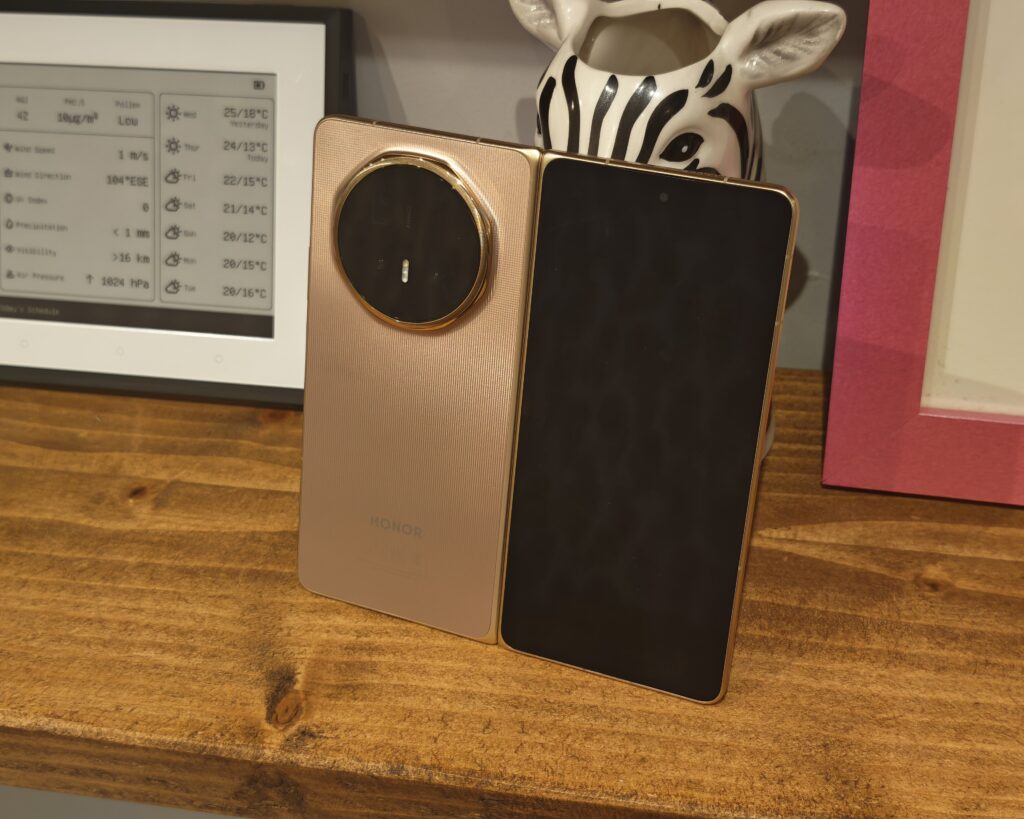

If you put the Magic V6 next to the V5, you would struggle to tell them apart without looking at the spec sheet. That is not a criticism. Honor arrived at a winning formula with the V3, refined it with the V5, and the V6 continues along the same path. The phone measures 4.0mm at its thinnest point when unfolded and 8.8mm folded for the white model, with the other colours coming in at around 9mm and 224g. For context, that folded thickness is essentially the same as an iPhone 17 Pro Max, and the V6 is actually lighter than Apple’s slab flagship at 219g for the white version.
Honor has achieved this by redesigning six internal components, including the antenna, speaker chamber, SIM tray, USB-C port, NFC module and vibration motor, and integrating them into a more compact internal structure. Marketing speak aside, the practical result is that the V6 passes the pocket test. It slides into jeans without complaint and does not feel like carrying two phones taped together, which was the standard foldable experience only a few generations ago.


The material choices vary by colour. The red model uses an eco-friendly leather finish with a suede-like feel, gold and black use a glass fibre back, and the white model uses what Honor calls Aerospace Special Fiber, which is why it is the thinnest and lightest of the four. My review sample is the gold, and while gold phones are not usually my preference, the textured finish looks and feels more refined in person than in press images.
The hinge is the third generation of Honor’s Super Steel design, now rated at 2,800MPa tensile strength, up from 2,300MPa on the V5, and validated for 500,000 folding cycles. That works out to over 130 folds a day for ten years, so the hinge should comfortably outlast the seven-year software commitment. In use, the hinge feels reassuringly solid with no creaks or free play, and it will hold intermediate angles for hovering the phone half-open on a desk.

The bigger durability news is the move to full IP68 and IP69 certification. The V5’s IP58/IP59 rating already covered water immersion and high-pressure jets, but the 5 meant it was only dust protected rather than dust tight. Dust is arguably the greater long-term threat to a folding mechanism than water, so the upgrade to a 6 is more meaningful than it looks. Honor claims this is the most advanced ingress protection of any foldable, and it brings the V6 in line with conventional flagship phones.
As with the V5, the phone ships with a rear cover that includes a built-in kickstand, which is genuinely useful for propping the phone up for video or as a small desktop display. There is no front protection included this time, though, and third-party case options for Honor foldables remain limited in the UK, which is still my biggest practical concern with committing this much money to a folding phone.
Front and Internal Foldable Display

Both displays are proper flagship panels rather than a good main screen paired with an afterthought. The cover display grows slightly to 6.52 inches with a 2420 x 1080 resolution, and its aspect ratio remains sensible, so the phone works perfectly well without ever opening it. The internal display stays at 7.95 inches with a 2172 x 2352 resolution, which works out to around 403 PPI, and both panels run LTPO 2.0 with an adaptive 1-120Hz refresh rate.
The foldable display still has a crease in it, but it is unnoticeable when face on. Honor quotes a 44% reduction in crease depth compared to the V5 and has an SGS Imperceptible Crease certification to wave around. You can still find the crease with your finger, and you can see it when the screen is off or catching light at an angle, but in normal use with content on screen, it disappears. Of all the foldables I have used, this is the closest any has come to making the crease a non-issue.

The other notable improvement is the anti-reflection coating. Honor uses a silicon nitride layer stack on both screens, and claims a reflectivity as low as 1.5% on the cover display. In practice, both screens are noticeably less mirror-like than the V5 outdoors, which does as much for legibility as raw brightness. On that subject, the cover display now quotes a 6,000-nit peak against 5,000 nits on the V5, but as I noted earlier, my own measurement came in at 1,222 nits in real-world HDR conditions, marginally below the 1,296 nits I recorded on the V5. Quoted peak figures only apply to tiny portions of the screen in HDR content, so I would treat the headline numbers as marketing. What matters is that both phones are perfectly usable in direct sunlight.
Eye comfort has clearly been a focus. The 4320Hz PWM dimming now applies to both displays, which is one of the highest figures on any phone, and there is a whole settings menu of eye care features including a flicker monitor, defocus display, circadian night display and hardware low blue light. Most people will never touch these, but if you are sensitive to screen flicker at low brightness, this is one of the better phones available. The internal display can also drop to under 1 nit for night-time reading.
Both screens support stylus input, including the tougher NanoCrystal Shield glass on the cover display, which now uses up to 5,600 coating layers for improved scratch resistance. The catch is that the Magic-Pen stylus is sold separately, and there is nowhere on the phone to store it, which undermines the productivity pitch somewhat at this price.
Camera

One of the factors that stops me from committing to a foldable is that the cameras are never as good as their slab counterparts.
The Magic V6 has three rear cameras:
- 50 MP, f/1.6, 23mm (wide), 1/1.56″, 1.0µm, PDAF, OIS
- 64 MP, f/2.5, 70mm (periscope telephoto), 1/2.0″, 0.7µm, PDAF, OIS, 3x optical zoom
- 50 MP, f/2.2, 13mm, 122˚ (ultrawide), AF
For comparison, the Magic8 Pro has:
- 50 MP, f/1.6, 23mm (wide), 1/1.3″, 1.2µm, multi-directional PDAF, OIS
- 200 MP, f/2.6, 85mm (periscope telephoto), 1/1.4″, 0.56µm, multi-directional PDAF, OIS, 3.7x optical zoom
- 50 MP, f/2.0, 12mm, 122˚ (ultrawide), 1/2.88″, 0.61µm, dual pixel PDAF
The gap is obvious on paper. The Magic8 Pro’s main sensor is considerably larger, and its 200MP periscope with a 1/1.4″ sensor is in a different class from the 64MP 1/2″ unit here. The zoom performance on the Magic8 Pro was the standout feature of that phone, and the V6 cannot match it. That is the trade-off you accept with any foldable; there simply is not the physical depth to house that class of camera hardware.

Judged against other foldables, though, the V6 holds up very well. The 64MP periscope has a larger sensor than the telephoto in either the Galaxy Z Fold7 or the Pixel 10 Pro Fold, and Honor has fitted it with CIPA 6.5-rated optical stabilisation, which it claims is industry leading. Whatever the rating, handheld telephoto shots at 3x and 6x are impressively consistent, even indoors.
Camera performance is still impressive in general use. While the zoom options only go up to 7x in the predefined options, I found that the digital zoom was surprisingly good; even going up to 30x there was a good level of detail. For a foldable, that is well beyond what I expected, and it comfortably beats what I got from the Z Fold line at equivalent magnification. The main camera produces punchy, confident colours in daylight with good dynamic range, and the AI Color Engine does a reasonable job of keeping white balance consistent across the three lenses, so switching between them mid-shoot does not produce jarring shifts in tone.
The Studio Harcourt portrait mode carries over, and it remains one of the more distinctive portrait implementations on any phone, with the telephoto providing pleasing subject separation. The telephoto also doubles as a useful macro option, focusing down to roughly 15cm.
Low light is where the smaller sensors show their limits. Results are perfectly acceptable with some ambient light, but push into proper darkness and noise and smoothing creep in faster than they would on the Magic8 Pro. Video is similarly serviceable rather than exceptional; 4K at 60fps with effective stabilisation covers casual use, but the processing lags behind what the stills pipeline achieves, and this is one area where Honor still has work to do.
The camera hardware being essentially identical to the V5 does mean there is no photographic reason to pick the V6 over its predecessor, and the ultrawide moving from f/2.0 to f/2.2 is technically a slight downgrade, even if I could not see a practical difference in results.
Photo Samples
The samples below were shot on the Magic V6 in a mix of conditions, including daylight landscape shots along the seafront, telephoto zoom tests from 3x through to 30x, and some low light examples. As with the V5, daylight results are the strong suit, and the telephoto consistency is what stands out most for a foldable.


Benchmarks

The Magic V6 uses the Snapdragon 8 Elite Gen 5, built on a 3nm process. This is the same chipset you will find in conventional flagships this year, but as always with foldables, the thin chassis leaves less room for cooling, so the more interesting question is not what the chip can do but how Honor has tuned it. For context, I have included my results from the Magic V5, which used the original Snapdragon 8 Elite.
Geekbench 6

The Magic V6 scored 1,673 for single core and 6,127 for multi core. My Magic V5 managed 1,106 and 5,022 in the same test, so that works out at roughly a 50% uplift in single core and around 22% in multi core.
It is worth being upfront here: both phones score well below what these chipsets achieve in conventional slab flagships. Honor is clearly running the chip conservatively, presumably to keep heat and battery drain in check within a 4.4mm-ish folded half. In day to day use, I would say this is the right call. The phone never feels slow, and I would rather have a foldable that stays cool than one that tops benchmark charts for thirty seconds.
AnTuTu
The Magic V6 produced an overall score of 2,529,037, with 505,948 for CPU, 1,136,416 for GPU, 393,704 for memory and 492,969 for UX. The V5 managed 1,636,564 overall.
One caveat: my V5 result was on AnTuTu V10.5 and the V6 was tested on V11.1.4, and AnTuTu scores are not directly comparable across major versions. The real generational gain will be smaller than the headline 55% difference suggests, though the GPU jump from 998,214 to 1,136,416 is still a healthy improvement. Thermals during the run were also well behaved, climbing 8°C to a peak of 34°C with 4% battery used.
3DMark Wild Life Stress Test


This is the test that matters most for a foldable, because it shows what happens under sustained load rather than in a short burst.
The Magic V6 achieved a best loop score of 22,318 and a lowest of 12,740, giving a stability rating of 57.1%. The V5 scored 20,830 and 11,967 with 57.4% stability. So peak performance is up around 7%, and sustained performance settles at a similar level on both phones, dropping to the 12,000 to 13,000 range after around a dozen loops.
A stability figure under 60% sounds alarming, but it is typical for foldables, and the more encouraging numbers are the thermals. The V6 peaked at 46°C against 50°C on the V5, and battery drain over the 20 loop run was 10% rather than 12%. Frame rates ranged from 48 FPS to 167 FPS. In practical terms, you will get excellent gaming performance for the first ten minutes or so, after which the phone settles at a level that is still perfectly playable, just noticeably down from the peak.
3DMark Solar Bay Stress Test
I also ran the Solar Bay stress test, which adds ray tracing to the workload. The Magic V6 managed a best loop score of 12,021 and a lowest of 7,909, which follows the same pattern as Wild Life: a strong opening burst followed by a sustained level around two thirds of peak. Ray tracing in mobile games remains a niche concern, but the results confirm the GPU has plenty in reserve for anything currently on the Play Store.
PCMark Work 3.1
PCMark simulates everyday productivity tasks rather than raw compute, and the Magic V6 scored 20,543 overall. The subscores were 24,190 for web browsing, 34,290 for writing, 44,586 for photo editing, 8,150 for video editing and 12,139 for data manipulation. The video editing and data manipulation results drag the average down, but the tests that map most closely to how people actually use a phone all scored strongly.
AI Performance
With on-device AI being the thing every manufacturer wants to talk about, I also ran a couple of AI benchmarks. In AI Benchmark, the Magic V6 scored 21,586. Geekbench AI produced 1,384 for single precision, 1,969 for half precision and 2,658 for quantised, though it is worth noting this test ran on the CPU backend via TensorFlow Lite rather than the NPU, so it understates what the Hexagon NPU can do with properly optimised workloads.
Day to Day Performance and Gaming
Benchmarks tell one story, but the more relevant question is how the phone behaves over a normal day, and the answer is: faultlessly. App launches are instant, animations hold their frame rate even when running three apps in split view, and I never once ran into stutter when jumping between the cover and internal displays. The transition when unfolding mid-app is seamless, with the interface reflowing to the larger canvas without a pause.
Multitasking is where the extra performance headroom earns its keep. Running a browser, a document and a messaging app simultaneously on the internal display is exactly the workload this phone is built for, and with 16GB of RAM in my review unit, apps stay in memory for a long time. I could leave a game suspended in the background for hours and return to it exactly where I left off.
For gaming, the internal display is a treat. The near square aspect ratio is not ideal for every title, and some games letterbox, but for anything that supports it, the 7.95 inch panel is far more immersive than any slab phone. Genshin Impact ran smoothly at high settings, and lighter titles hold a locked 120Hz without warming the chassis. Under sustained load, the throttling I saw in 3DMark does materialise; after fifteen to twenty minutes of a demanding game, frame rates step down noticeably, though never to the point of being unplayable. The back of the phone gets warm around the camera module rather than hot, and the folded phone spreads heat better than I expected. If you want maximum sustained performance for emulation or long competitive sessions, a slab flagship with a vapour chamber will serve you better, but for everything else, the V6 is more than capable.
Battery Life
This is the headline change of the generation, and it delivers. The 6,660mAh silicon-carbon cell is the largest battery fitted to any foldable to date, achieved by pushing the silicon content of the anode to 25%, against an industry average of around 16%, for an energy density of roughly 921Wh/L. The remarkable part is that Honor has done this without adding any thickness over the V5.
In my testing, the V6 achieved a PCMark active use score of 15 hours 21 minutes, compared to 12 hours 20 minutes for the V5, which is a bigger improvement than the 14.5% capacity increase alone would suggest, so the more efficient chipset is clearly contributing. In real-world terms, this is a comfortable full day phone even when leaning heavily on the internal display. A typical day for me of browsing, messaging, camera use, navigation and a bit of gaming, mostly on the big screen, ended with 30 to 40% remaining. Used folded like a normal phone, two days is achievable. Honor quotes a TÜV Rheinland certified 24 hours of inner display battery life, and while lab claims always deserve scepticism, my experience does not contradict it.
For comparison, the Galaxy Z Fold7 has a 4,400mAh cell and the Pixel 10 Pro Fold has 5,015mAh. The V6 carrying over 50% more capacity than Samsung’s foldable while being no thicker is the clearest illustration of why silicon-carbon chemistry matters, and why Samsung’s reluctance to adopt it is increasingly hard to defend.
Charging improves too. Wired charging rises from 66W to 80W, and with the official charger, I went from empty to 50% in around 17 minutes and a full charge in a little under 45 minutes. Wireless charging at 66W is faster than most phones manage over a cable, though you need Honor’s own wireless charger to reach that speed, and the phone continues the frustrating tradition of not including a charger in the box in the UK. Reverse wireless charging is a new addition this generation, handy for topping up earbuds. As before, the fastest speeds require Honor’s proprietary SuperCharge kit; on a standard USB-PD charger, you will see considerably slower rates.
Android 16 & MagicOS 10
The Magic V6 ships with Android 16 and MagicOS 10 out of the box, with a commitment of up to 7 major Android upgrades and security updates for the UK and EU. That matches Samsung and Google and works out to software support until 2033, which softens the high purchase price a little when spread across the potential lifespan.
MagicOS 10 introduces a translucent design language across the lock screen, home screen and system apps, and it is hard to miss the Apple Liquid Glass inspiration. Honor at least gives you a slider to control the transparency level. I find MagicOS divides opinion less than it used to; it is clean, quick and considerably less cluttered than earlier versions, though iPhone converts will find it familiar to the point of imitation.
The multitasking remains the best reason to buy a foldable from Honor. Multi-Flex lets you run three apps side by side in adjustable windows, and it continues to be the best implementation I have seen on any foldable, ahead of Samsung’s One UI in my view. New this generation is Fast Flex, which triggers a pre-assigned split-screen layout with a slight folding motion, so you can flick the phone partly closed and open to snap your two most used apps side by side. It sounds like a gimmick, and partly it is, but I found myself using it daily once muscle memory kicked in. One oddity carried over from previous versions is that the camera app refuses to sit in a proper split-screen pair, which is an irritation if you like comparing shots in the Gallery while shooting.
Honor has also leaned further into working alongside Apple devices, which is a smart acknowledgement of how many potential buyers live in mixed ecosystems. HONOR Connect provides two-way notification sync with an iPhone or iPad, and an Apple Watch can display notifications from the V6. Quick Share now works with AirDrop, so you can send files to and from a MacBook, iPhone or iPad with no extra apps installed. Through the HONOR WorkStation app, the V6 can even act as an extended display for a Mac. I tested the AirDrop transfers with my MacBook, and it worked with less friction than most third-party solutions I have tried. These features will be irrelevant to some, but if you carry an iPad or use a Mac for work, they are more than box-ticking.
On the AI front, the V6 comes with Google Gemini integrated, including Gemini Live with camera and screen sharing, plus a complimentary three-month Google AI Pro trial that bundles 5TB of cloud storage. Honor adds its own agents on top: an AI Settings Agent that changes phone settings from natural language requests, an AI Photos Agent for conversational photo editing, and an AI Meeting Agent that produces summaries and mind maps from meetings in apps like Teams. There is also on-device deepfake detection for video calls and AI voice cloning detection, which run locally and are arguably the most defensible AI additions on the phone, even if the average person will hopefully never see them trigger.
Like all technology nowadays, there is an excessive amount of AI, and some of it is decent, but a lot of the time it feels like features added for the sake of the spec sheet. AI Image to Video, which animates two or three photos into a short clip, is amusing for five minutes. The Settings Agent, on the other hand, I used more than I expected. Your mileage will vary depending on your appetite for this sort of thing.
My biggest gripe with the software remains the inclusion of Honor’s App Market alongside the Play Store, which is just unnecessary duplication, and it occasionally pushes notifications until you dig into its settings to silence it. Bloatware beyond that is modest by Chinese manufacturer standards, and everything unwanted can be uninstalled or disabled.
Price and Alternative Options
The Honor Magic V6 officially has an RRP of £2,000, but at the time of writing, early bird discounts were available taking it down to £1,500, along with a gift package with options for a tablet, business essentials or an entertainment package.
The Honor Magic V5 launched at £1,700, but the early discounts were only £300, so £1,400. Several months on, the V5 can be found well below that, which makes it the obvious value alternative considering how much of the V6 it shares.
The Samsung Galaxy Z Fold7 starts at £1,800 for the 256GB/12GB model or £2,000 for the 512GB/12GB model. It has the more polished app ecosystem for foldables and DeX for desktop-style working, but the 4,400mAh battery, slower 25W charging and smaller telephoto sensor make it hard to recommend over the V6 on hardware alone.
The Pixel 10 Pro Fold is technically cheaper with an RRP of £1,749. It is no longer available from the Google Store, but it is available for £1,619 from Currys for the 512GB model or £1,500 for the 256GB model. You get the best software experience and Google’s excellent computational photography, but the hardware is thicker, heavier and less impressive across the board.
Honor’s pricing pattern is worth understanding before you buy. The RRP is best treated as fiction; launch discounts and bundles are standard practice, and prices fall quickly after the first few months. Paying the full £2,000 would be a mistake, but at £1,500 the V6 undercuts the equivalent Fold7 while offering more battery, faster charging and better ingress protection.
Overall
I loved the Honor Magic V5, and the V6 is basically the same phone with a better chipset and a bigger battery, so it follows that I love this too.
Due to the incremental improvement, there is no point in upgrading from the previous generation, which is true for every phone nowadays. If you own a V5, keep it; you are missing very little beyond the battery capacity and the IP68 rating. If you own a V3 or older, the accumulated improvements in thickness, battery, displays and durability make the jump far more worthwhile.
I stand by my earlier comments: I think Honor produces the best foldable on the market, as far as the hardware is concerned, at least. The battery alone makes the case. Samsung asking similar money for a 4,400mAh cell while Honor fits 6,660mAh into the same footprint is the sort of gap that should embarrass the bigger brand.
As for the software aspects, I am likely biased, as I have used Honor phones more than anything else recently, so I am very familiar with it. It works well, it is easy to use, and there is not too much bloatware on it. I think my biggest gripe is the inclusion of the App Market, which is just unnecessary. Also, like all technology nowadays, there is an excessive use of AI. Some of it is decent, but a lot of the time it feels like companies add AI features just for the sake of it.
I am still unsure if I could commit to a foldable as my main phone. I am a very active person and run a lot, and I am just not convinced these phones would handle a drop the same way a slab phone in a good quality case can handle them. The improved hinge, tougher glass and full dust sealing all help, but the limited third-party case options mean I would be relying on Honor’s own half-cover, and I am not keen on the thought of breaking a £1,500+ phone.
Overall, though, the Honor Magic V6 is undeniably one of the best foldables on the market (not that there is much competition), and in my opinion, it is the best option.
Honor Magic V6 Review
-
Overall - 90%90%
Summary
The Honor Magic V6 is one of the best foldable phones currently available, combining an impressively slim and lightweight design with excellent displays, strong performance and class-leading battery life. The larger 6,660 mAh battery and improved IP68/IP69 protection address two of the main weaknesses traditionally associated with foldables.
Pros
- Class-leading foldable battery life
- Exceptionally thin, lightweight design
- Excellent internal and cover displays
- Strong telephoto camera performance
- Improved IP68/IP69 protection
- Seven years of updates
Cons
- High RRP
- Minimal upgrade over Magic V5
- Cameras trail slab flagships
- Charger not included
- Limited third-party case selection
- Unnecessary App Market duplication

I am James, a UK-based tech enthusiast and the Editor and Owner of Mighty Gadget, which I’ve proudly run since 2007. Passionate about all things technology, my expertise spans from computers and networking to mobile, wearables, and smart home devices.
As a fitness fanatic who loves running and cycling, I also have a keen interest in fitness-related technology, and I take every opportunity to cover this niche on my blog. My diverse interests allow me to bring a unique perspective to tech blogging, merging lifestyle, fitness, and the latest tech trends.
In my academic pursuits, I earned a BSc in Information Systems Design from UCLAN, before advancing my learning with a Master’s Degree in Computing.
I’m proud to share that Vuelio has consistently ranked Mighty Gadget as one of the top technology blogs in the UK. With my dedication to technology and drive to share my insights, I aim to continue providing my readers with engaging and informative content.
I work directly with the companies he reviews products for or their chosen PR agency.
For Social Media, you can find me on: