
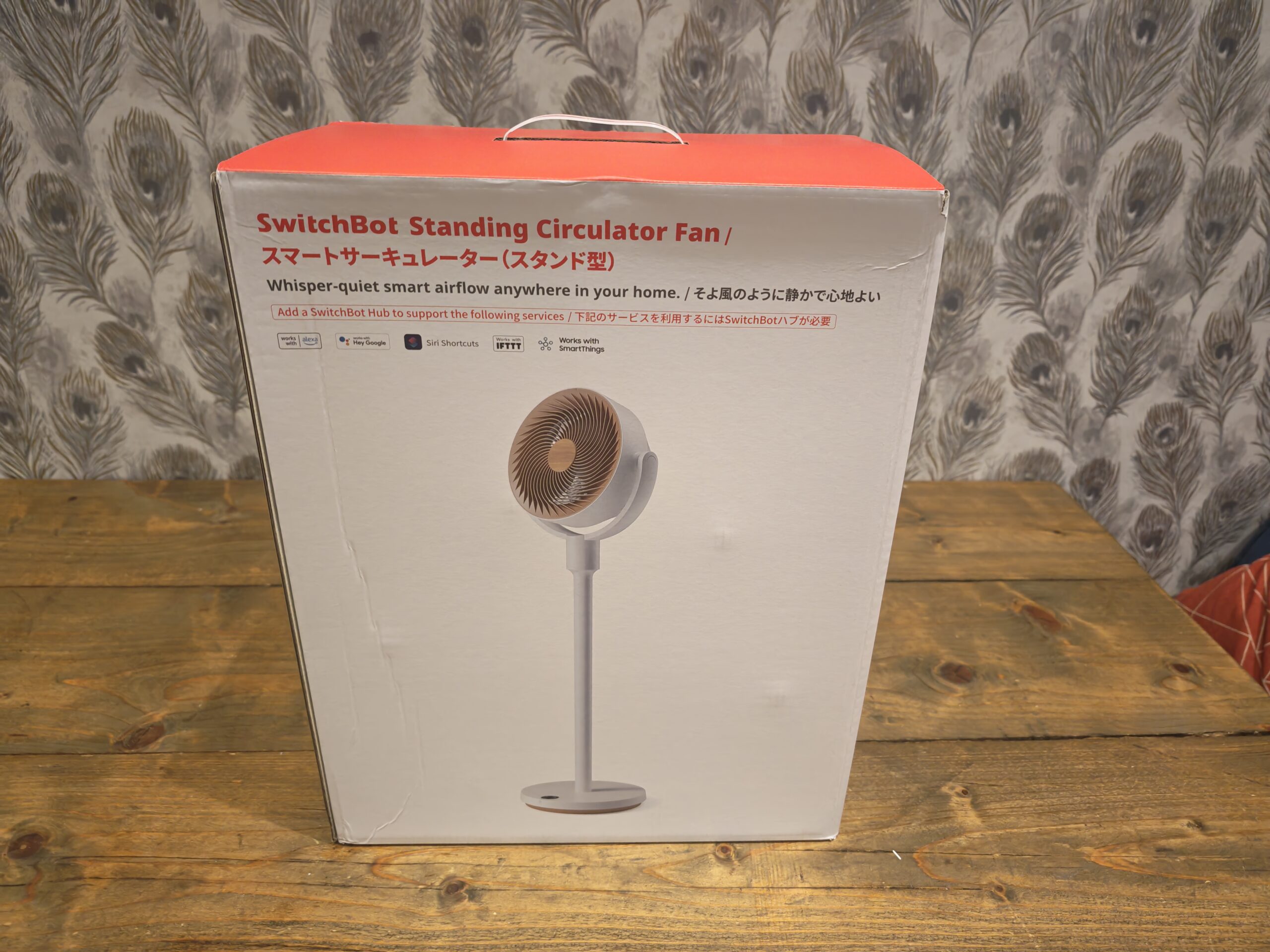
SwitchBot Standing Circulator Fan Review – Smart Pedestal Fan
SwitchBot has been steadily expanding its smart home product range, and the Standing Circulator Fan is the company’s latest attempt to bring proper automation capabilities to a category that has traditionally been fairly dumb. The fan offers Bluetooth connectivity, app control, Matter support via a compatible SwitchBot hub, a built-in rechargeable battery, and a modular design that lets it work as both a desk fan and a pedestal fan. At an RRP of £99.99, it is positioned squarely in the mid-range of the smart fan market.
The core appeal here is flexibility. Most smart fans on the market are fixed mains-powered units, so the ability to detach the poles and move it around without hunting for a socket is a genuine practical advantage. Add in the SwitchBot ecosystem integrations and the potential for temperature-triggered automations, and there is a reasonable case for paying the premium over a standard pedestal fan.
That said, anyone buying this primarily as a bedroom fan for light sleepers may want to temper their expectations. I have spent time reviewing fans from this angle specifically, and the noise floor here is not quite low enough for particularly sensitive sleepers. For office use, living rooms, or households that do not require near-silence, it is a different story.
Related Reviews
- MeacoFan Sefte 8″ Portable Fan Review
- Dreo Falcon S Air Circulator Smart Fan Review
- MeacoFan 1056P Pedestal Fan Review
- Dyson Pure Cool Tower Fan Review
- Devola Low Noise DC 12” Air Circulator Pedestal Fan Review
- GeoSmartPro AirGo Smart Fan Review
Specification
| Specification | SwitchBot Standing Circulator Fan |
| Dimensions | 335 x 290 x 1000 mm |
| Height Settings | 47.3 cm (desk) / 73.6 cm / 100 cm |
| Weight | 3450 g |
| Materials | ABS plastic |
| Noise Level | 22 dB (Baby mode) / 28 dB (Speed 1%) / 44 dB (Speed 100%) |
| Wind Spread Distance | 27 m |
| Airflow Performance | Up to 6.1 m/s wind speed |
| Oscillation (Vertical) | 10 to 90 degrees |
| Oscillation (Horizontal) | -45 to +45 degrees (90 degrees total) |
| Battery | 2400 mAh rechargeable, USB-C (5 V) |
| Battery Life | 28 hrs (Baby mode) / 13 hrs (Sleep mode) / 12 hrs (Natural mode) |
| AC Input | 100-240 V |
| Power Connector | 2-pin figure-8 AC connector |
| Connectivity | Bluetooth Low Energy (BLE) |
| Bluetooth Range | Approx. 100 m |
| Control Modes | Manual buttons, infrared remote control, SwitchBot app |
| Warranty | 2 years |
Design and Assembly
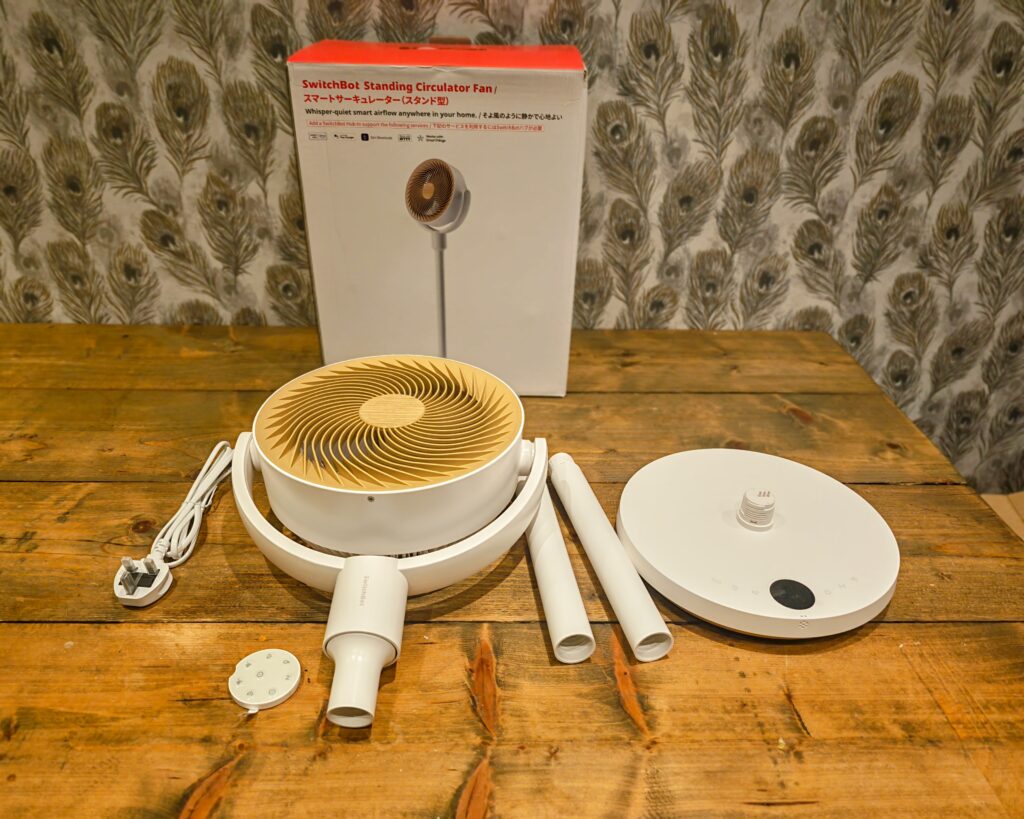
The fan arrives in a compact box containing the base, two extension poles, and the fan head itself. Assembly is straightforward – you screw the poles onto the base and attach the fan head to the poles. It takes a couple of minutes at most. The modular design means you can run it at three heights: 47.3 cm without the poles as a desk fan, 73.6 cm with one pole section, and the full 100 cm pedestal configuration.
Build quality is adequate. The overall construction is quite plastic in feel, which is not surprising given the ABS material and the £99.99 price point. What matters is that it feels sturdy in use – there are no rattles, no creaks, and no annoying vibrations at any speed setting. The fan head has a natural wood-look centre cap which does give it a more considered aesthetic than the typical all-white plastic fan, and it sits reasonably well in a modern living room or home office.
Controls are available in three ways: the SwitchBot app, an included infrared remote control, and physical buttons on the base of the unit. The remote is a nice touch and means you do not need your phone to hand for basic adjustments. The buttons on the base are intuitive enough, covering power, speed, oscillation, and mode selection.
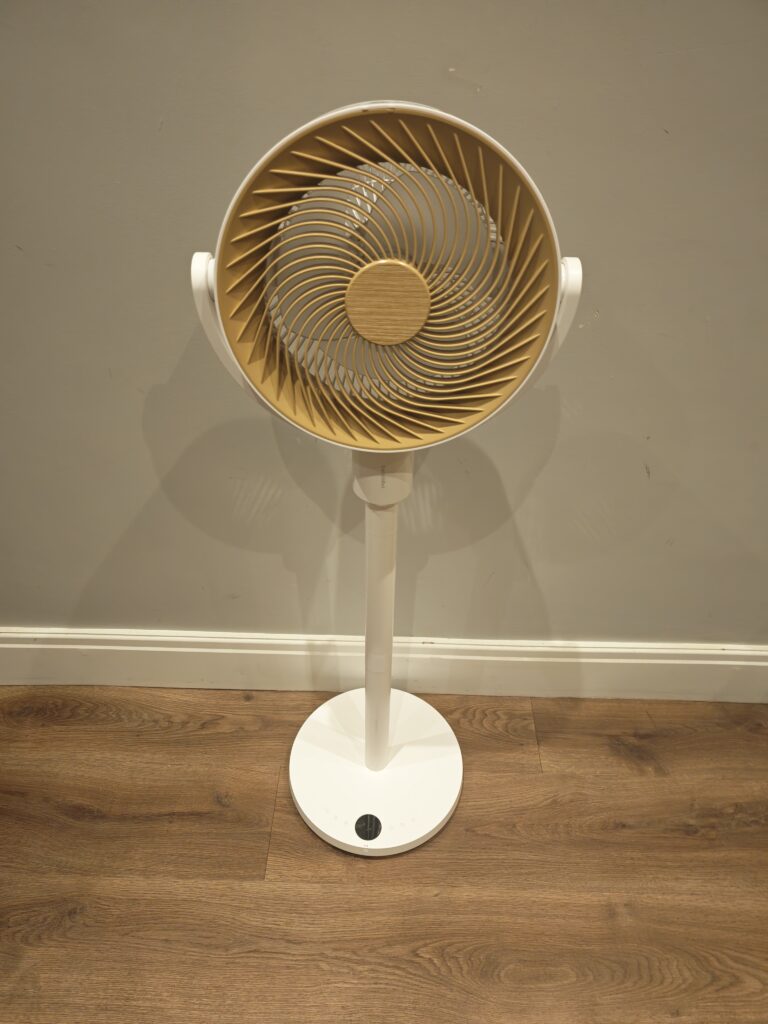
One minor design note – the fan head is quite compact relative to a traditional pedestal fan. The smaller blade diameter means the blades spin faster to achieve the same airflow, which has implications for noise that I will cover in its own section.
SwitchBot App
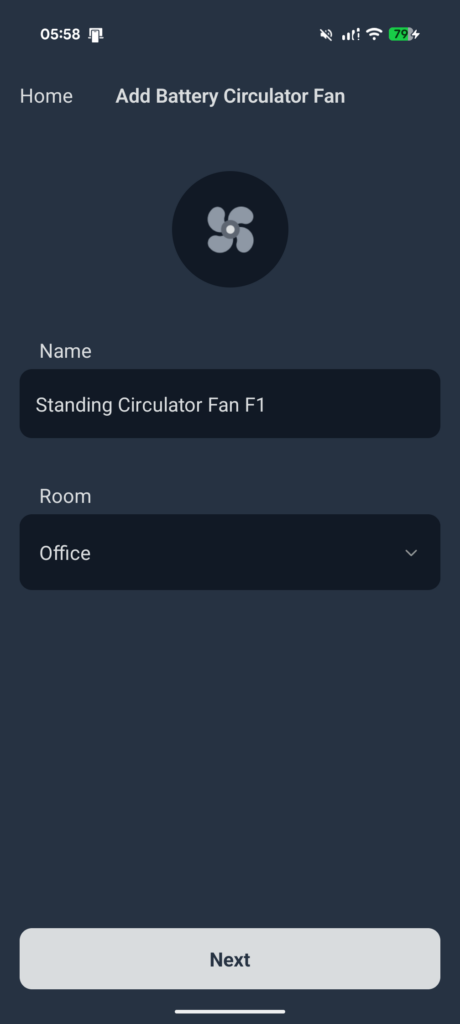


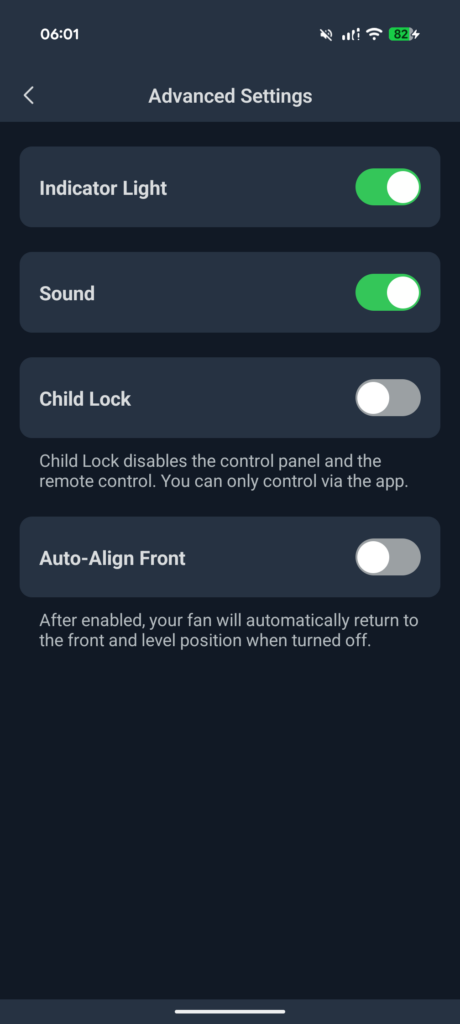
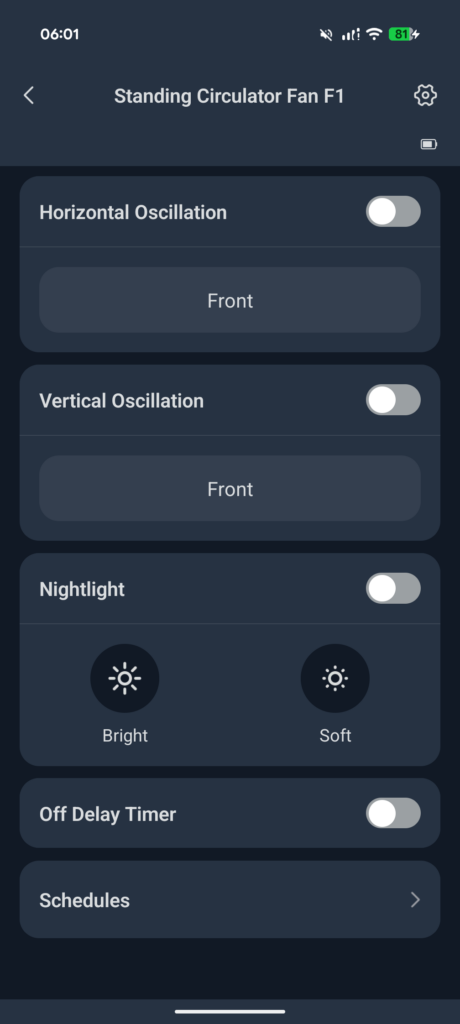
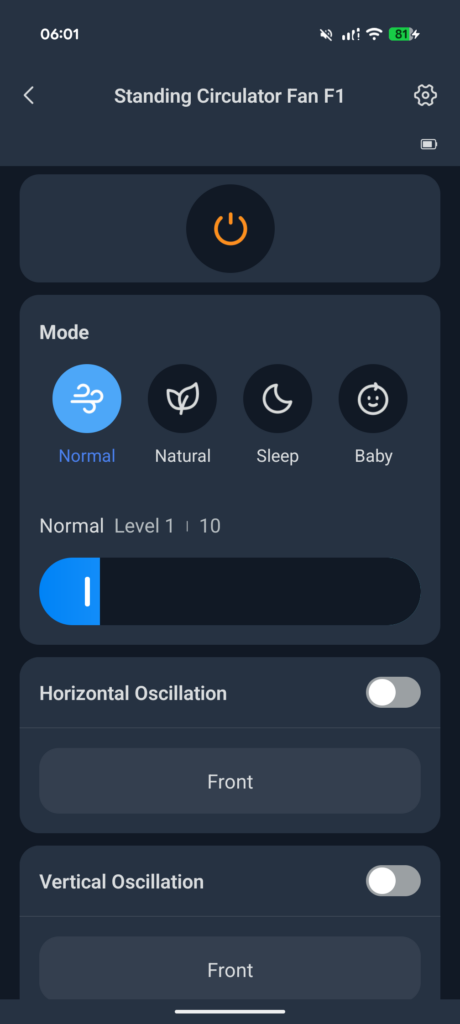
Setting the fan up through the SwitchBot app was slightly awkward initially. When adding a new device, the fan needs to be selected as ‘Circulator Fan’ rather than ‘Smart Fan’ – a distinction that is not immediately obvious, particularly because the thumbnail image in the app at the time of testing more closely resembled the older desk fan model. Once you select the correct device type, the pairing process itself is quick and straightforward.
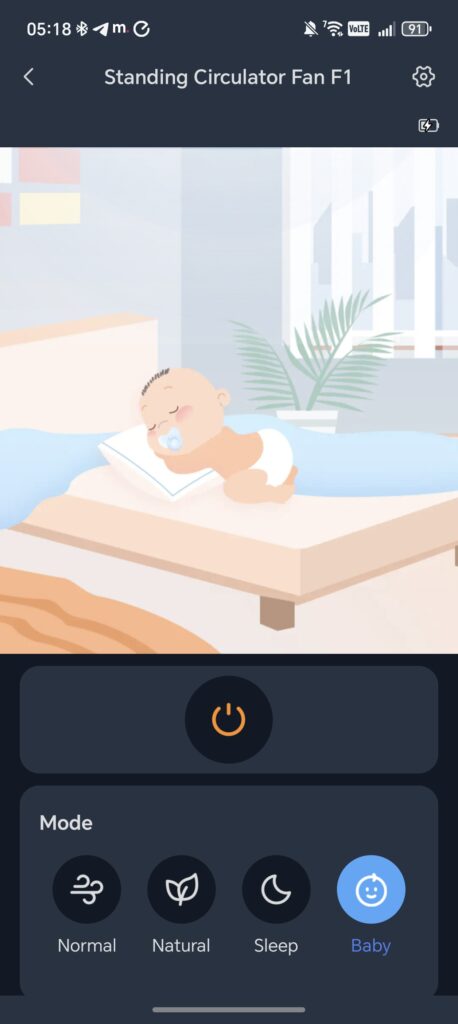
The app controls are functional without being particularly sophisticated. You get speed adjustment from 1 to 100 per cent (compared to the nine discrete physical steps), four operating modes – Normal, Natural, Sleep, and Baby – plus independent controls for horizontal and vertical oscillation. There is also a night light toggle with two brightness levels, an off-delay timer, and scheduling functionality.
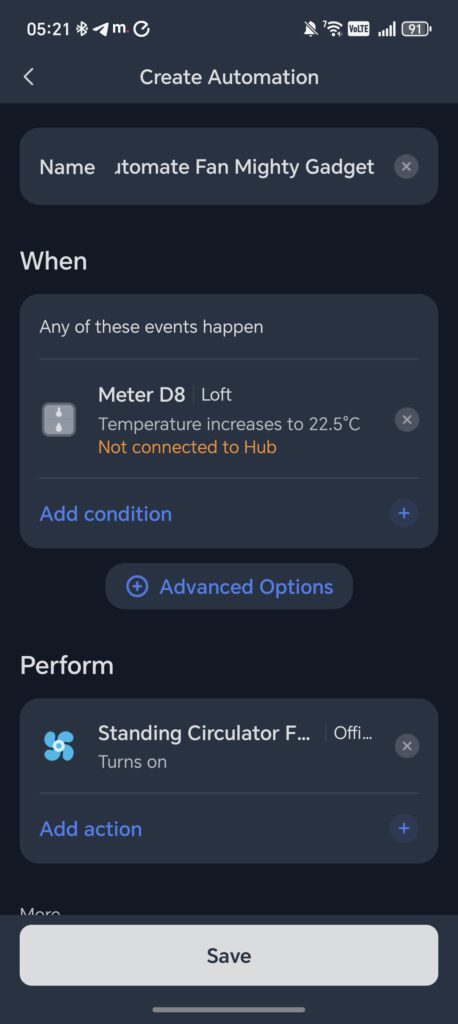
One feature that is absent, and which would have been a useful addition, is a built-in temperature sensor. A sensor would allow the fan to trigger automatically based on ambient conditions without needing any additional hardware. As it stands, you can achieve this, but you need to pair the fan with a separate SwitchBot temperature and humidity sensor and build an automation in the app. For existing SwitchBot users who already own compatible sensors, this is straightforward enough. For someone buying this as a standalone product, it requires an additional purchase.
The automation options within the SwitchBot app are reasonably capable for those already invested in the ecosystem. You can set the fan to activate when a paired sensor reports a temperature above a certain threshold, link it to routines, or trigger it based on schedules. For users with a broader SwitchBot setup, this works well in practice.
Home Assistant and Third-Party Apps
To use this fan with Home Assistant or other third-party platforms, you need to pair it with a SwitchBot hub. I tested this using a SwitchBot Hub 3. The fan does support Matter when paired with a Matter-enabled SwitchBot hub, which in theory should make integration with Apple Home and Home Assistant more straightforward.
At the time of writing, however, the integration with Home Assistant was not working correctly. The hub itself appeared in Home Assistant without issue, but the fan was not visible as a controllable device. This is a known limitation with some SwitchBot devices during the early stages of Matter rollout, and it may well be resolved via firmware or software updates by the time this review is widely read. It is worth checking the current status in the Home Assistant SwitchBot integration documentation before purchasing if this matters to your setup.
For those without a hub who want basic voice control, the fan works with Amazon Alexa and Google Assistant via the SwitchBot cloud. This is less useful for automation purposes but covers the common voice control use cases without any additional hardware. Apple Home support requires the Matter-enabled hub.
For users like me who have a more involved Home Assistant setup, the promise of automation here is significant – being able to trigger the fan via an Aqara presence sensor in the office, for example, or based on a temperature reading from another room. The implementation just needs to catch up with the marketing claims.
Fan Performance
The fan itself performs well. Nine physical speed steps are available via the remote and base buttons, and the app extends this to a full 1 to 100 per cent continuous range, which gives considerably more granularity than most fans at this price. In practice, the difference between adjacent percentage points at the lower end is minimal, but having the fine control available is useful when you want a very specific airflow level.
The four modes offer different airflow patterns. Normal mode runs at a steady set speed. Natural mode varies the speed in a wave-like pattern to simulate a more organic outdoor breeze. Sleep mode runs at a low, consistent speed suited to overnight use. Baby mode drops to the lowest speed and noise level for use around infants or very light sleepers.
The 3D oscillation is a practical feature. Horizontal sweep covers 90 degrees, and the head tilts vertically across 100 degrees, which means you can direct airflow at ceiling level to push warm air down in winter, or angle it across a room at any height. SwitchBot claims it can fully circulate a bedroom in around three minutes at higher speeds, and the 6.1 m/s maximum wind speed and 27 m throw distance are consistent with what I measured in a standard-sized room.
In day-to-day office use at lower speeds, the fan does its job competently. It moves enough air to keep a room feeling fresh without being intrusive. At higher speeds, airflow is genuinely strong for a fan of this size. The DC brushless motor is noticeably more efficient than traditional AC motors, and SwitchBot quotes a 31.4 per cent reduction in energy consumption compared to conventional AC pedestal fans.
Fan Noise
I have been reviewing fans for a while, primarily because I was searching for something quiet enough to run in the bedroom overnight. I sleep extremely lightly and am sensitive to any inconsistent hum or high-pitched tone, so noise is something I assess fairly critically.
The SwitchBot Standing Circulator Fan is not quiet enough for me personally to use while sleeping. The relatively small fan head means the blades have to spin faster than a traditional large-blade pedestal fan to achieve the same airflow, and this comes through in the noise floor. SwitchBot’s official figures, tested at one metre, are:
- Baby mode: 22 dB
- Speed 1 per cent: 28 dB
- Speed 100 per cent: 44 dB
These figures align with my experience. Baby mode at 22 dB is impressively quiet in absolute terms – genuinely approaching whisper level – but 28 dB at the lowest standard speed is still audible enough to disturb a light sleeper in an otherwise quiet room. For comparison, the Ansio 9-blade 26-speed Pedestal Fan can be run more quietly for the same level of airflow due to its larger blade diameter, and the MeacoFan 1056P Pedestal Fan is also quieter at equivalent speeds. The noise level is similar to the battery-powered MeacoFan Sefte 8-inch Portable Fan, which costs £80.
For people who are not particularly sensitive to fan noise – which, to be fair, is most people – this is a non-issue. The Baby mode figure of 22 dB is low enough that many users would have no difficulty sleeping with it running. For office use or living room circulation, the noise level at any setting below about 60 per cent is entirely unobtrusive.
The character of the noise is also worth mentioning. There are no buzzing, rattling, or inconsistent tonal qualities – just the clean sound of moving air. That makes it easier to tune out than fans with an electrical hum or vibration component.
Battery Life
The built-in 2400 mAh battery is one of the features that differentiates this fan from most of the competition. SwitchBot’s quoted runtime figures are 28 hours in Baby mode, 13 hours in Sleep mode, and 12 hours in Natural mode. These figures are broadly plausible given the low power draw at lower speeds.
The fan is charged via either the USB-C port or the DC C7 figure-8 mains connector. Worth noting: the USB-C port does not support fast charging, so topping up from empty is not a quick process. The mains connector is the more practical option for regular recharging at home.
I tested power draw by running the fan from a Ugreen power bank and monitoring consumption at different speeds:
- Speed 1: 3 to 4 W
- Speed 5: 5 to 6 W
- Speed 9: 8 to 9 W
These are low figures, and the USB-C compatibility means you can extend runtime with a standard power bank if you are taking the fan somewhere without a socket. For use in a garden, on a patio, or in a room where running a cable would be awkward, this is a genuine advantage over mains-only competitors.
It is also worth pointing out that the battery does not need to be depleted before using the mains. You can run the fan plugged in continuously, effectively using the battery as a backup, or charge it fully and use it cordlessly as needed. This makes it practical as both a permanent office desk fan and a portable unit.
Price and Alternative Options
The SwitchBot Standing Circulator Fan has an RRP of £99.99. Given that the battery and smart features are a significant part of what you are paying for, this is a reasonable price – though it does mean you are accepting some trade-offs in raw fan performance compared to what a £100 mains-only fan could offer.
Dreo is the most frequently cited alternative for smart fans. From experience, Dreo fans tend to offer stronger airflow and lower noise at equivalent speeds, but their smart features are less developed, especially for automation and third-party integration. If app control via Alexa and Google Home is all you need, a Dreo may offer better core fan performance at a similar price. If you want proper automation or Home Assistant integration, the SwitchBot ecosystem advantage is meaningful – once the integration works reliably.
The TurboPolyFan 508S with 7-inch blades is available for around £119, with a claimed noise level of 20 dB. The larger 513S model with 9-inch blades costs £135. Interestingly, the 513S has a higher quoted noise level of 25 dB, which is counterintuitive since larger blades typically allow quieter operation for the same airflow. Neither of these has a battery or smart home integration beyond basic app control.
Pro Breeze offers the AirFlo 43-inch pedestal fan with app control for around £100. Like Dreo, the smart functionality is limited to app control, Google Home, and Alexa, without the deeper automation capabilities of the SwitchBot platform.
The MeacoFan Sefte 8-inch Portable Fan, which I reviewed previously, is battery-powered and available for £80. It lacks an app and is a desktop-only unit, but it is cheaper and very quiet for its size – comparable in noise level to the SwitchBot at low speeds.
If you have no interest in smart features or battery operation, there are mains-only pedestal fans that will outperform this on airflow and noise at the same price. The SwitchBot fan earns its premium specifically from the battery and the ecosystem integration.
Overall
The SwitchBot Standing Circulator Fan is a competent product that does what it sets out to do, with a few caveats worth knowing before you buy.
As a general-purpose fan for office or living room use, it works well. The variable speed range is impressively granular via the app, the 3D oscillation covers a wide area, and the battery gives it a flexibility that most fans at this price cannot match. The design is clean and inoffensive, assembly takes minutes, and the inclusion of a remote control alongside the app is a practical touch.
The SwitchBot ecosystem integration is the key selling point for smart home users. The ability to build automations – triggering the fan based on a temperature sensor reading, linking it to a presence sensor, or setting schedules that respond to time and occupancy – puts this in a different category from the average app-controlled fan. For those already running SwitchBot devices or Home Assistant, the potential here is significant. The Home Assistant integration via Matter was not fully functional at the time of testing, which is worth bearing in mind, but this is likely to improve as the platform matures.
On noise, I would not recommend it as a dedicated bedroom fan for light sleepers. The 28 dB floor at Speed 1 is audible in a quiet room at night, and while the 22 dB Baby mode is impressively low, it may not be sufficient for the most sensitive users. Larger-blade alternatives such as the MeacoFan 1056P will run more quietly at the same airflow levels. For everyone else, the noise is perfectly acceptable.
The absence of a built-in temperature sensor is a minor frustration. Adding one would have allowed straightforward temperature-based automations without requiring additional hardware. As it stands, you need a separate SwitchBot sensor to achieve this, which adds cost for new users.
At £99.99, the price is fair given what the fan includes – battery, smart connectivity, Matter support, and a well-built modular design. You are not getting the cheapest fan, nor the quietest, nor the most powerful; you are getting a versatile, smart-capable unit that fits well into an existing smart home setup. For that specific use case, it represents good value.
SwitchBot Standing Circulator Fan Review
-
Overall - 80%80%
Summary
The SwitchBot Standing Circulator Fan is a versatile and well-considered option that prioritises flexibility and smart home integration over outright performance, making it particularly well suited to office or living room use rather than as a dedicated bedroom fan for light sleepers. The modular design, battery operation, and granular app control give it a level of convenience that most competitors at this price cannot match, while integration with the wider SwitchBot ecosystem adds meaningful automation potential for those already invested. However, the relatively small fan head results in a higher noise floor than larger pedestal alternatives, and the lack of a built-in temperature sensor slightly limits out-of-the-box automation.
Pros
- Battery powered flexibility
- Strong smart home integration
- Wide oscillation coverage
- Granular speed control
- Easy modular design
Cons
- Not ideal for light sleepers
- No built-in temperature sensor
- Plastic build feels basic
- App setup slightly confusing
- Matter support not fully mature

I am James, a UK-based tech enthusiast and the Editor and Owner of Mighty Gadget, which I’ve proudly run since 2007. Passionate about all things technology, my expertise spans from computers and networking to mobile, wearables, and smart home devices.
As a fitness fanatic who loves running and cycling, I also have a keen interest in fitness-related technology, and I take every opportunity to cover this niche on my blog. My diverse interests allow me to bring a unique perspective to tech blogging, merging lifestyle, fitness, and the latest tech trends.
In my academic pursuits, I earned a BSc in Information Systems Design from UCLAN, before advancing my learning with a Master’s Degree in Computing.
I’m proud to share that Vuelio has consistently ranked Mighty Gadget as one of the top technology blogs in the UK. With my dedication to technology and drive to share my insights, I aim to continue providing my readers with engaging and informative content.
I work directly with the companies he reviews products for or their chosen PR agency.
For Social Media, you can find me on:

0 Comments