What happens to excess solar generation when using an EcoFlow Stream Microinverter?
I recently reviewed the EcoFlow Stream Microinverter, an 800W plug-in solar device that converts the output of two solar panels into AC power for your home. I followed that up with a look at whether you can wire panels in series or parallel with the Stream Microinverter, which covered the electrical limits of the two MPPT inputs. This article tackles the next question people keep asking me: what actually happens to the electricity you generate but do not use?
It is a fair question, because the answer changes the economics of a system like this completely. I have seen some people ask the opposite question. They do not have a battery, they have no export agreement, and they want to stop their system feeding the grid at all. I will cover both, along with the paperwork side, including the G98 notification and whether skipping it can get you into trouble.
Where does the excess actually go?

A grid-tied microinverter like the EcoFlow Stream synchronises its output with the mains and pushes power into your home’s wiring. Your appliances draw from the nearest source first, so generation gets consumed by whatever the house is using at that moment. Anything left over flows out through your electricity meter and into the local distribution network. The grid absorbs a small system like this without any difficulty.
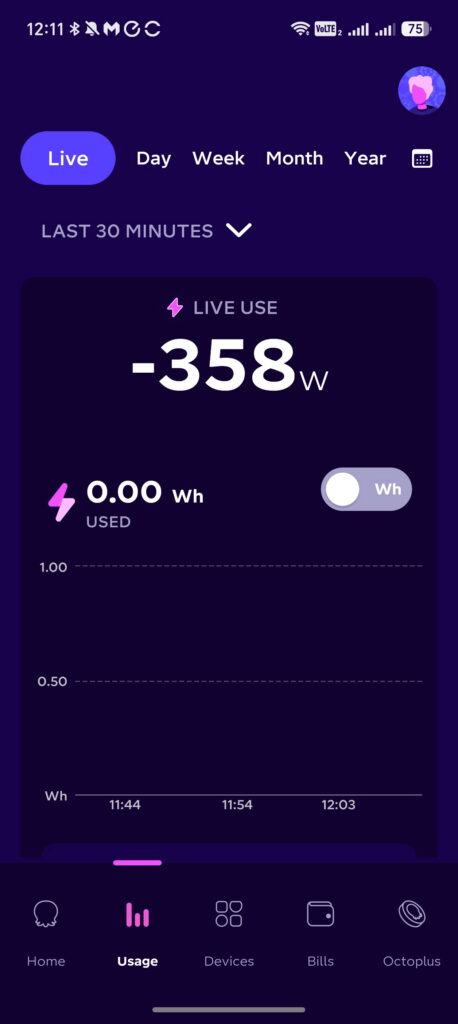
The problem is financial rather than technical. Unless you have an export tariff in place, every unit that leaves your property is given away for free. Your import meter simply stops counting while you export, and nobody credits you for the surplus. I saw this clearly in my own testing. On 10th of July I was generating around 1kwh of electricity with my Octopus Mini showing -322w of usage. The difference came down to how much of the generation overlapped with the house drawing power.
My home is unusually well suited to soaking up plug-in solar, with a base load of around 500W thanks to several mini-PCs, a NAS and CCTV running constantly. On a sunny day, even with my sub-optimal placement, a single EcoFlow microinverter generates me easily 500W+ and I now have two in place.
A home with a 100W base load running the same panels would have exported a large share of that generation for nothing. Realistic self-consumption for a battery-free plug-in system in a typical home tends to sit around 30 to 40 per cent.
Can you get paid for exported electricity?
In principle, yes. The Smart Export Guarantee (SEG) requires all licensed suppliers with 150,000 or more customers to offer a tariff that pays for exported electricity, with rates ranging from around 3p to 15p per kWh depending on the supplier. In practice, a plug-in system will almost never qualify.
To sign up for a SEG tariff, suppliers want your installation carried out by an MCS certified installer using certified products, a smart meter registered to record export, and evidence of your G98 notification, along with an export MPAN. A self-installed plug-in kit fails the first requirement immediately, and certification cannot be granted retrospectively for work that has already been done. So, if you buy a Stream Microinverter and a couple of panels, even with a compliant fused-spur installation by an electrician, you should assume the exported surplus earns you nothing.
Honestly, for an 800W system this barely matters. Even a poorly matched setup exporting half its annual generation might send 300 to 400 kWh to the grid, which at a typical SEG rate of 5p per kWh is worth £15 to £20 a year. The admin involved would not justify the return even if you were eligible. The sensible goal with a system this size is maximising self-consumption, not chasing export payments.
The G98 notification
Whether or not you export, any grid-tied generator in the UK needs to be notified to your Distribution Network Operator, the company that runs the cables in your area. This is the G98 process, an Energy Networks Association engineering recommendation covering generators up to 16A per phase, or 3.68 kW, which comfortably includes every 800W plug-in system.
G98 is a fit-and-inform process rather than an approval gate. You do not need permission in advance. The system is installed and commissioned, and the notification goes to the DNO within 28 days. The form is short, it is free. If a registered electrician wires your microinverter into a dedicated circuit, which remains the only fully compliant installation route in the UK (for the time being) as I covered in my series and parallel wiring article, they may submit the G98 paperwork as part of the job, but it is easy enough to fill out yourself.
The reason the DNO wants to know is grid management. Electricity networks were designed for power flowing one way, and the DNO needs a record of generation in each area to manage voltage and plan capacity. An individual 800W system is trivial, but thousands of unregistered ones in the same postcode area are not.
Does exporting without a G98 get you into trouble?
This is the question people actually want answered, so I will be direct. The notification is a legal requirement, not an optional courtesy, but there is no enforcement squad scanning the network for unregistered microinverters, and I am not aware of anyone being prosecuted over an 800W plug-in system. Nothing usually happens immediately if you skip it.
The problems tend to surface later and indirectly. If the DNO investigates a voltage or fault issue on your street and finds unregistered generation, you will be asked awkward questions. If you make a home insurance claim relating to an electrical fault and the insurer discovers a non-compliant, unregistered generator wired into the property, that gives them an easy reason to dispute the claim. When you sell the house, add a battery, install an EV charger or apply for anything that requires the DNO to check your supply, the missing record causes delays. And if you are still on an old-style spinning-disc meter, exporting can make the meter run backwards, which under-records your consumption and puts you into billing irregularity territory with your supplier. That is a genuine risk worth avoiding.
Given the notification takes about 20 minutes and costs nothing, skipping it is a false economy. Do it properly and the system is on record, which also matters if the promised standardised plug-in route arrives later this year and you want to regularise an existing setup.
How to stop your system exporting at all
Some people want the opposite outcome. Without a battery and without SEG eligibility, exported electricity is pure waste, and some people would rather their system never fed the grid in the first place. There are a few ways to approach this with the Stream Microinverter.
The bluntest tool is the output limit in the EcoFlow app. The grid-tied output setting that caps the unit at 800W for the UK can be lowered further, so if your daytime base load is 300W you can cap output at or below that figure. The downside is obvious. This is a static cap, so on bright days you throw away everything above the limit, and on days when your consumption rises the cap still applies. It prevents most export, but at a real cost in lost generation.
A smarter option is matching consumption to generation. EcoFlow sells smart plugs that integrate with the Stream system, allowing loads to switch on when generation is high. Shifting the dishwasher, washing machine or car charging into daylight hours costs nothing and raises self-consumption meaningfully. In my case, the high base load does this job automatically.
The proper fix is a battery. The Stream Max, Stream Ultra and Stream Ultra X all sit between the panels and your home, absorbing surplus generation and releasing it in the evening. With a battery in the system, EcoFlow’s dynamic control feeds the house what it needs and stores the rest, which gets export close to zero without wasting generation. The catch is cost. At £900 to £1,500 a battery stretches the payback period considerably, and the maths only works if your tariff and usage pattern suit it, something I covered in more depth in my full review.
One thing worth stating clearly: configuring a system for zero export does not remove the G98 requirement. The notification applies to grid-tied generation, not to exported energy, so a capped or battery-buffered system still needs to be on record with your DNO.
Final thoughts
Excess generation from a plug-in system goes to your neighbours via the grid, and unless you have jumped through hoops that a plug-in system almost certainly cannot jump through, you are paid nothing for it. That makes self-consumption the whole game. Homes with a healthy base load, like mine, waste very little. Homes with low daytime usage should either cap the inverter output, shift loads into daylight hours, or budget for a battery.
On the paperwork, submit the G98 notification regardless of how you configure the system. Skipping it will not trigger immediate consequences, but it creates entirely avoidable problems with insurers, house sales and future electrical work, and it costs you nothing to do it right.

I am James, a UK-based tech enthusiast and the Editor and Owner of Mighty Gadget, which I’ve proudly run since 2007. Passionate about all things technology, my expertise spans from computers and networking to mobile, wearables, and smart home devices.
As a fitness fanatic who loves running and cycling, I also have a keen interest in fitness-related technology, and I take every opportunity to cover this niche on my blog. My diverse interests allow me to bring a unique perspective to tech blogging, merging lifestyle, fitness, and the latest tech trends.
In my academic pursuits, I earned a BSc in Information Systems Design from UCLAN, before advancing my learning with a Master’s Degree in Computing.
I’m proud to share that Vuelio has consistently ranked Mighty Gadget as one of the top technology blogs in the UK. With my dedication to technology and drive to share my insights, I aim to continue providing my readers with engaging and informative content.
I work directly with the companies he reviews products for or their chosen PR agency.
For Social Media, you can find me on: