Can You Run Solar Panels in Series or Parallel with the EcoFlow Stream Microinverter?
I recently reviewed the EcoFlow Stream Microinverter, a device that lets you build a small solar array for a balcony, garden wall, shed, or garage without a full rooftop installation. During testing, a natural follow up question came up: can you wire extra panels together, in series or in parallel, to get more out of a single microinverter input? I tested this using JA Solar 460W All Black panels, and the answer comes down to some hard electrical limits that are worth understanding before you try it.
What Is the EcoFlow Stream Microinverter?

- EcoFlow STREAM Microinverter is a highly efficient and secure power conversion device specifically engineered for home energy systems. It directly converts the energy generated by solar parhels into electricity to power your home.
- Smart App Control for Real-Time Monitoring: Take full control with the EcoFlow app, your gateway to real-time solar inverter performance tracking and energy savings insights. Customise your power consumption strategy based on solar generation, monitor electricity savings with an intuitive income calendar, and seamlessly connect to smart plugs for remote energy management—all from the palm of your hand.
- MPPT ALGORITHM: With MPPT (Maximum Power Point Tracking) built in, this inverter optimises solar power generation under varying conditions. It features a nominal MPPT efficiency of 95%, max input of 860, and max output of 800W.
The EcoFlow Stream Microinverter has grown in popularity over the past year or so, as it is one of the few devices on the market built around plug-in solar. It accepts input from two solar panels, one per MPPT (Maximum Power Point Tracking) port, and converts the DC power they produce into AC power that feeds into your home to reduce how much you draw from the grid. Build quality feels solid for the price, with an IP67 rating for outdoor use and a 10 year warranty.
The plug-in part is exactly what it sounds like: in theory, you plug the unit directly into an electrical socket and it feeds power straight into your home through that socket, with no consumer unit wiring required. In practice, the UK does not currently allow that shortcut, so you will need an electrician regardless of how simple the hardware makes the process look. I cover the current legal position in more detail below.
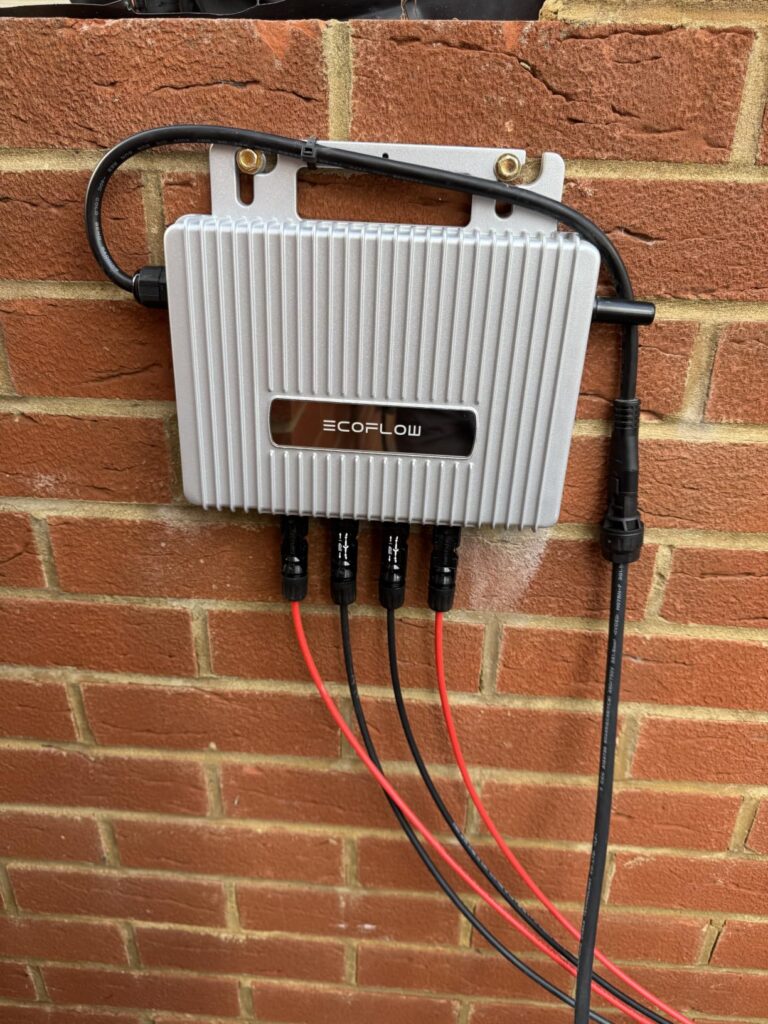
Each MPPT port can accept up to 600 W, for a theoretical maximum DC input of 1200 W across both ports, but the unit’s AC output is capped at 800 W (800 VA) to match UK and European microgeneration limits. That gap between input and output capacity is normal for solar inverters generally, not a design flaw. Panels rarely hit their full rated output at once, given real world angle, temperature, and light conditions, so building in more DC headroom than the AC output strictly needs helps the inverter sit closer to its output ceiling for more of the day, rather than tailing off whenever conditions drift from ideal.
Cost and Payback
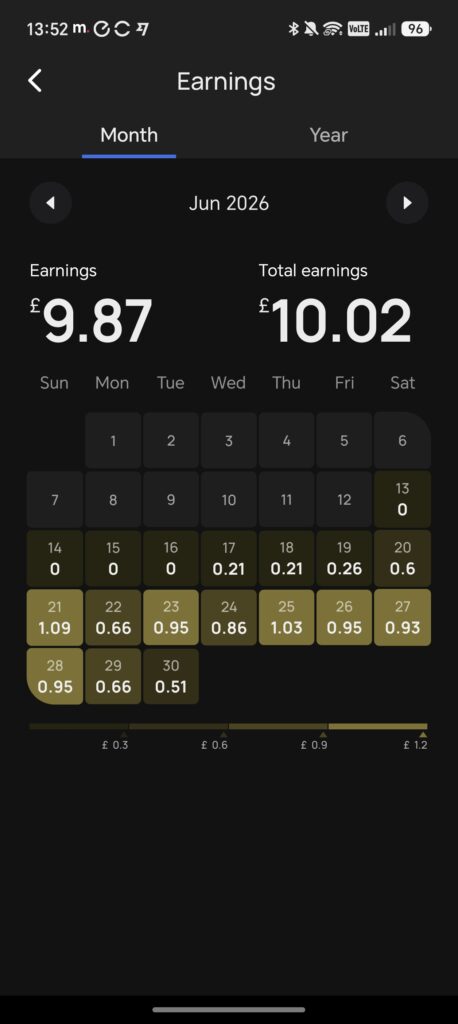
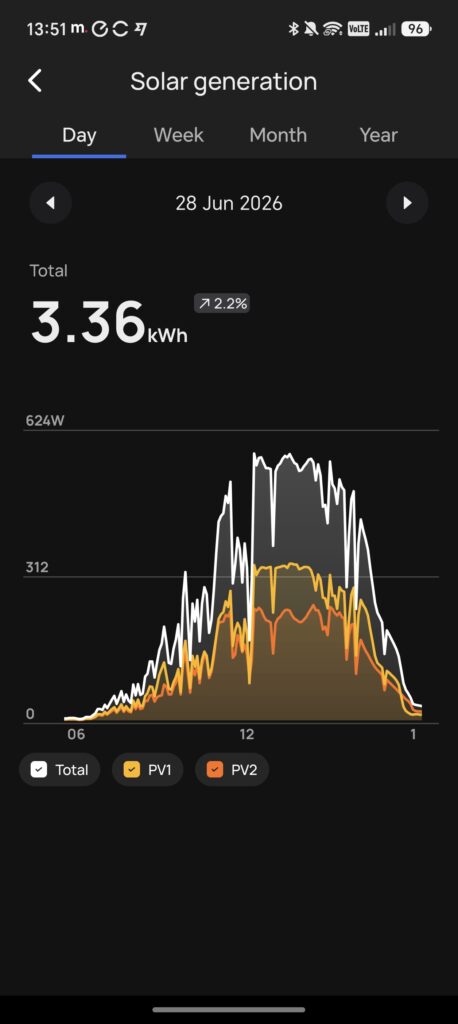
With energy prices under pressure again this year, largely due to the conflict between Israel, the US, and Iran that began in February 2026 and disrupted oil and gas shipping through the Strait of Hormuz, it is easy to see why interest in devices like this has grown. Ofgem’s price cap rose by 13% from 1 July 2026, taking the average annual dual fuel bill to £1862 and the standard electricity unit rate to 26.11p per kWh. A ceasefire agreement was reached in June 2026, though it remains fragile, so it is difficult to say with any confidence where prices go from here.
On paper, a microinverter at around £129 and two 460 W solar panels at around £93 each works out at roughly £315 for the full hardware. The panel price is JA Solar’s current City Plumbing listing for this model, up from about £80 when I first tested this setup, partly a result of panel prices rising generally after China removed its export VAT rebate on solar panels from April 2026.
EcoFlow states that the Stream Microinverter can generate up to 858 kWh annually, with savings of up to £115 per year. That figure is based on German average household consumption and pricing rather than UK figures, so treat it as a reasonable ballpark rather than a personalised estimate. It also assumes you use the power as it is generated, since without a battery or an export payment, anything you produce beyond what your home is using at that moment is exported to the grid for free. Realistic self-consumption for a system like this, without a battery, tends to sit around 30 to 40%, so shifting appliance use towards daylight hours makes a real difference to what you actually save.
Taking the £115 figure at face value, the hardware alone pays for itself in around 2.5 to 3 years, a far shorter payback period than a full roof mounted system. That number only holds if you install it yourself, though, and as the next section explains, that is not currently a legal option in the UK. Add a registered electrician, typically £250 to £450 for a job like this, and the realistic payback period stretches to somewhere between 5 and 7 years. Still a reasonable proposition, but a long way from the headline numbers you will see quoted elsewhere.
Is Plug-In Solar Legal in the UK?
This is the part of the plug-in solar story that has moved on since I first looked at it, and it is worth a proper update.
In March 2026, the government announced its intention to legalise plug-in solar, and on 15 April 2026 the IET published BS 7671 Amendment 4, updating the UK wiring regulations to formally recognise small scale plug-in solar systems for the first time, with a cap of 800 W per home. That part of the process landed roughly on schedule.
What has not landed yet is the part that actually matters for a genuine DIY setup: a British Standards Institution product standard that would certify specific kits for self-installation, meaning you could buy an approved kit and plug it into a normal 13A socket yourself. As of the end of June 2026, that standard is still unpublished. The Department for Energy Security and Net Zero released a draft interim product specification and ran a consultation that closed on 30 June 2026, with a government response expected around 22 July 2026, and the regulations themselves not expected to take effect until some months after that.
So my scepticism about the government dragging its feet on this looks to have been fair. The wiring regulations arrived close to on schedule, but the product standard that would let you legally plug a kit straight into a wall socket is still stuck in consultation as I write this, and realistically will not land until fairly late in the year, if not later.
That means the only fully compliant way to use the EcoFlow Stream Microinverter in the UK right now is to have a registered electrician connect it to a dedicated circuit at your consumer unit, exactly as I described when I first tested it. You should not use the AC lead supplied with the unit to plug it into a wall socket, and you will still need your installer to notify your Distribution Network Operator under the G98 process as part of the job.
EcoFlow Stream Microinverter Specification
| Specification | Details |
| MPPT Channels | 2 |
| Maximum Input Power (Per MPPT) | 600 W |
| Maximum Input Voltage | 65 V DC |
| Start-up Voltage | 20 V |
| MPPT Voltage Range | 16-60 V DC |
| Maximum Input Current (Per MPPT) | 16 A |
| Maximum Short-Circuit Current (Per MPPT) | 16 A |
| Rated AC Output Power | 800 VA |
| Maximum Grid Output Current | 3.48 A |
| Rated AC Voltage | 230 V AC |
| AC Voltage Range | 183-276 V AC |
| Grid Frequency Range | 45-55 Hz / 55-65 Hz |
| Operating Temperature | -40C to 65C |
| Dimensions (W x H x D) | 252 x 180 x 35 mm |
| Weight | 3.2 kg |
| Ingress Protection Rating | IP67 |
| Warranty | 10 years |
JA Solar 460W All Black Solar Panel Specification and Price
The JA Solar 460W All Black panel remains one of the most popular options to pair with the EcoFlow microinverter, largely on price. City Plumbing currently lists it at £92.77 including VAT, up from the £79.54 it was selling for when I first tested this setup, though delivery is still free, which is worth noting since each panel is 1.75m long, 1.1m wide, and around 22kg.
These are not the most efficient panels on the market, but 23% module efficiency from TOPCon N-Type cells is a genuinely good figure at this price point, and the 25 year warranty matches what you would expect from a considerably more expensive panel. For a budget plug-in setup like this one, where the goal is a fast payback rather than squeezing out every last watt, that combination makes sense. If you are comparing degradation curves and efficiency figures against pricier alternatives, that is a different conversation, but for this specific use case the JA Solar panels do the job without asking you to pay for headroom you will not use.
| Specification | Details |
| Brand | JA Solar |
| Model | Deep Blue 4.0 PRO |
| Supplier Part Number | JAM54D41-460/LR |
| Cell Technology | TOPCon N-Type Monofacial |
| Cell Configuration | 108 cells (6 x 18) |
| Maximum Power (Pmax) | 460 W |
| Module Efficiency | 23% |
| Voltage at Maximum Power (Vmp) | 33.68 V |
| Current at Maximum Power (Imp) | 13.66 A |
| Open Circuit Voltage (Voc) | 40.60 V |
| Short Circuit Current (Isc) | 14.43 A |
| Dimensions (L x W x D) | 1762 x 1134 x 30 mm |
| Frame Material | Aluminium |
| Colour | Full Black |
| Connector Compatibility | MC4 EVO2A |
| Maximum Installation Altitude | 5000 m above sea level |
| Warranty | 25 years |
| Standards | MCS, IEC 61215, IEC 61730, IEC 62941 |
Can You Wire the JA Solar 460W Panels in Series or Parallel with the EcoFlow Microinverter?
During testing, I wanted to see if I could combine more than one panel per MPPT input to get more out of the two ports available. I have four JA Solar 460W panels in total but only one microinverter, and my longer term plan is to wire all four into a Solis hybrid inverter alongside a Fogstar battery once that installation goes ahead. In the meantime, I wanted to make better use of the panels currently propped up against my garage.
Disclaimer: I am not a qualified electrician, and you should check with someone who is before wiring any of this yourself.
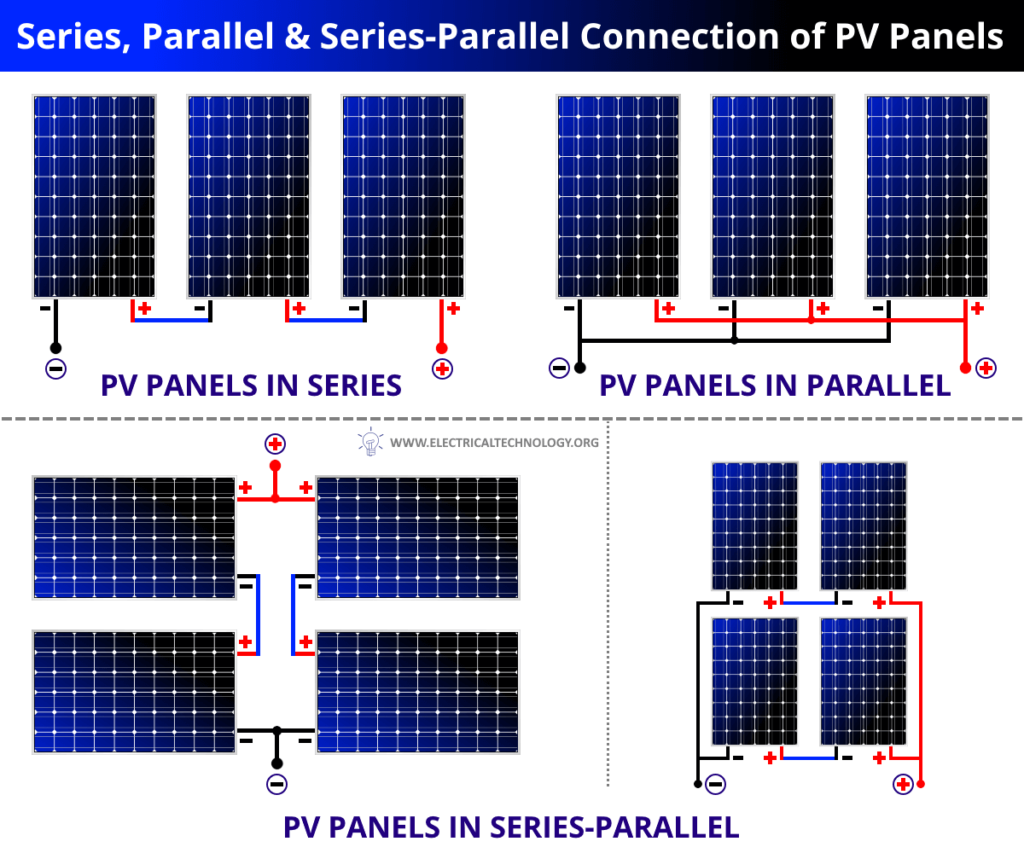
There are two ways to combine panels, and they behave differently.
Wiring panels in parallel adds their current (amperage) together, while voltage stays the same as a single panel. This is useful because a shaded panel does not drag down the output of a panel that is in full sun. If one panel is producing 12A in direct sun and a second, partially shaded panel is producing 4A, wiring them in parallel gives you a combined 16A, with each panel contributing what it can independently.
Wiring panels in series adds their voltage together, while the current through the whole string is limited by whichever panel is producing the least, since current has to be equal at every point in a series circuit. Picture water flowing through a single pipe: pinch the pipe at any one point and you restrict flow through the entire length, not just at that point. A shaded panel in a series string acts as that pinch point, capping the current for every panel in the string, not only the shaded one.
So, can you wire two JA Solar 460W panels into a single MPPT input on the EcoFlow Stream Microinverter?
In theory, yes. In practice, you should not, at least not with panels this powerful.
Series wiring is the clearer problem. Each JA Solar 460W panel has an open circuit voltage (Voc) of 40.6V. Two in series would give you 81.2V, well over the EcoFlow’s 65V maximum input voltage. Open circuit voltage also rises in cold weather, so on a cold, bright UK morning the real figure would likely run higher still, not lower. There is no safe way to fit two of these panels in series onto one port.
Parallel wiring fares better on voltage, since two panels in parallel still sit at 40.6V, comfortably within the 16 to 60V MPPT range and the 65V maximum. Current is the problem here instead. Each panel has a short circuit current (Isc) of 14.43A, so two in parallel could theoretically reach 28.86A, close to double the EcoFlow’s 16A limit per port. Even using the more realistic current at maximum power (Imp) of 13.66A per panel, two in parallel could still hit 27.32A, still well over the limit.
If one panel were reliably shaded, for example by mounting one facing east and one facing west rather than both facing south, you might keep the combined current below 16A in practice. That means designing a system that only stays within spec because of how much shade it gets, though, rather than one that is within spec by design. I would not want to rely on that for something wired into my house.
My recommendation, at least with panels of this size, is not to combine more than one JA Solar 460W panel per MPPT port. If you are using lower powered panels with a meaningfully lower Isc and Voc, doubling up might stay within the EcoFlow’s limits, but check the numbers for your specific panel first. Do not assume it will be fine just because it worked for someone else’s setup.

I am James, a UK-based tech enthusiast and the Editor and Owner of Mighty Gadget, which I’ve proudly run since 2007. Passionate about all things technology, my expertise spans from computers and networking to mobile, wearables, and smart home devices.
As a fitness fanatic who loves running and cycling, I also have a keen interest in fitness-related technology, and I take every opportunity to cover this niche on my blog. My diverse interests allow me to bring a unique perspective to tech blogging, merging lifestyle, fitness, and the latest tech trends.
In my academic pursuits, I earned a BSc in Information Systems Design from UCLAN, before advancing my learning with a Master’s Degree in Computing.
I’m proud to share that Vuelio has consistently ranked Mighty Gadget as one of the top technology blogs in the UK. With my dedication to technology and drive to share my insights, I aim to continue providing my readers with engaging and informative content.
I work directly with the companies he reviews products for or their chosen PR agency.
For Social Media, you can find me on: