Willow Smart Plant Sensor Review – Interactive Plant Monitor
Neither my partner nor I has green thumbs, and my partner kills every plant she buys, so I was intrigued to test the Willow Smart Plant Sensor to see if it can help fix our neglectful attitude towards plants.
Willow isn’t like most other smart sensors for plants, it doesn’t just monitor the soil but will also monitor light, humidity and temperature and can customise the guidance based on the specific plant.
Specification
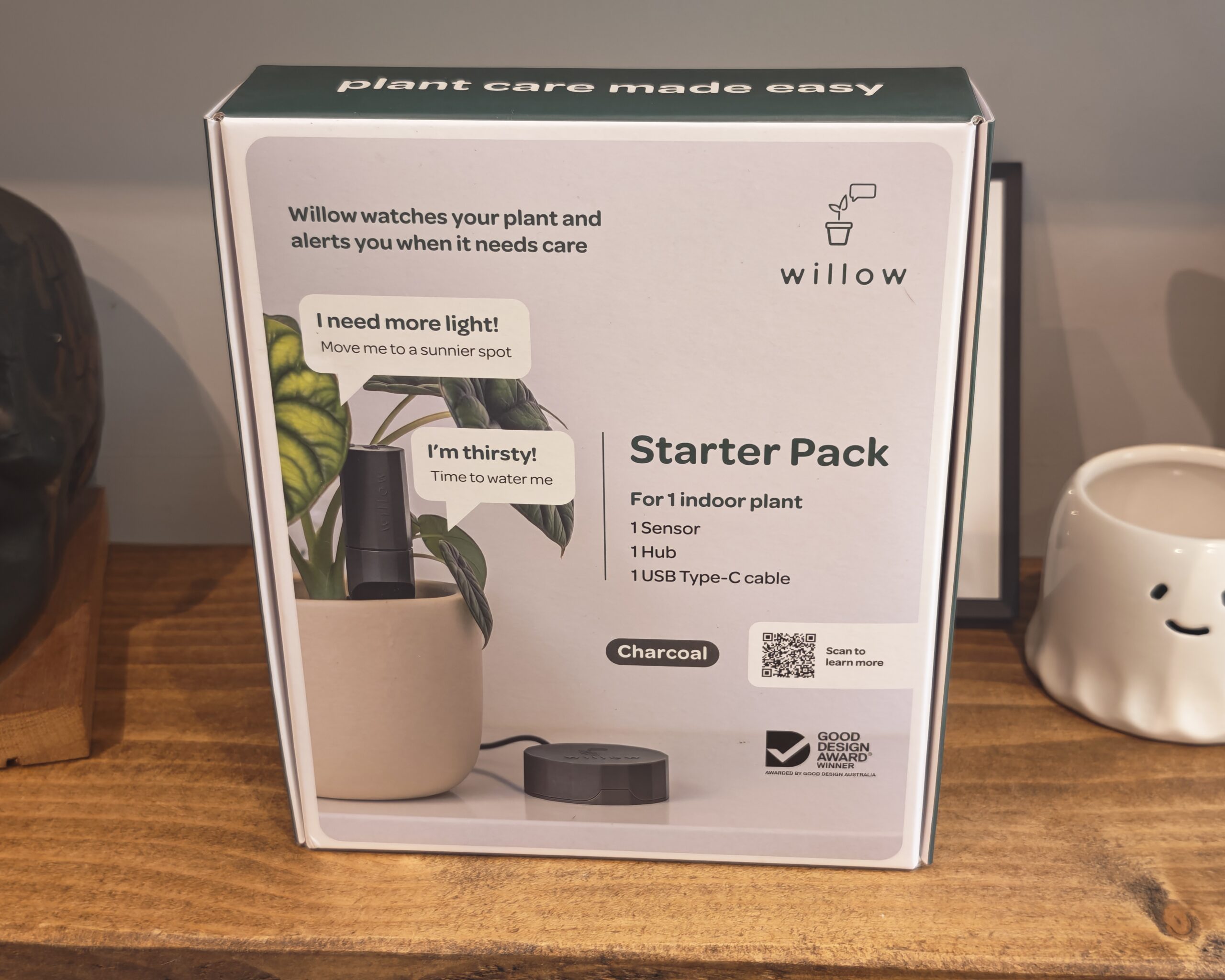
Before getting into how Willow performs day to day, here is a rundown of what is actually in the box and what the sensor itself is capable of. The Starter Pack I tested includes one Sensor, one Wi-Fi Hub and a USB-C cable, finished in a charcoal colourway (a lighter moss green option is also available).
- Sensor size: 172mm length x 32mm diameter, with a 124mm probe suitable for pots up to 20cm deep. A Large Pot Extension is sold separately for deeper containers
- Hub size: 74mm x 26mm
- Battery: replaceable CR2477 coin cell, fitted inside the sensor from the factory
- Connectivity: Bluetooth 5.2 between the Sensor and Hub, with a range of around 20 metres, and 2.4GHz Wi-Fi between the Hub and your router
- Sensors per hub: up to 40
- Weatherproofing: IP54 rated, so it is dust and splash resistant rather than fully waterproof
- Measurement range: light 0 to 100,000 lux, temperature 0°C to 55°C, humidity 0 to 100%, soil moisture 0 to 90%
- App requirements: Android 5.0 or later, iOS 13 or later
- Warranty: 1 year from date of purchase
- Price: £34.99 for the Starter Pack (1 sensor, 1 hub)
For context, the sensor takes a fresh reading roughly every 15 minutes, which is frequent enough to catch a plant drying out without draining the coin cell too quickly.
Features – What does Willow do?
At its core, Willow is trying to solve a fairly simple problem: most of us have no real idea what is happening inside a plant pot. You can look at a leaf and guess, but by the time a plant visibly droops, the damage is often already done. Willow’s sensor sits in the soil and quietly measures four things: soil moisture, ambient light, temperature and humidity. That data is sent via Bluetooth to the Hub, which relays it to Willow’s servers over your home Wi-Fi.
The clever part is not the sensing itself, most soil moisture probes can manage that, it is what Willow does with the data. Once you have identified your plant species in the app, either by typing the name or using the photo scanner, Willow compares your readings against what that specific species needs and produces a Plant Happiness Score, updated regularly through the day. If your plant is drying out, sitting in low light, or the room has drifted outside its comfortable temperature range, you get a notification rather than having to open the app and check manually.
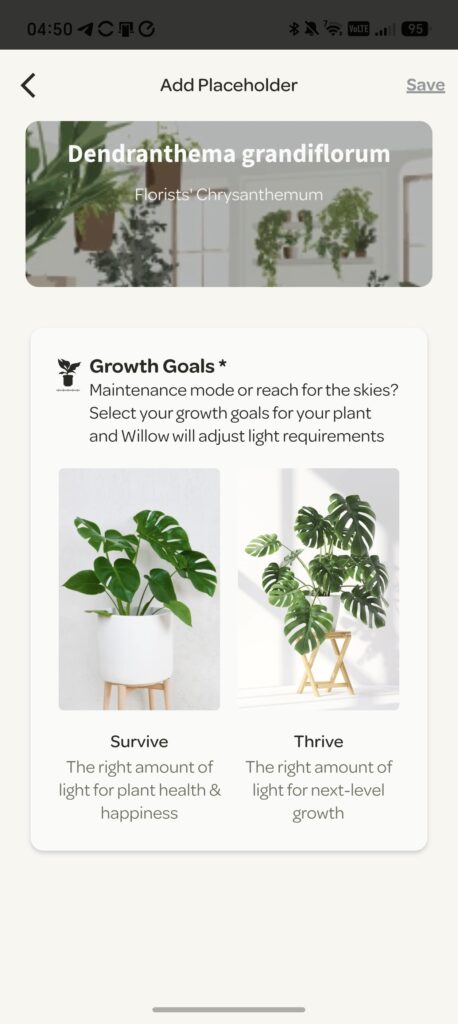
You can also set a Growth Goal for each plant, choosing between Survive, the minimum light and water needed for general health, and Thrive, higher targets aimed at more vigorous growth. Willow adjusts its light and watering thresholds depending on which you pick, which is a sensible way of avoiding a one size fits all watering schedule for a plant on a dim hallway shelf versus one sitting on a bright windowsill.
Beyond the sensor readings, the app also includes a plant care library, a fertiliser schedule, an event log for tracking things like repotting or pruning, and a photo based Plant ID scanner. Some of these features are free, others sit behind Willow’s optional Grow subscription, which is worth understanding before you buy.
Optional Subscription
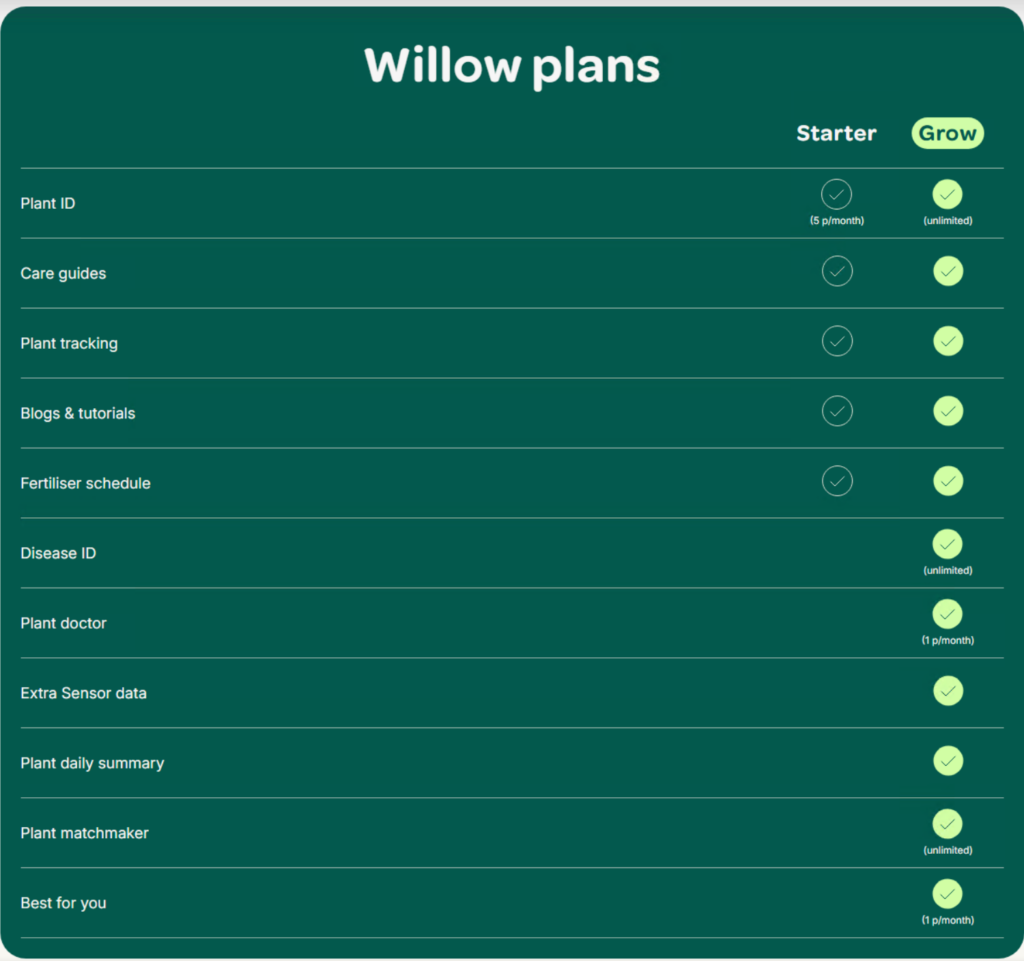
Sadly, Willow follows almost every other brand by introducing subscription features. Thankfully this is optional but does limit the features.
The free Starter plan is not as stripped back as most competitors’ free tiers. You get care guides, plant tracking, the blogs and tutorials library, and a fertiliser schedule at no cost, with only Plant ID capped at 5 scans a month. For anyone with a handful of houseplants and no interest in disease diagnosis, Starter on its own is a genuinely usable product, which is more than I can say for some subscription-gated smart home apps I’ve tested.
Willow Grow costs £25.99 a year, or £3.29 a month if you’d rather pay monthly. That works out at roughly £2.17 a month on the annual plan.
What Grow actually unlocks:
- Unlimited Plant ID scans, rather than 5 a month
- Disease ID, so you can photograph a struggling plant and get a diagnosis
- Plant Doctor, a monthly consultation with a horticulturist
- Extra sensor data, presumably the full 30-day history rather than a snapshot
- Plant daily summary
- Plant matchmaker, unlimited plant recommendation quizzes
- Best for you, a monthly personalised plant suggestion based on your sensor data
The one that stings is Disease ID. The sensor itself cannot detect pests or disease, and Starter does not include this feature at all, so anyone buying Willow mainly to catch plant problems early will need to pay for Grow. The single consultation and single recommendation per month caps on Plant Doctor and Best for you also feel mean at this price point, particularly if you’re managing several plants and want to ask about more than one of them in the same month.
Overall, the pricing is fair by the standard of plant care apps, but the value of Grow depends heavily on how many plants you own and whether disease diagnosis matters to you. If reminders and a happiness score are all you’re after, Starter genuinely does the job.
Design

Willow’s hardware has clearly been designed to disappear into a plant pot rather than announce itself as a gadget. The sensor is a slim charcoal grey stick, roughly the size of a large marker pen, with a smooth, slightly matte finish and no visible branding beyond a small embossed “willow” logo near the top. The two metal probes are widely spaced and finished in a dulled steel, and there is a printed “MAX SOIL LEVEL” line partway down the shaft, so you know exactly how deep to push it in.
The Hub is a small hexagonal puck, also finished in charcoal, carrying the same embossed leaf and speech bubble logo on the lid. It tucks out of sight easily on a windowsill or shelf, and being USB-C powered means you are not tied to a proprietary charger if the supplied cable goes missing.


Build quality feels solid rather than premium. Twisting the sensor apart to access the battery compartment reveals a simple screw fixing and a small gasket, which lines up with Willow’s IP54 rating: this is a device built to survive the odd splash from a watering can, not to be submerged. For a sensor that is going to live in damp soil for months or years at a time, that level of protection seems about right, though I would still avoid dunking it if you can help it.
Setting up the Willow Hub & Sensor
Setup follows the same pattern as most smart home devices. Download the Willow app, available for Android and iOS, create an account, then plug the Hub into a USB-C power source. A charger is not included in the box, so you will need a spare wall adapter or a free USB port on one you already own.
The app connects to the Hub over Bluetooth first, then asks you to manually enter your Wi-Fi network name and password so the Hub can join your 2.4GHz network. Willow does not scan for nearby networks automatically, you have to type the SSID in yourself, so it is worth double checking for typos, particularly on networks with mixed case or unusual characters.
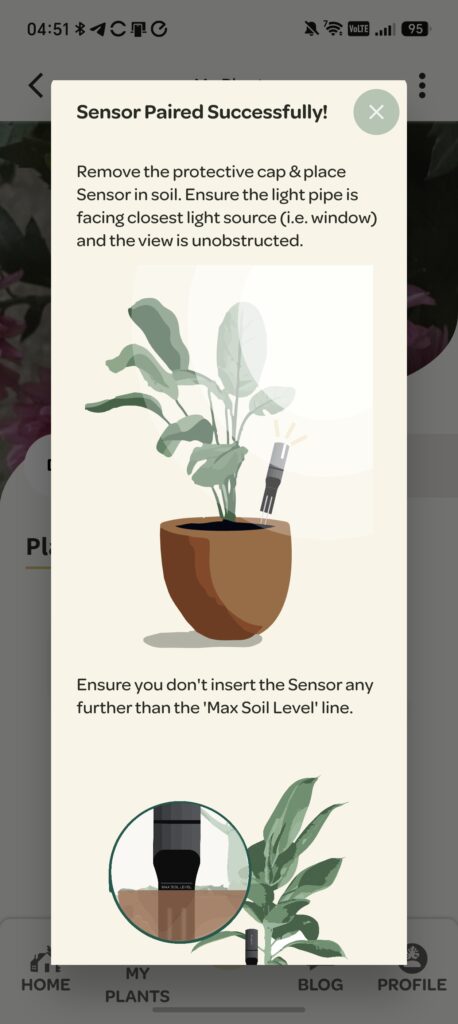
Pairing the sensor is more straightforward. Twist off the base cap, insert the small pin included in the box to activate the battery, and the sensor pairs to the Hub automatically. Once paired, the app displays a short guide reminding you to remove the protective cap from the probe tips, push the sensor into the soil up to the “MAX SOIL LEVEL” marking, and angle the top of the sensor towards the nearest light source, since that is where the light sensor sits.
From opening the box to having a working, paired sensor sitting in soil took me around ten minutes, most of which was spent typing my Wi-Fi password on a phone keyboard. That is a reasonable amount of time for a smart home device, and noticeably quicker than some smart plug or camera setups I have been through in the past.
Adding Plants to Willow
Once the sensor is paired, you need to tell Willow what plant it is actually looking after. There are two routes into this: type the plant name manually, or use the built in photo scanner, which is where things got interesting during my test.
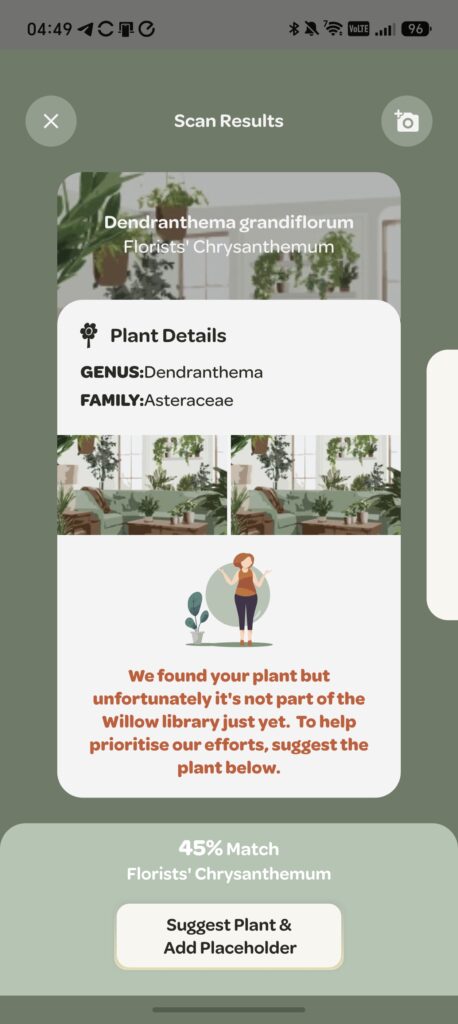
I pointed the camera at a potted chrysanthemum, and Willow returned a match: Dendranthema grandiflorum, the florists’ chrysanthemum, along with the genus and family. The catch was a fairly blunt message underneath, the app had identified the plant correctly but admitted it was “not part of the Willow library just yet”, giving only a 45 percent match confidence and asking me to suggest the plant so it could be added in future. That is a reasonable way of handling a gap in the plant database, and better than pretending to have full care data it does not have, but it does mean the photo ID feature is only as useful as the species list behind it. Mainstream houseplants such as monsteras, spider plants and pothos will fare noticeably better than anything less common.
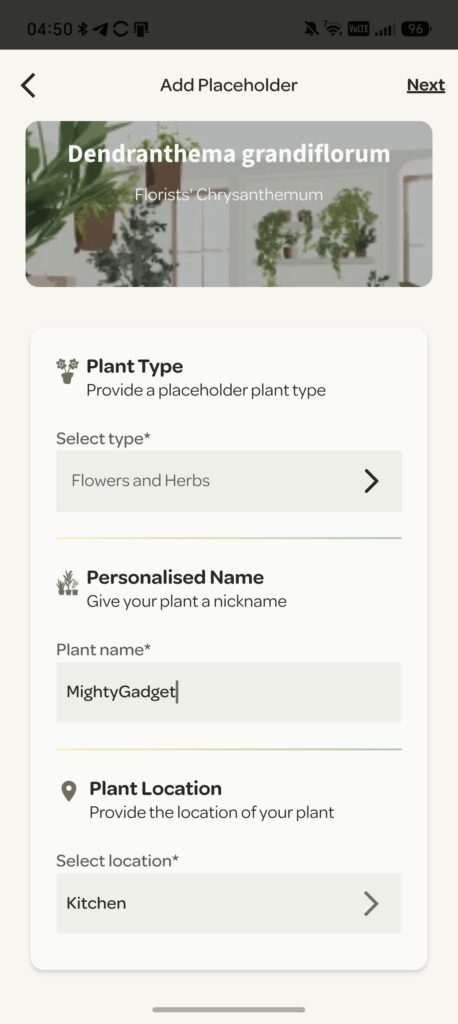
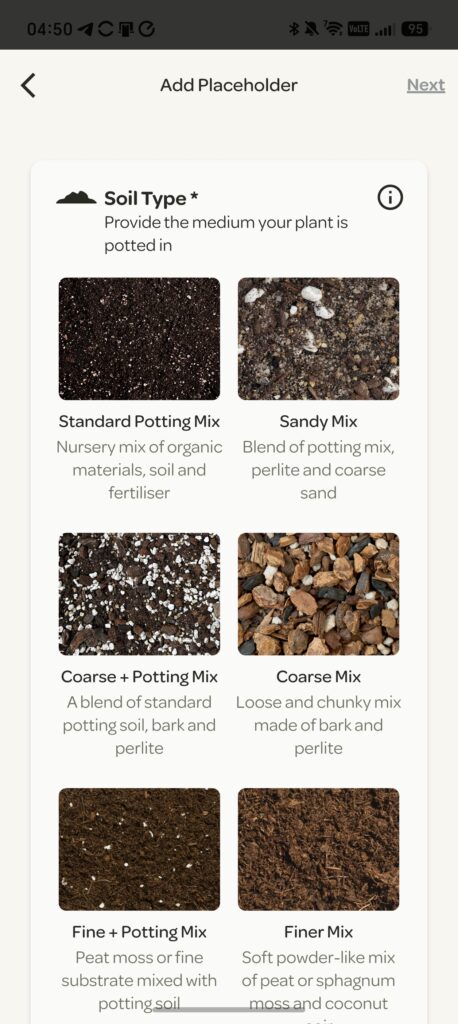
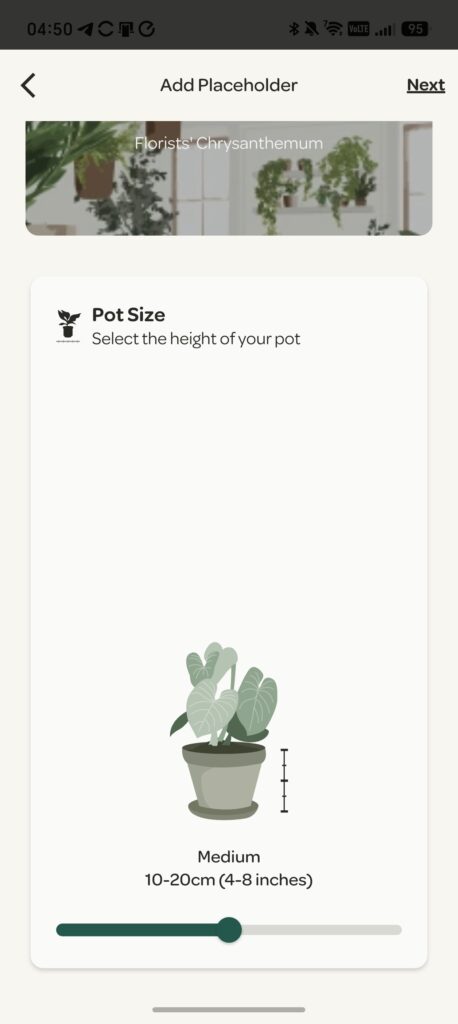
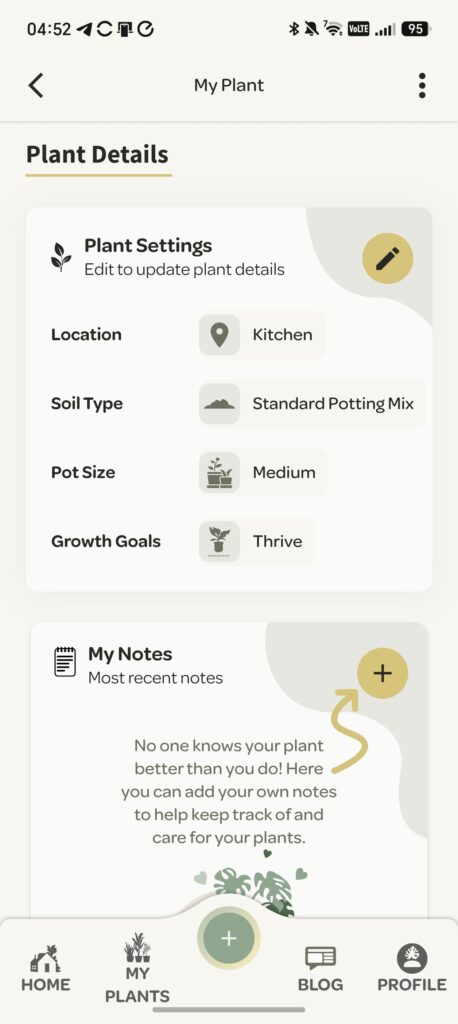
Rather than a dead end, Willow lets you add a placeholder entry using the identified species name and photo, then walks you through a short setup process: naming the plant (I went with “MightyGadget”), choosing its location in the home from a preset list such as kitchen, bedroom or living room, selecting the soil type from six illustrated options ranging from a standard potting mix to a fine, powder like mix suited to orchids and succulents, and picking a pot size band based on height. The final step is choosing a Growth Goal, Survive or Thrive, before the app pairs everything with the sensor reading.
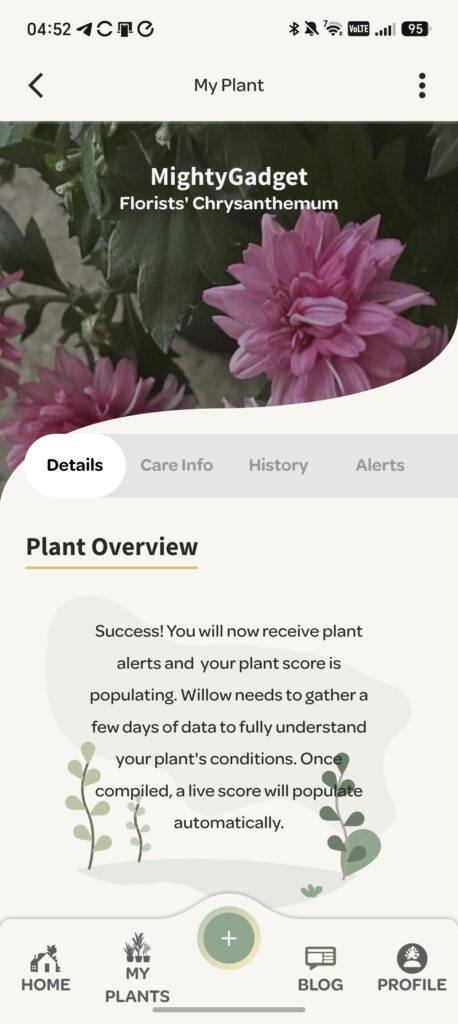
Once saved, the app is upfront about needing a few days of data before a live happiness score appears, rather than guessing from a single reading. That is a sensible approach: a soil moisture reading taken five minutes after setup tells you almost nothing about a plant’s actual watering needs over a week.
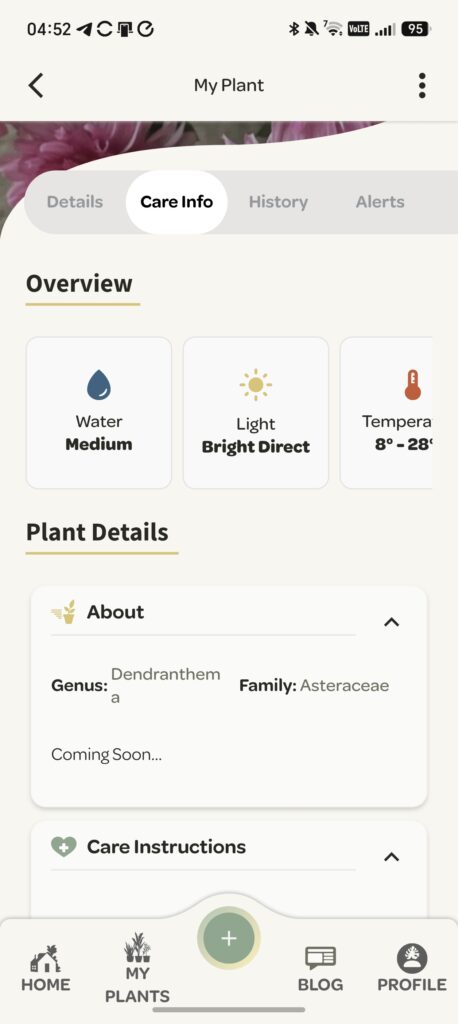
The plant’s profile page is organised into four tabs: Details, Care Info, History and Alerts. Care Info shows target ranges for water, light and temperature, my chrysanthemum wanted medium water, bright direct light and a temperature range of 8°C to 28°C, but the fuller “About” and care instruction sections for this particular species were still marked “Coming Soon” during testing, another sign that Willow’s plant library is still being filled out behind the scenes for less common species.
Performance
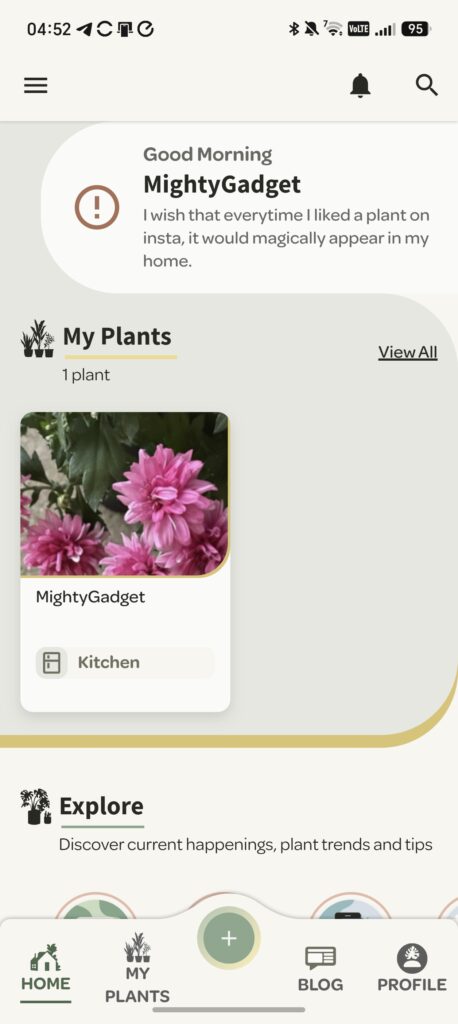
Living with Willow day to day is less about the sensor itself and more about how the app translates readings into something useful. The home screen greets you each morning with a short, plant themed message and a warning icon if something needs attention, alongside a card for each plant you have registered. It is a light touch way of checking in without having to dig through menus.
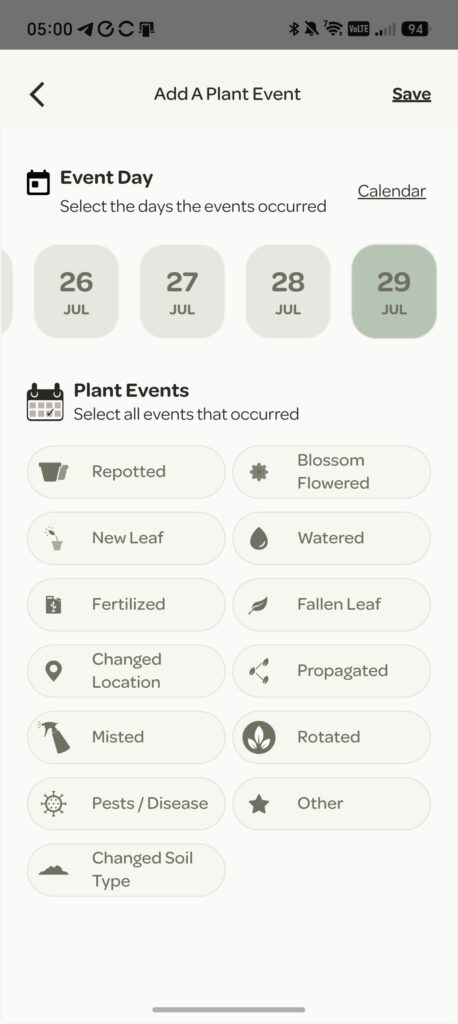
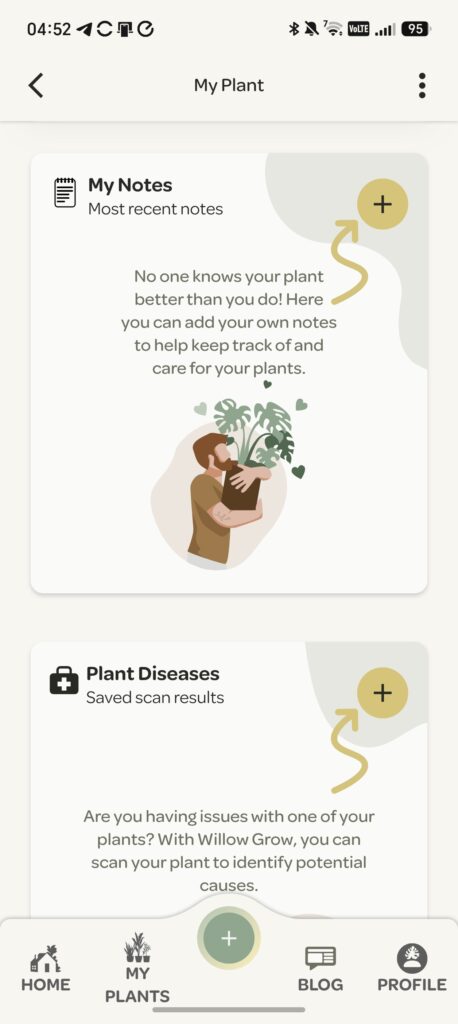
The History tab is where Willow becomes more of a plant diary than a monitoring tool. You can log events such as watering, repotting, fertilising, new leaves, fallen leaves, blossoms, misting, rotating the pot, pests or disease, and changes to location or soil type, each tagged to a specific date. Over several months this builds into a genuinely useful record, particularly if you tend to forget when you last repotted something or fed it.
The sensor readings themselves felt consistent with what I would expect from the plant’s position in the kitchen. Moisture dropped steadily between waterings rather than jumping around erratically, and the temperature and humidity figures matched a rough check against a separate thermometer, comfortably within the stated tolerances of ±0.3°C and ±1.8%. Light readings are where the sensor earns its keep: it is easy to assume a spot is bright because it looks bright to the eye, and having an actual lux figure removes the guesswork. That is exactly the sort of thing that catches out people, myself included, who assume a north facing kitchen windowsill is getting more light than it actually is.
Notifications arrived at sensible intervals rather than nagging constantly, and reflected genuine changes in conditions rather than repeating the same alert every hour. The one limitation worth flagging is that Willow is a closed system: it does not integrate with Home Assistant, HomeKit or any other smart home platform, so if you were hoping to trigger an automation, turning on a grow light when a sensor reports low light, for example, that is not currently possible. For most people buying this purely for plant care, that will not matter, but it is a limitation for anyone who already has a wider smart home setup and was hoping to fold plant monitoring into it.
Price and Alternative Options
The Willow Starter Pack that I have reviewed is available for a reasonable price of just £35.
The main cost seems to be the sensors themselves. The Plant Parent bundle, which has three sensors plus the hub, is £75, while the Urban Jungle pack, with 5 sensors and the hub, is available for £114. The sensors by themselves are £25 each.
The main competing option I can see is the SmartyPlants Monitor, which is £100 for a three pack. This does not require a hub, but it works out quite a bit more expensive than Willow for an equivalent number of sensors.
Amazon has a variety of alternative options, but they all appear to be more basic soil sensors. ThirdReality has some interesting Zigbee sensors which you could integrate into Home Assistant, priced at just £17 each, though they are not particularly well reviewed. There are also non-smart sensors that monitor light plus other variables; these are well reviewed and cheap at around £19, but there is no app to guide you on what to actually do with the readings.
Overall
Overall, I think the Willow Smart Plant Sensor holds up well against the competition.
There is only one product that competes directly, and that costs more up front. SmartyPlants has the advantage of not requiring a subscription, which would make it cheaper long term, but I have become increasingly wary of smart companies offering subscription free services, as they have a tendency to change their minds once they need to fund ongoing server and app costs.
As for Willow, it is a nice app and does a good job of making looking after your plants as easy as possible. The setup is quick, the sensor readings held up against my own checks, and features like the event log and Growth Goal settings show a level of thought that goes beyond a basic moisture alarm. The plant identification gaps and the caps on Grow subscription features are the main blemishes, and worth knowing about before you buy rather than after.
I do feel the sensors themselves are quite expensive at £25 each once you move beyond the Starter Pack, but on the flip side, I am used to plants having a short life in our house. If this helps us keep a plant alive indefinitely, it will probably be worth the investment.
Willow Smart Plant Sensor Review
-
Overall - 80%80%
Summary
The Willow Smart Plant Sensor takes much of the guesswork out of houseplant care, translating soil, light, humidity and temperature data into a simple happiness score and sensible, well timed alerts. Setup is quick, the readings held up against my own checks, and the free Starter tier is generous enough to be worth using on its own. The main downsides are a still growing plant ID library and a Grow subscription that gates useful features like disease detection behind fairly tight monthly caps. For anyone who regularly over or under waters their plants, it is a worthwhile, if not essential, purchase.
Pros
- Quick and simple setup
- Accurate light and temperature readings
- Useful plant care event log
- Generous free Starter tier
- Adjustable Survive or Thrive goals
Cons
- Plant ID library has gaps
- Disease detection needs paid subscription
- No smart home integration
- Additional sensors are expensive
- Grow subscription features feel capped

I am James, a UK-based tech enthusiast and the Editor and Owner of Mighty Gadget, which I’ve proudly run since 2007. Passionate about all things technology, my expertise spans from computers and networking to mobile, wearables, and smart home devices.
As a fitness fanatic who loves running and cycling, I also have a keen interest in fitness-related technology, and I take every opportunity to cover this niche on my blog. My diverse interests allow me to bring a unique perspective to tech blogging, merging lifestyle, fitness, and the latest tech trends.
In my academic pursuits, I earned a BSc in Information Systems Design from UCLAN, before advancing my learning with a Master’s Degree in Computing.
I’m proud to share that Vuelio has consistently ranked Mighty Gadget as one of the top technology blogs in the UK. With my dedication to technology and drive to share my insights, I aim to continue providing my readers with engaging and informative content.
I work directly with the companies he reviews products for or their chosen PR agency.
For Social Media, you can find me on: