Ceptics 140W Universal Travel Adapter Review
As someone who travels a lot, I love a universal adaptor; they are so convenient, covering Europe, America and Asia rather than requiring multiple adaptors for different regions. I also regularly use them at home so I can use devices with EU plugs (normally review samples).
Most of these devices also come with USB ports, saving you the hassle of carrying around a USB plug as well, and over the past few years, companies have been adding increasingly powerful USB ports, allowing you to charge devices like power banks, phones and laptops at full speed without a bulky plug.
For the EU and US, I have often found that when plugging a PD USB charger into an adaptor, the weight of the plug often risks pulling the adaptor out of the socket, so having USB ports built in helps eliminate this risk.
I recently reviewed the Verbatim Charge n Travel 70W 2C Universal Travel Adaptor Review, which was a 70W charger with built-in cables. I loved the convenience of it, but this Ceptics universal adaptor takes things up a few notches with its 140W output. The one downside is that it lacks a built-in cable, but I can live with that in favour of the high power output.
The 140W figure is worth dwelling on for a moment. Until recently, most universal adaptors topped out somewhere between 30W and 65W from their USB ports, which is fine for phones and tablets but leaves larger laptops charging slowly. 140W is the current practical ceiling for a single USB-C port under the USB PD 3.1 standard, using the 28V Extended Power Range profile, and it is enough to charge a 16-inch MacBook Pro or most high-power laptops at full speed. Seeing it in a universal travel adaptor at this price point is unusual.
Technical Specifications
| Specification | Details |
| Product type | Universal travel adaptor |
| Model number | UP-140KU |
| Accepted plug types | Type A, B, C, E, F, G, H, I, J, K, L, N and O |
| Output plug types | Type A, Type C, Type G and Type I |
| AC input sockets | 2 (1 universal, 1 USA/JP) |
| USB ports | 1 x USB-A, 3 x USB-C |
| Maximum USB output | 140W total (PD 3.1, 28V/5A on C1 and C2) |
| Charging protocols | PD 3.1, QC4+, FCP, AFC, PPS, BC1.2 and more |
| Maximum simultaneous devices | Up to 6 devices |
| AC rating | 100-250V, 10A max, 2500W max |
| Fuse | Replaceable 10A fuse with spare fuse included |
| Grounded | No |
| Surge protection | No |
| Voltage conversion | No |
| Safety features | Safety shutters and replaceable fuse |
| Certification | CE, UKCA, FCC and RoHS compliant |
| Warranty | 2-year limited warranty |
| Claimed country compatibility | Over 200 countries and regions |
Key Features
Universal Travel Compatibility
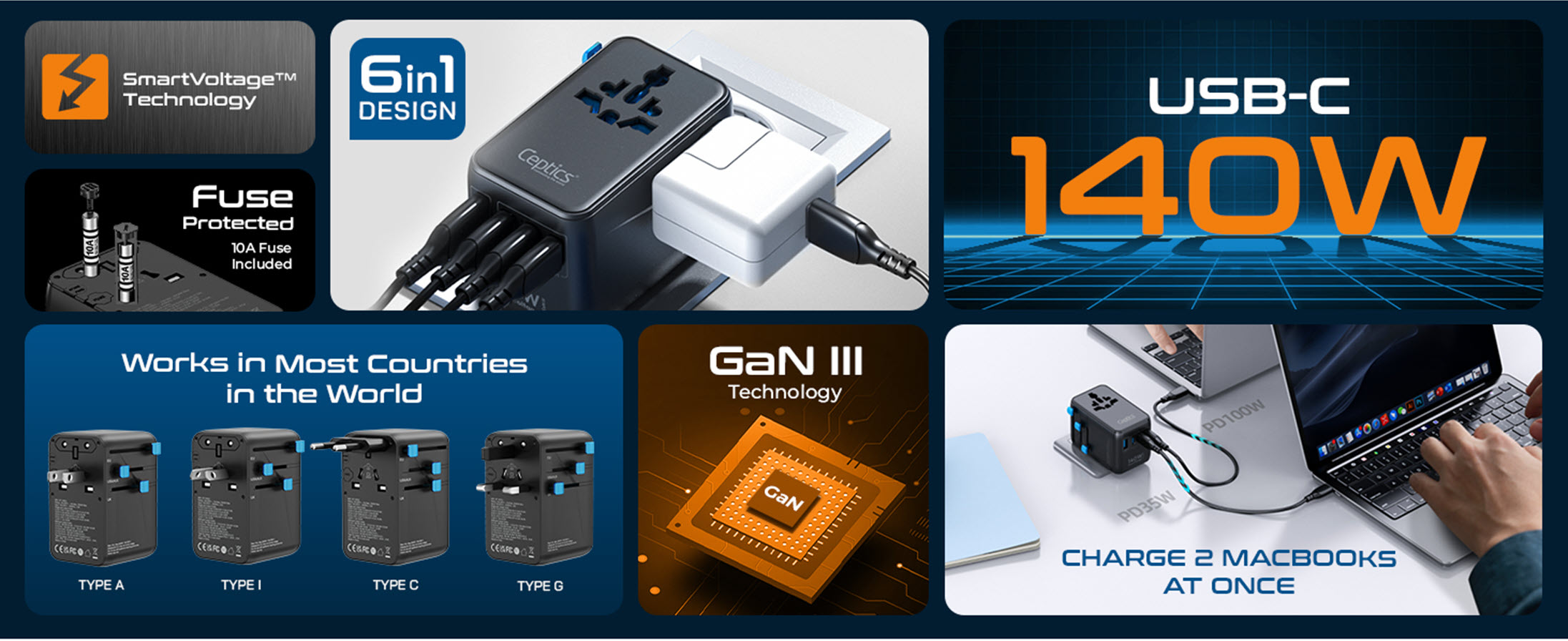
The adaptor accepts a wide range of international plug formats, including Type A, B, C, E, F, G, H, I, J, K, L, N and O plugs. This makes it suitable for travellers carrying devices from different regions. In practice, it means you can plug UK, EU, US, Australian and most Asian plugs straight into the universal socket without thinking about it.
Four Slide-Out Plug Types
The integrated slide-out plugs support Type A, Type C, Type G and Type I wall sockets. These plug types cover many commonly visited regions, including the UK, Europe, the USA, Japan, China, Australia and much of Asia and the Middle East. Ceptics claims compatibility with over 200 countries and regions, which is broadly in line with other universal adaptors using the same four plug types. Each plug deploys via a colour-coded blue slider on the side of the unit, and the sliders lock into place with a reassuring click.
Dual AC Socket Design
The unit includes two AC input sockets, allowing two mains-powered devices to be connected at the same time. As well as the universal socket on the front, there is a dedicated two-pin USA/JP socket on the side. Combined with the USB ports, it can charge or power up to six devices simultaneously. Most universal adaptors only offer a single AC passthrough, so the second socket is a genuinely useful addition, though the flat two-pin format limits its usefulness for UK and EU travellers unless you happen to be carrying US-plugged devices.
USB Charging Ports
The adaptor includes:
- 1 x USB-A port
- 3 x USB-C ports
The USB ports are useful for charging phones, tablets, headphones, smartwatches and similar devices without needing multiple separate chargers. Two of the USB-C ports (C1 and C2) are full 140W PD 3.1 ports, while C3 and the USB-A port are capped at 18W each. This is a sensible arrangement; you get the high-power ports for laptops and power banks, with the lower-power ports handling earbuds, watches and other small accessories.
Built-In Safety Shutters
The universal socket includes safety shutters to reduce the risk of accidental contact with live parts. This matters more than it might sound; universal sockets are inherently less safe than a dedicated national socket because the apertures need to accept so many pin shapes, so shutters are the minimum I would expect on any adaptor sold in 2026.
Replaceable Fuse
The adaptor includes a replaceable 10A fuse and is supplied with a spare fuse stored in a compartment on the rear. This helps protect the adaptor from overloads, though it should still be used within its rated limits. It is a small thing, but many cheaper adaptors use non-replaceable fuses, which effectively turns a blown fuse into a dead adaptor mid-trip.
No Voltage Conversion
This adaptor only changes the plug format. It does not convert the voltage. It is suitable for dual-voltage devices rated for 100-240V input, such as most modern phone chargers, tablet chargers and laptop power supplies.
Single-voltage devices may require a separate voltage converter when used in countries with a different mains voltage. The classic examples are hair dryers and straighteners, which are often 230V-only in the UK; plugging one into a US socket through this adaptor will simply result in a very underpowered appliance, while doing the reverse with a 120V-only device can destroy it.
No Surge Protection
The adaptor does not include surge protection. Sensitive electronics may still benefit from being used with a dedicated surge-protected power strip or charger where appropriate, particularly in countries with less stable mains supplies.
Design

The Ceptics is a chunky black cube measuring roughly the size of a large GaN charger, which is inevitable given the amount of hardware packed inside. The front face houses the four USB ports (A1, C3, C2 and C1, clearly labelled), along with the 140W SmartVoltage branding. The universal input socket sits on top, the USA/JP socket is on one side, and the plug selection sliders are on the other.
The blue sliders are the main visual flourish and they are labelled by region (USA/AUS, UK and so on), so there is no guesswork about which slider deploys which plug. The mechanism feels positive enough, with each plug locking firmly into place, and the UK pins felt solid in my sockets with no sagging despite the weight of the unit.


The rear of the unit carries the full output specification, the fuse compartment and the spare fuse holder, which is more transparency than many brands offer; a surprising number of chargers make you dig through documentation to find the multi-port power splits.
My main design criticism is that the plastics feel a bit lightweight and hollow compared to something like an Anker or Ugreen charger. Nothing creaks or flexes alarmingly, but it does not have the dense, reassuring feel of premium GaN chargers. Given the price, that is probably where the savings have been made.
One other practical note: at this size and weight, the adaptor is best suited to sockets that grip firmly. In a worn hotel socket, a heavy adaptor with a laptop cable hanging off it can work loose, though the UK three-pin plug largely avoids this problem thanks to its design.


Port Output
The adaptor has four USB charging ports. C1 and C2 are the headline ports, each capable of the full 140W (28V/5A) when used alone, while C3 and the USB-A port top out at 18W.
USB Port Output Configurations
| Port label | Port type | Maximum output when used alone |
| C1 | USB-C | 140W (PD 3.1) |
| C2 | USB-C | 140W (PD 3.1) |
| C3 | USB-C | 18W |
| A1 | USB-A | 18W |
Single-Port Charging
| Active port | Output |
| C1 only | 140W |
| C2 only | 140W |
| C3 only | 18W |
| A1 only | 18W |
Two-Port Charging
| Active ports | Output allocation |
| C1 + C2 | 100W + 35W |
| C1 or C2 + C3 | 100W + 18W |
| C1 or C2 + A1 | 100W + 18W |
| C3 + A1 | 12W shared total |
It is worth noting that my original assumption of an 18W + 100W split for C1 + C2 turned out to be wrong; the specification printed on the rear of the unit lists 100W + 35W for that pairing, and my testing confirmed it. The only weak combination is C3 + A1, which drops to a shared 12W, so avoid pairing those two ports if you want anything resembling fast charging.
Three and Four-Port Charging
| Active ports | Output allocation |
| C1 + C2 + C3 | 65W + 35W + 18W |
| C1 + C2 + A1 | 65W + 35W + 18W |
| C1 + C3 + A1 | 100W + 18W (C3 + A1 shared) |
| C1 + C2 + C3 + A1 | 65W + 35W + 12W (C3 + A1 shared) |
With three high-demand devices connected, the total lands at 118W, which is a respectable amount of the 140W total to sustain across multiple ports. The important practical takeaway is that C1 remains the priority port in every configuration, so your laptop or largest power bank should always go there.
Performance

I do not have any devices that can draw the full 140W, but my Anker power bank can take up to 120W input, and this is what I used for the single-port test. Charging from C1, the Ceptics settled at 114W to 116W sustained, which the power bank display confirmed at 114.1W and later 115.9W. That is essentially the maximum my power bank will accept once you allow for conversion losses, so I have no reason to doubt the port can deliver its full 140W to a device that requests it.

For the multi-port tests, I added a Ugreen power bank that accepts up to 100W and a smaller 65W Anker. With two power banks connected on C1 and C2, the split behaved exactly as the printed specification suggests: the larger Anker drew 89W on C1 while the Ugreen pulled 34W on C2, matching the advertised 100W + 35W allocation once you account for what each device negotiated.
With three devices connected, the outputs settled at 59W, 34W and 18W across the three power banks, which lines up with the advertised 65W + 35W + 18W three-port split. Renegotiation when plugging in an additional device was quick, with the existing devices dropping to their new allocation within a couple of seconds and without any of the disconnect-reconnect cycling that some multi-port chargers suffer from.

Thermals were reasonable throughout. After around 40 minutes of sustained 115W output, the casing was warm to the touch but not uncomfortably hot, which is in line with what I would expect from a GaN III charger at this load. I did not observe any thermal throttling during my testing, though I was testing at UK room temperature; a hot hotel room in summer may be a different story.
I also used the AC passthrough with a UK power strip plugged into the universal socket, which worked without issue. The 10A/2500W AC rating is the same as most rivals, and is enough for laptop bricks, camera chargers and similar travel loads, though as noted above it is not suitable for earthed or high-draw heating appliances.
Price and Alternative Options
The Ceptics 140W Universal Travel Adapter is available from Ceptics directly for just £39. It is not currently available from Amazon UK, but it is listed on the US Amazon site for around $51, so UK buyers will need to order from the Ceptics website and factor in any shipping and import costs.
At £39, it significantly undercuts the competition. In the UK, the Tessan Universal Travel Adapter is the only comparable model I can find with 140W, and this is available for £65. Momax seems to be the main brand for high-powered adaptors; they have a 170W model at £72 and a 205W model at £95, both of which add a display but cost considerably more.
If you do not need laptop-class charging, the market opens right up. Well-reviewed 65W to 70W universal adaptors from the likes of Tessan, Epicka and Verbatim are widely available for £25 to £35, and for phone-and-tablet travellers these remain perfectly adequate. The Ceptics only makes sense if you genuinely want to leave the laptop charger at home, but if you do, nothing else at this price gets close on output.
Overall
Overall, I cannot really fault the Ceptics; it has a very high power output that is capable of charging devices like power banks, laptops and phones at full speed, and my testing confirmed the port allocations behave exactly as specified. The combination of 140W USB output, two AC sockets, four slide-out plugs and a replaceable fuse at £39 is a genuinely strong package, undercutting the nearest UK rival by £26.
The only criticisms I can think of are that it feels a bit plasticky and light, and combined with the low price, it does make me wonder how long it will last or whether it will consistently provide a reliable power output over years of travel. However, it has very positive reviews on Amazon.com, and the two-year warranty and replaceable fuse provide some reassurance, so there is nothing to suggest this would be the case.
The usual universal adaptor caveats apply: no earth connection, no surge protection and no voltage conversion, so it is not suitable for every device. But for the typical traveller carrying a laptop, phone, power bank and a few accessories, this covers everything in one compact unit at a price that is hard to argue with.
Ceptics 140W Universal Travel Adapter Review
-
Overall - 90%90%
Summary
The Ceptics 140W Universal Travel Adapter delivers exceptional value for those requiring laptop-tier charging whilst travelling. Priced highly competitively, it provides reliable, high-speed power distribution across its USB ports alongside the convenience of dual AC sockets. Although the build quality feels slightly lightweight compared to premium alternatives, its impressive performance, accurate port allocation, and practical safety features make it a superb all-in-one charging solution.
Pros
Outstanding 140W power output.
Exceptional value at £39.
Charges six devices simultaneously.
Useful replaceable 10A fuse.
Features dual AC sockets.
Cons
Plastic casing feels slightly lightweight.
Lacks a built-in cable.
No earth grounding connection.
Does not convert mains voltage.
Combined lower ports charge slowly.

I am James, a UK-based tech enthusiast and the Editor and Owner of Mighty Gadget, which I’ve proudly run since 2007. Passionate about all things technology, my expertise spans from computers and networking to mobile, wearables, and smart home devices.
As a fitness fanatic who loves running and cycling, I also have a keen interest in fitness-related technology, and I take every opportunity to cover this niche on my blog. My diverse interests allow me to bring a unique perspective to tech blogging, merging lifestyle, fitness, and the latest tech trends.
In my academic pursuits, I earned a BSc in Information Systems Design from UCLAN, before advancing my learning with a Master’s Degree in Computing.
I’m proud to share that Vuelio has consistently ranked Mighty Gadget as one of the top technology blogs in the UK. With my dedication to technology and drive to share my insights, I aim to continue providing my readers with engaging and informative content.
I work directly with the companies he reviews products for or their chosen PR agency.
For Social Media, you can find me on: