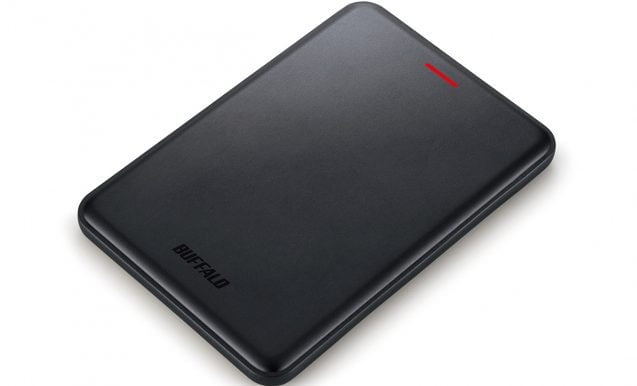
Solid State Storage is all the rage for laptops and desktops nowadays, it offers exponentially better performance than a mechanical drive while being smaller, quieter and giving off less heat. However, they are expensive compared to their mechanical equivalents and store less data, this means that we haven’t really seen many external SSDs on the market.The Buffalo MiniStation Velocity is one of the few external SSD products out there and is the flagship of company’s portable SSD range of storage drives. Based around an SSD drive, the MiniStation Velocity uses a USB 3.1 (Gen 2) interface and Buffalo claim it to be the slimmest portable SSD of its class at just 8.8mm thick.The MiniStation Velocity comes in three sizes, 240, 480 and 960GB with pricing around £115, £190 and £425. So while the cost of SSDs has dropped a lot in recent years, this is still a huge amount of money to spend on an external drive.This drive combines Toshiba 19nm TLC NAND and a Phison PS3110-S10 controller. Performance for the drive is quoted by Buffalo as reaching above 500MB/s for reads and above 480MB/s for writes.As expected the drive is very thin indeed, it doesn’t feel a great deal bigger than a bare SSD, and the weight is negligible which is all perfect for anyone needing to commute or travel frequently.I don’t normally pay much attention to the cables shipped, but Buffalo has included 2 USB cables, one a type A and one a type C. This is quite important as a lot of ultra-portable laptops now only ship with Type C ports, like the Acer Spin 7 I recently reviewed.The drive is designed to be used with Buffalo’s SecureLock Mobile2 encryption software which you can download from the Buffalo website. Though this is obviously optional.When it comes to performance for the average user an SSD is an SSD, they all perform great nowadays, and in this case, the performance you get will largely be dependent on the USB port you plug it into. If you use a legacy port you will get some slow speed. I used the Type C port on the Dell Latitude 2-in-1 I am currently reviewing and the results are great as expected, though not quite the advertised speeds, though this is usual. I also did one test using my main desktop to make sure the results matched up.
As you can see, sequential read ranges from around 430 MB/s to 440 MB/s. Sequential writes are pretty much 425MB/s. I had one random result for the 4K read times at 11MB/s but in general, this was around 40MB/s with the same write speeds. Overall, these might not be the best SSD speeds on the market but the small difference won’t be noticeable to anyone other than bench markers.
Overall
This is without a doubt an amazing external drive, it will outperform any mechanical external drive on the market. This comes at a cost though, the 960GB MiniStation Velocity is ten times the cost of a mechanical drive. So, you need to be rich or doing some serious read/write intensive work to justify this.However, if you have forked out £1200 for a 2-in-1 ultraportable and fine its 250GB internal SSD getting full too quick buying something like the MiniStation Velocity is the only option for improved storage with SSD speeds.

I am James, a UK-based tech enthusiast and the Editor and Owner of Mighty Gadget, which I’ve proudly run since 2007. Passionate about all things technology, my expertise spans from computers and networking to mobile, wearables, and smart home devices.
As a fitness fanatic who loves running and cycling, I also have a keen interest in fitness-related technology, and I take every opportunity to cover this niche on my blog. My diverse interests allow me to bring a unique perspective to tech blogging, merging lifestyle, fitness, and the latest tech trends.
In my academic pursuits, I earned a BSc in Information Systems Design from UCLAN, before advancing my learning with a Master’s Degree in Computing.
I’m proud to share that Vuelio has consistently ranked Mighty Gadget as one of the top technology blogs in the UK. With my dedication to technology and drive to share my insights, I aim to continue providing my readers with engaging and informative content.
I work directly with the companies he reviews products for or their chosen PR agency.
For Social Media, you can find me on:
Twitter/X – Instagram – Facebook – LinkedIn – Strava