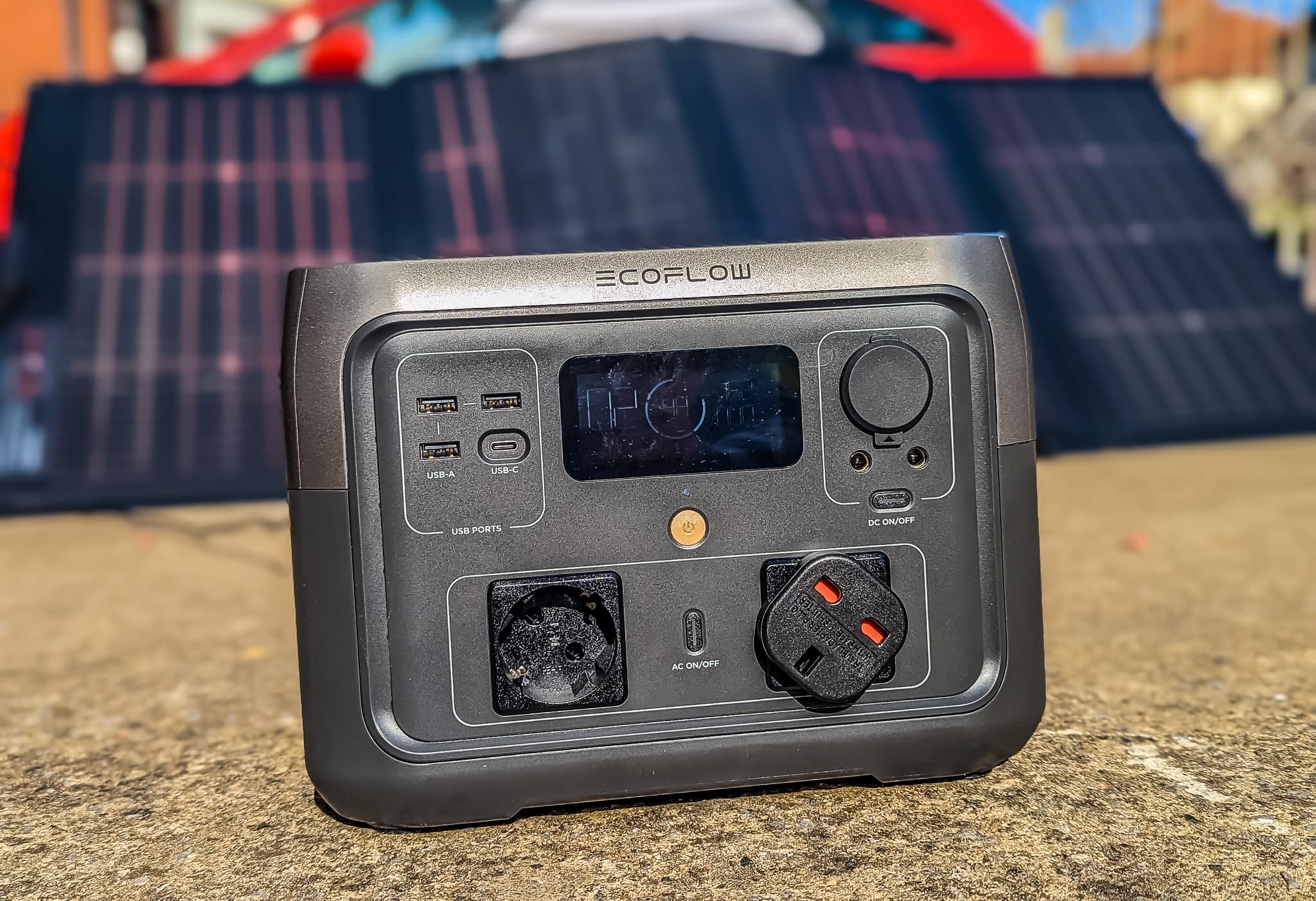
EcoFlow RIVER 2 Max Portable Power Station Review – Upgraded with LiFePO4 battery for a 6-fold increase in longevity
EcoFlow has been refreshing its product line-up. Last month they launched the new DELTA 2, and this month, it is the RIVER 2.
This is another portable power station that has been upgraded to use the LiFePO4 battery chemistry, which significantly improves the lifespan of the battery by about sixfold.
I have been using both the RIVER 2 and DELTA 2 for the past few weeks. As much as I love the bigger DELTA 2, I have found that the smaller size of the RIVER 2 makes it more convenient for me to use in a lot of scenarios.
EcoFlow RIVER 2 Models, Capacities and Price
[table id=469 /]
EcoFlow RIVER 2 MAX vs EcoFlow RIVER MAX Specification
[table id=470 /]
As I was sent the EcoFlow RIVER 2 MAX, I have compared the equivalent previous model.
As you would expect, there are a lot of improvements with the EcoFlow RIVER 2 series compared to the original, but not everything has improved.
For the RIVER 2 MAX, the capacity is slightly smaller, but this is a tiny trade-off to make for the new LFP battery chemistry, which improves the longevity six-fold. Charge speeds have also been improved, and this should charge fully in about an hour vs over an hour and a half. You can also charge via 100W PD USB-C, it is probably not something you will do very often, but it provides a bit of flexibility and is helpful if you have mislaid/forgotten your kettle lead.
Capacity is not the only thing that has been reduced. The output has dropped from 600W to 500W and surged from 1200W to 1000W. This won’t make any difference to me, but it could mean you may struggle to power certain high-power appliances.
The USB output situation seems to have had a slight downgrade. You now have three USB-A ports with a max of 12W per port and 24-watt total. The older model had one port capable of USB Fast Charge, which could do 18W + the two normal USB-A ports.
The weight has dropped by quite a bit, with a 1.6kg saving, but the overall dimensions appear to have increased slightly. If my maths is correct, the RIVER 2 MAX is now larger by 9.27% by volume.
The design itself has also changed. Now, all the ports are located on the front, with the charging on the rear. It has a flat top which could allow you to stack other power stations on top of it. The carry handles then protrudes slightly out of the back.
EcoFlow RIVER 2 MAX vs DELTA 2
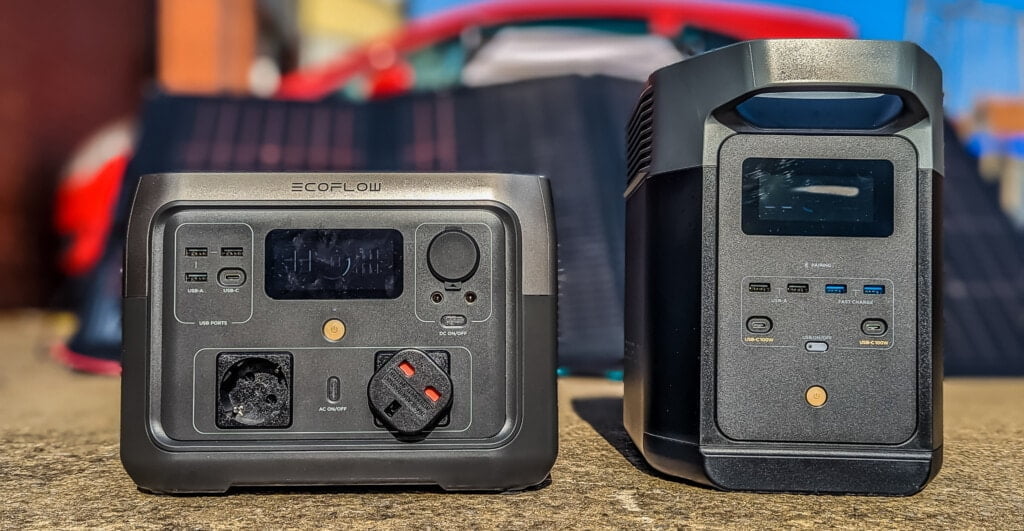
These are not like-for-like power stations, but the DELTA 2 is the last model I reviewed, and I think there are some interesting comparisons between the two ranges.
Obviously, the DELTA 2 is significantly more expensive and has a lot more capacity than the RIVER models. But it is quite likely a lot of potential buyers will want to evaluate portability vs capacity vs price.
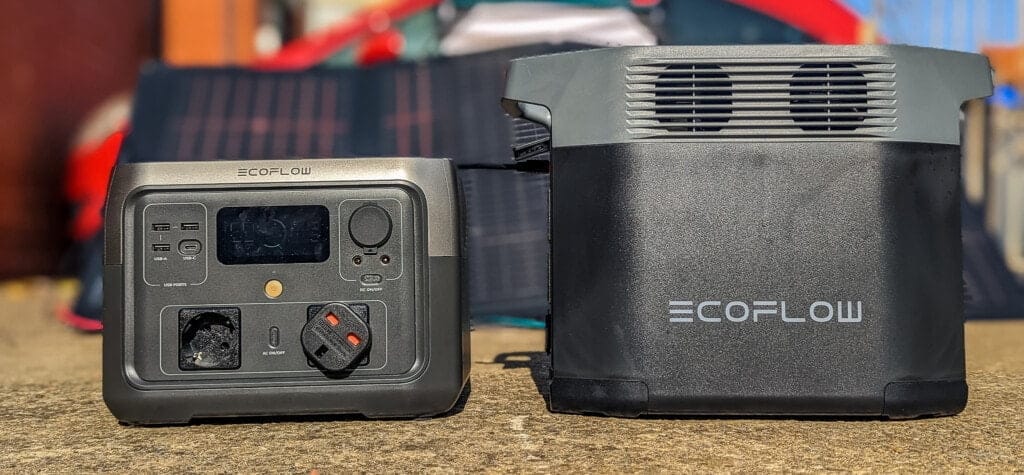
It has 33% more capacity than the RIVER 2 Pro and doubles the capacity of this MAX model. UK pricing puts the DELTA 2 at 47% higher than the Pro and 100% higher than the MAX.
The DELTA is 50% larger by volume than the Pro and 73% vs the MAX, and it is almost double the weight of the MAX and 53% heavier than the Pro.
When it comes to output and input, the DELTA 2 is on another level entirely. This can handle 1800W (Surge 2700W) across its four outlets and up to 2400W with X-Boost.
AC charging is 1200W, though the RIVER 2 Pro isn’t far behind with 940W, and a full charge of the DELTA 2 is slower than a full charge of any of the RIVER 2 models at 80mins vs 60-70mins (due to its capacity).
Solar input is also massively increased with up to 500W input. It is also possible to extend the battery capacity significantly using add-on batteries.
The DELTA 2 easily justifies its price in comparison to the RIVER 2 series. The only issue I have with it is the overall size and weight, I only have a small car, and it does take up quite a bit of boot space. I can imagine that I will end up using the RIVER 2 MAX more often for trips due to its more portable nature.
Design
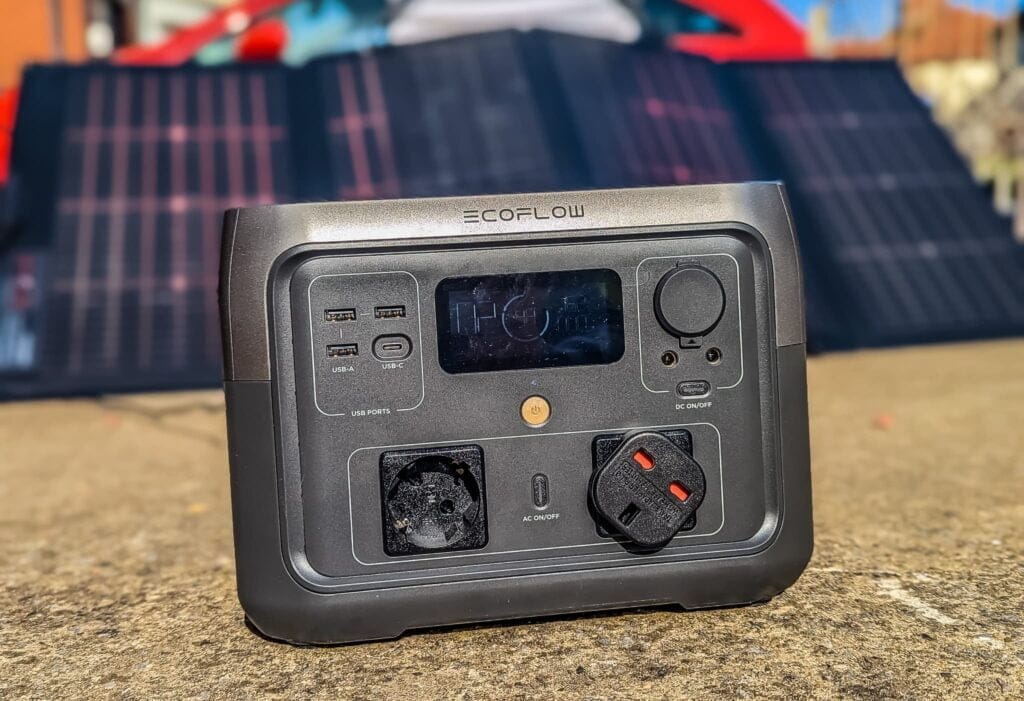
I prefer the overall design of the RIVER 2 vs the older model. I like having everything on the front panel, making it easier to access. The original RIVER I reviewed had a universal plug socket for both EU and UK. For this review, I was sent the EU socket version, and I am unsure if a universal model is being launched. Adaptors are cheap, but if you travel abroad a lot, the universal design is convenient.
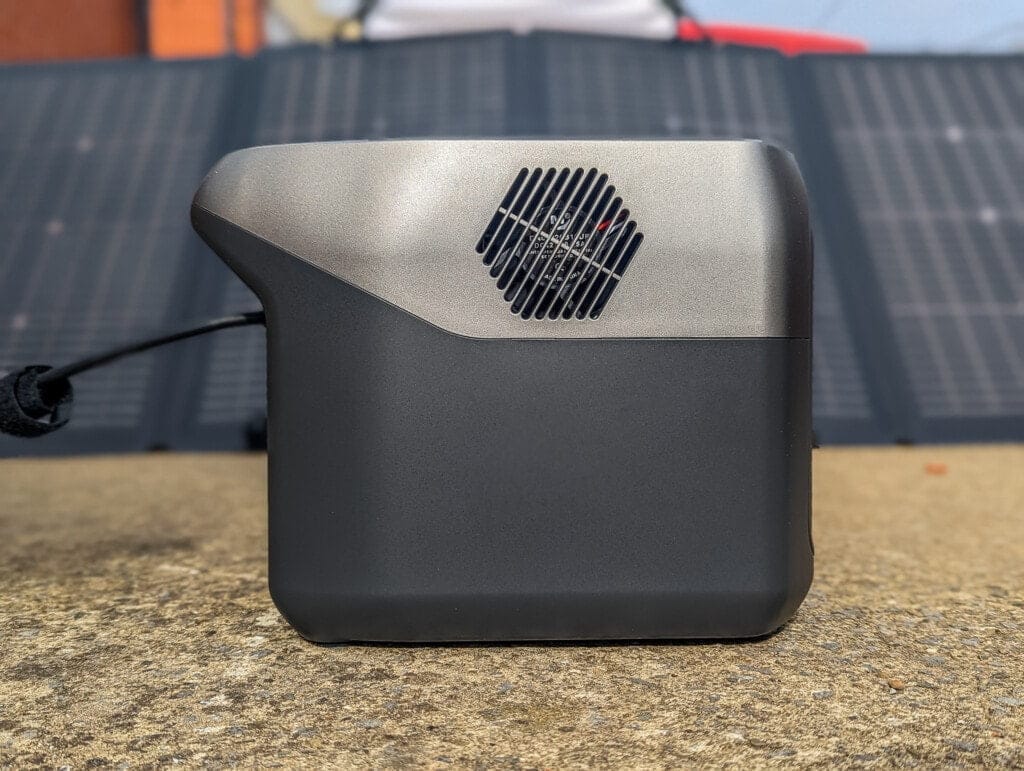
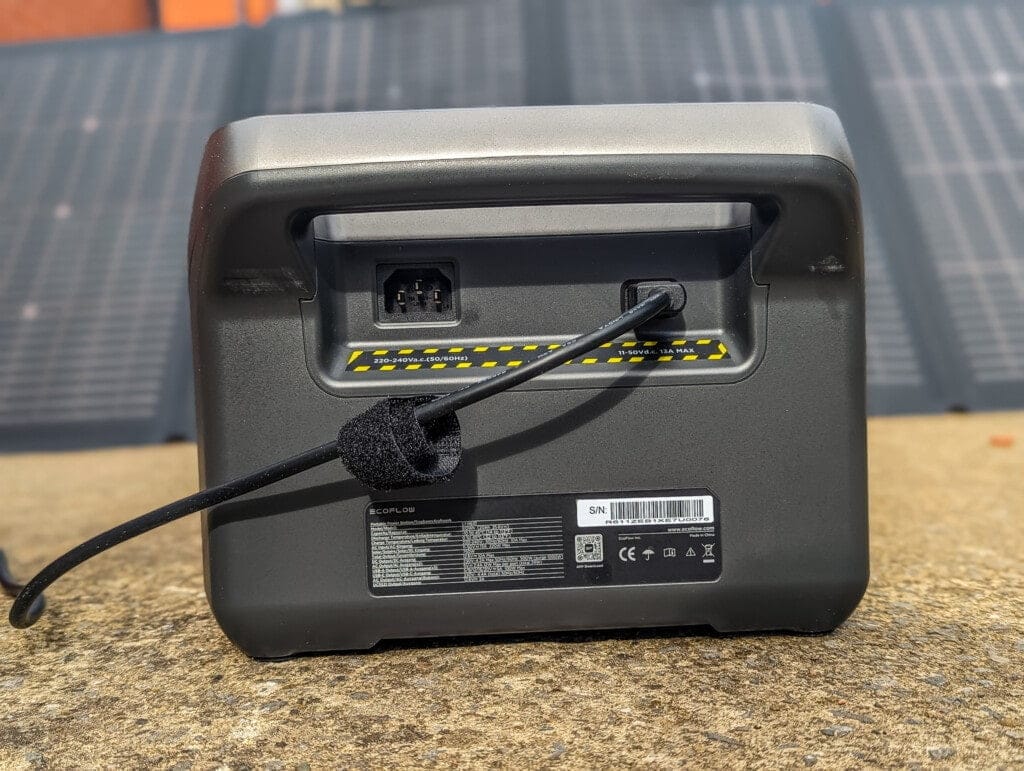
The fans are still located on the side, and the mains and XT60 ports are on the rear.
App
When I loaded up the EcoFlow app, I was immediately asked if I wanted to add the RIVER 2 MAX to the app. However, the app didn’t seem to register any information or provide any way for me to control the until. Going into the device settings, it confirms that it is the RIVER 2 MAX, and I think the app has just not had the functionality pushed through to the Play Store, as I am using this before the official launch.
Performance
There is not a great deal to say about the overall performance. It does exactly what it is supposed to do. Being in the UK, I had to buy some EU adaptors, but once I had these, the plug sockets worked as expected.
The 100W USB-C output can comfortably charge my Huawei Matebook 13, which requires a 65W input.
The unit comfortably kept my car (beer) fridge running on a drive down to London, and I also tested it running my desktop PC set up which included the PC itself and two monitors. The power draw stayed under around 300W, so this was well within the limits of the unit.
Mains, USB and Solar Charging
For solar charging, I tested this with the 400W EcoFlow solar panel and the bifocal 220W solar panel. On a semi-sunny day, I was able to hit a peak input of 220W with both panels, which is the limit this portable power station can take from a solar panel.
With an input of around 220W and a starting charge of 48%, the unit reported that it would take 1 hour to complete charging.
I like the idea of USB-C power delivery charging, I am not sure how much I will use it, but I have a lot of USB-C PD plugs. I always have one with me when I travel, so I know I will always be able to charge this, because I will almost certainly forget to pack the kettle lead one day.
With USB-C, the charge speed will be limited by the cable if it doesn’t support the current speed. I thought 100W+ rated cables may have been more marketing than a physical for a lot of cables difference. For the first few cables I tested, I was limited to 55W charging. It was only when I switched to the 200W cable Ugreen cable that I was able to achieve almost 100W. For the Ugreen 140W Nexode, the charge rate was 95W with the battery telling me it would charge in 4 hours from the 33% charge it was on.
When charging at 100W, the fans will kick in, whereas at 55W, they stay off.
Price and Alternative Options
As previously stated, the RIVER 2 MAX is priced at £549 in the UK. It is a bit disheartening to see that the US price is significantly lower, but there is not much we can do about that.
The Anker 535 PowerHouse is the most logical alternative, though I would say it is not quite as good. It matches the batter capacity and LiFePO4 chemistry as well as longevity. AC output is the same, but the surge capacity is less at 750W. USB output is not quite as good either, with the USB-C being limited to 60W (input and output). The Anker has a 5-year warranty, and I am waiting to confirm what the RIVER 2 series warranty is.
Bluetti has the EB55 for £569. This is also another LiFePO4, but they only claim 2,500+ life cycles to 80%. It has a superior output with 2x AC capable of 700W total and 1400W surge. It then has 1x100W USB-C (not capable of input charging) and 4x USB-A 5V/3A. AC charging is quite slow, with 200W charging the device in 3 hours. You can combine the 200W AC with 200W solar for a quicker charge of 1.8~2.3 Hours. It then weighs more at 7.5kg and has a 2-year warranty.
Overall
As always from EcoFlow, the RIVER 2 MAX is a superb portable power station.
Looking at the three main LiFePO4-equipped power stations at this capacity, I would say this is the best current option based on the overall specification and price (I haven’t used the other two, so I can’t comment on real-world usage).
Depending on your usage scenario, I’d still highly recommend the original EcoFlow RIVER. The Li NCM battery is still going to last many years, and it will likely be cheaper to buy while having the same capacity.
EcoFlow RIVER 2 Max Portable Power Station Review Rating
-
Overall - 95%95%
Summary
As always from EcoFlow, the RIVER 2 MAX is a superb portable power station. Looking at the three main LiFePO4-equipped power stations at this capacity, I would say this is the best current option based on the overall specification and price.
Pros
- Excellent specification for the price
- Convenient dimensions for easy transport
Cons
- Not all specs are equal to the older RIVER Max

I am James, a UK-based tech enthusiast and the Editor and Owner of Mighty Gadget, which I’ve proudly run since 2007. Passionate about all things technology, my expertise spans from computers and networking to mobile, wearables, and smart home devices.
As a fitness fanatic who loves running and cycling, I also have a keen interest in fitness-related technology, and I take every opportunity to cover this niche on my blog. My diverse interests allow me to bring a unique perspective to tech blogging, merging lifestyle, fitness, and the latest tech trends.
In my academic pursuits, I earned a BSc in Information Systems Design from UCLAN, before advancing my learning with a Master’s Degree in Computing.
I’m proud to share that Vuelio has consistently ranked Mighty Gadget as one of the top technology blogs in the UK. With my dedication to technology and drive to share my insights, I aim to continue providing my readers with engaging and informative content.
I work directly with the companies he reviews products for or their chosen PR agency.
For Social Media, you can find me on:
![Love Yourself Review: Calorie counted fresh meals delivered with MyFitnessPal integration [Performance Diet]](https://mightygadget.com/wp-content/uploads/2026/03/Love-Yourself-Review-1-768x384.jpg)