Audeze Maxwell 2 ANC Wireless Gaming Headset Review
Mighty Gadget is reader-supported. Links to retailers may be affiliate links, and I may earn a commission if you buy through them, at no extra cost to you. As an Amazon Associate I earn from qualifying purchases. How I test and review products.
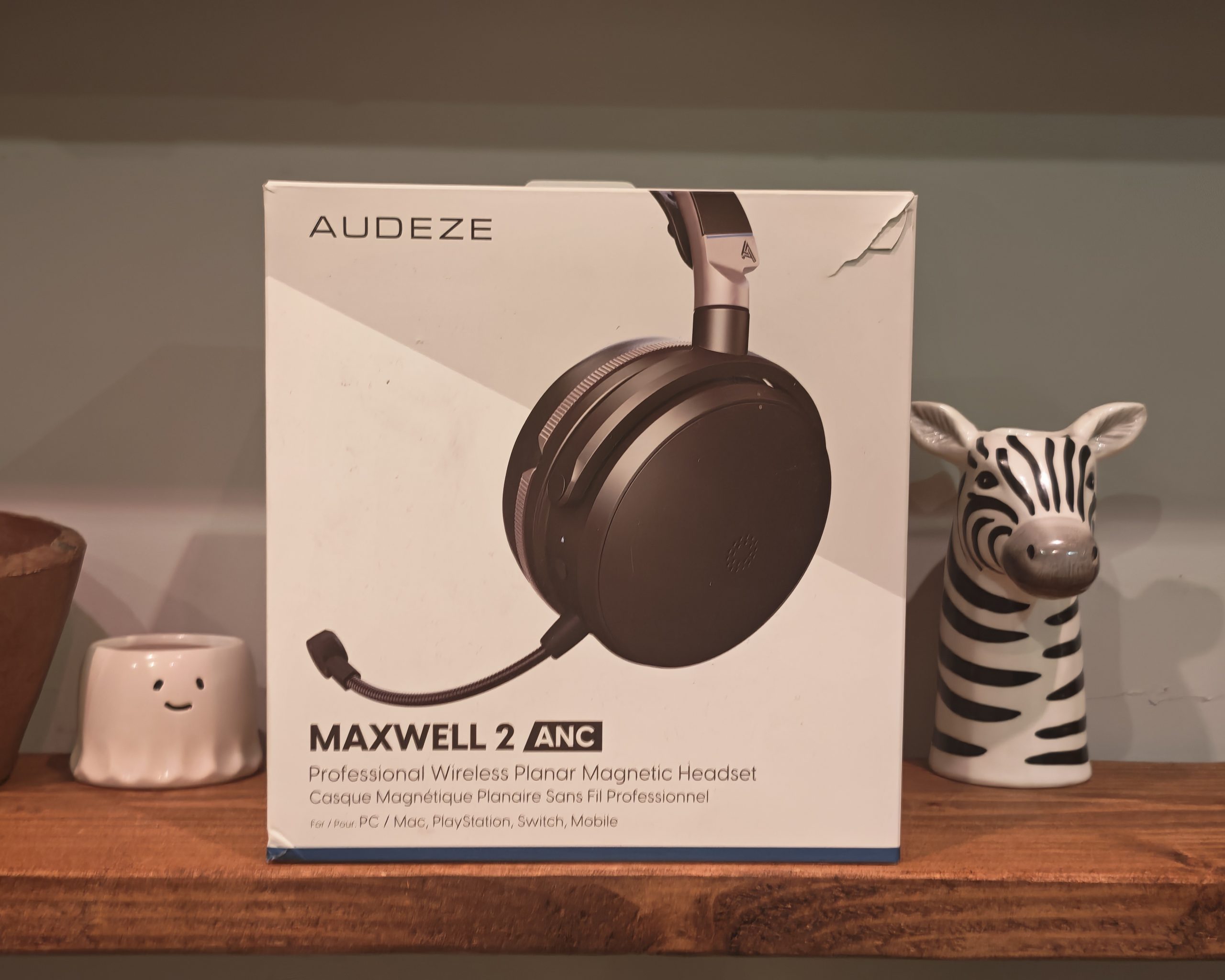
I previously reviewed the excellent Audeze MM-100 planar magnetic headphones back in 2024, and now I have finally got my hands on one of their popular gaming headsets. This is the latest Maxwell 2 ANC, which, as you might guess, is an upgraded version of the Maxwell 2, but now with ANC.
As I have not used any of the prior models, I can’t comment on how these perform against them, but as far as wireless gaming headphones go, I think they are awesome.
What makes the Maxwell range different from almost every other gaming headset is the driver. Most headsets use 40 mm or 50 mm dynamic drivers, whereas Audeze uses 90 mm planar magnetic drivers, the same type of technology found in its audiophile headphones. Adding ANC to that is not a small change either. It adds £90 to the price, 70 g to the weight and cuts the rated battery life by more than half compared with the standard Maxwell 2, so it is worth understanding what you gain and what you give up.
Specification
| Specification | Details |
|---|---|
| Audio | |
| Headphone style | Over-ear (circumaural), closed-back |
| Transducer type | Planar magnetic |
| Magnetic structure | Fluxor magnet array |
| Phase management | Fazor |
| Acoustic management | SLAM |
| Magnet type | Neodymium N50 |
| Diaphragm type | Uniforce |
| Driver size | 90 mm |
| Maximum SPL | Greater than 115 dB |
| Frequency response | 10 Hz to 50 kHz |
| Total harmonic distortion (THD) | Less than 0.1% at 100 dB |
| Spatial audio | Dolby Atmos / Tempest 3D |
| Amplification | Professional-grade dual 1.4 W balanced |
| Active noise cancellation | Up to 35 dB, with transparency mode |
| Weight | 560 g |
| Microphones | |
| Boom microphone | Detachable, hypercardioid |
| Beamforming | Physical and AI noise reduction, internal microphone for chat |
| Battery and Charging | |
| Battery type | 1,800 mAh lithium-polymer |
| Battery life (ANC off) | Up to 40 hours |
| Battery life (ANC on) | Up to 35 hours |
| Battery test conditions | Bluetooth continuous playback, pink noise at 80 dBA |
| Fast charging | 25% charge in 20 minutes |
| Full charging time | Approximately 2 hours |
| Charging connection | USB-C, 5 V / 1.8 A maximum |
| Connectivity | |
| Low-latency wireless | USB-C wireless dongle |
| Bluetooth version | Bluetooth 5.3 |
| Bluetooth features | Auracast, LE Audio, multipoint |
| Bluetooth codecs | LC3, LC3plus, LDAC, AAC, SBC |
| Wired digital connection | USB-C with dual-audio endpoints and game-chat mixing |
| Wired analogue connection | 3.5 mm TRRS (active) |
| Package Contents | |
| Headset | Audeze Maxwell 2 ANC |
| Microphone | Detachable boom microphone with pop filter |
| Wireless adapter | USB-C wireless dongle |
| USB-C cable | USB-C to USB-C, 1.5 m |
| USB-A adapter cable | USB-C to USB-A, 0.3 m |
| Analogue audio cable | 3.5 mm TRRS, 1.2 m |
Planar Magnetic Drivers Explained
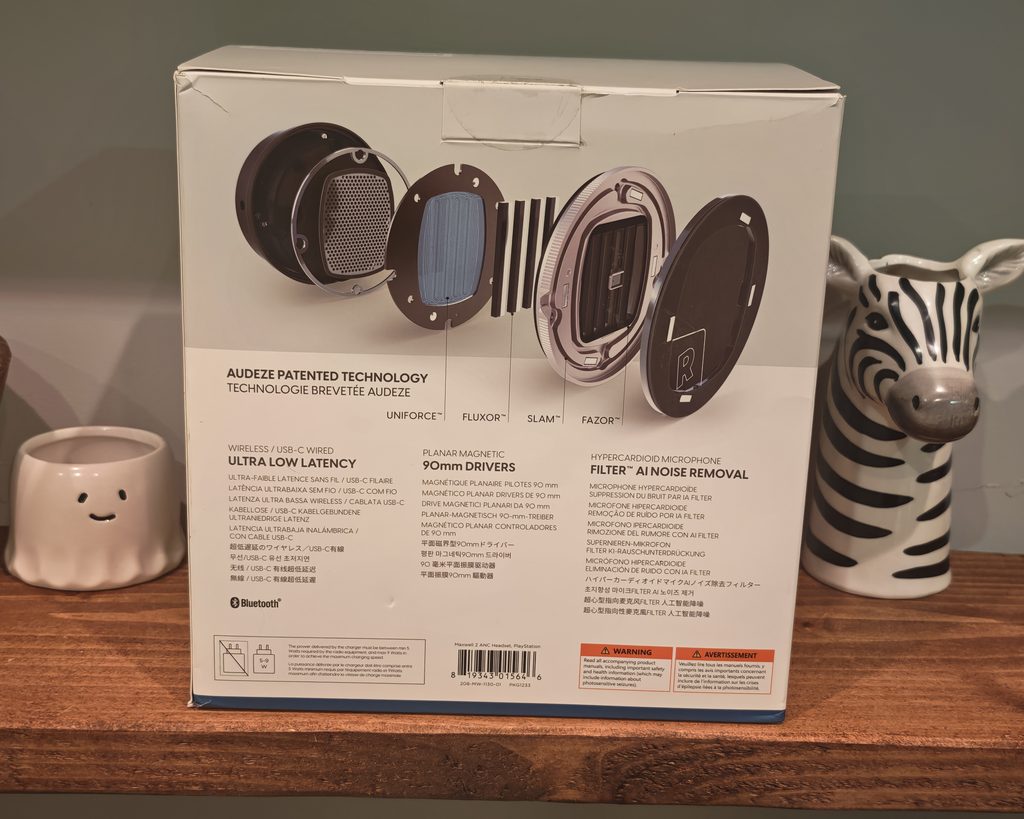
A conventional dynamic driver uses a voice coil attached to the centre of a cone, which pushes the cone back and forth. A planar magnetic driver instead uses a very thin, flat diaphragm with a conductive trace running across its whole surface, suspended between rows of magnets. The entire diaphragm is driven at once rather than from a single point.
In practical terms, this means lower distortion, faster response to sudden sounds and bass that stays controlled at high volume. The trade-off is weight and cost. Large magnet arrays are heavy, which is the main reason the Maxwell 2 ANC weighs 560 g when most gaming headsets are between 300 g and 400 g.
Audeze has its own names for the various parts of the driver. Fluxor is the magnet arrangement, Uniforce is the diaphragm design, Fazor is a set of waveguides that manage how sound leaves the driver, and SLAM is a newer acoustic system introduced with the Maxwell 2 that is designed to improve bass response and the sense of space. The headset also has dual 1.4 W balanced amplifiers built in, so it has plenty of volume in reserve.
Design & Comfort
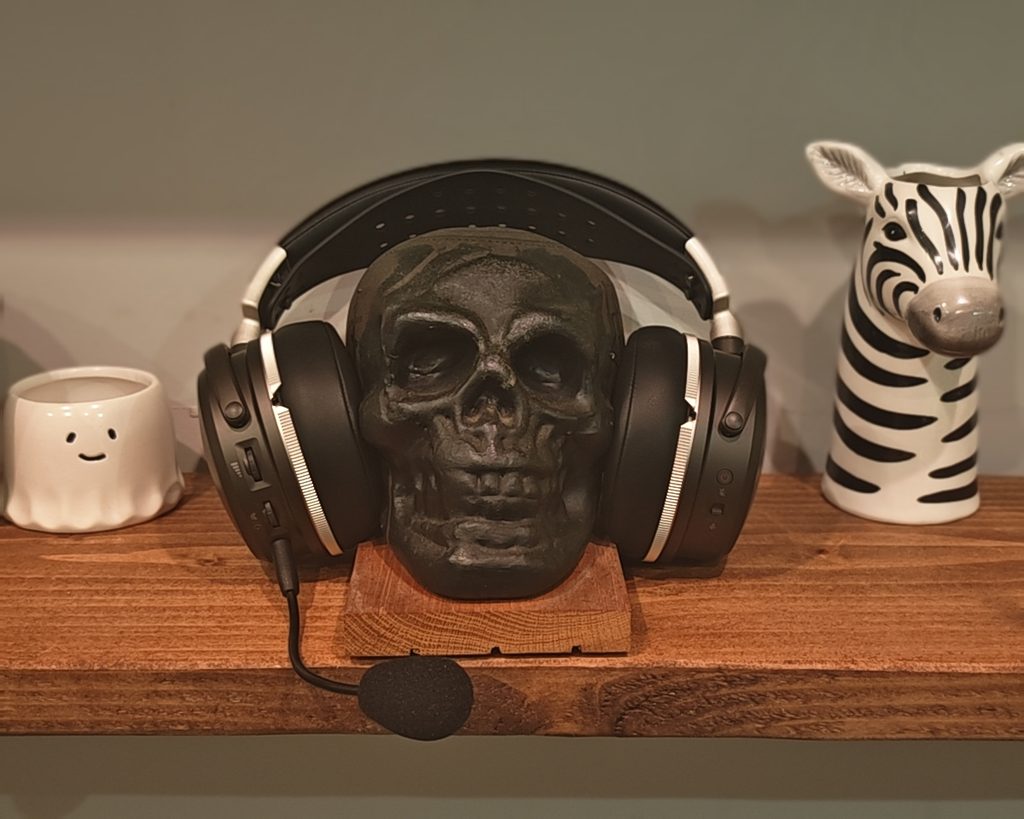
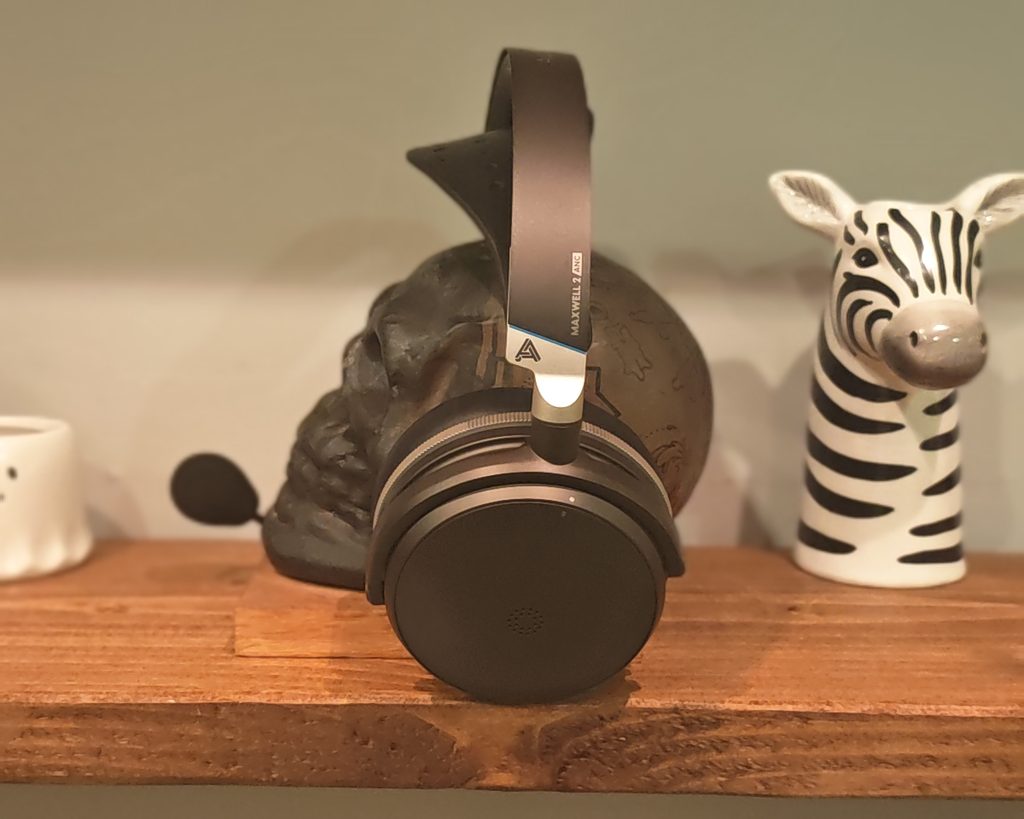
The Maxwell 2 ANC has an understated design with matte black earcups, a silver knurled ring around each cup and silver yokes. The build is mostly metal, and it feels like it will survive years of use. The outer plates are held on with magnets and can be swapped for different designs, which Audeze sells separately.
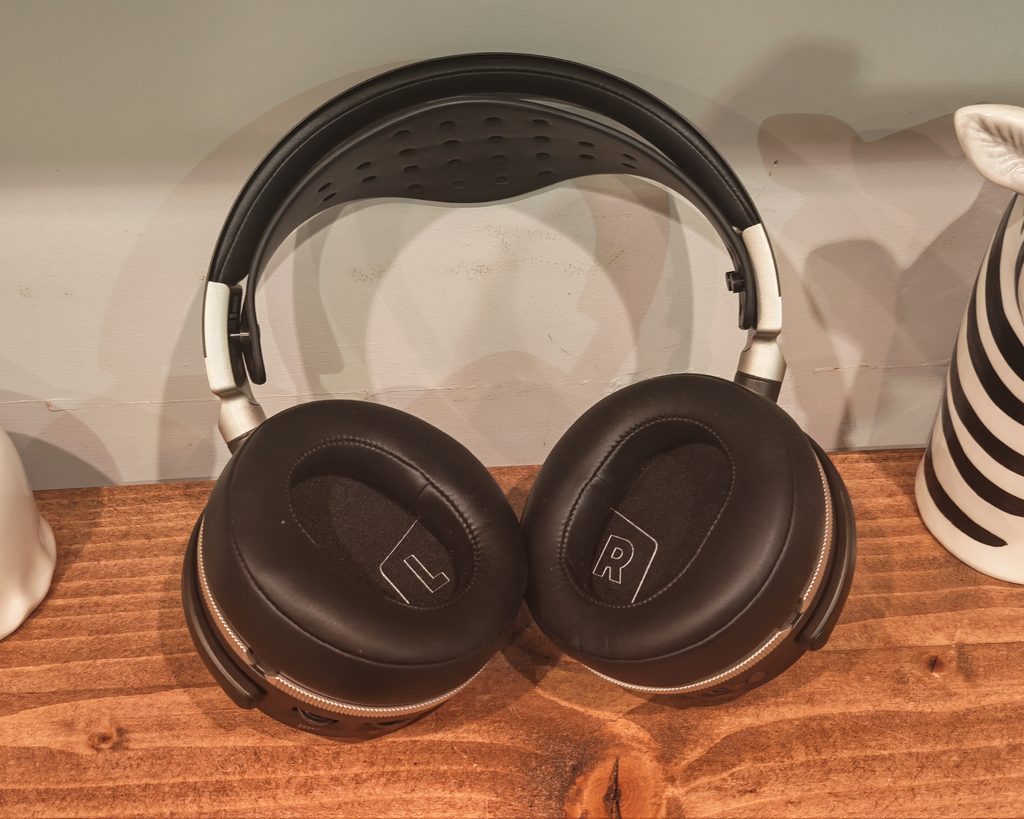
The headband uses a wide, ventilated suspension strap that sits under the metal band. Size adjustment is done by moving the strap between three peg positions on each side rather than using a sliding mechanism. It is less convenient than a slider, but once it is set, you don’t need to touch it again.
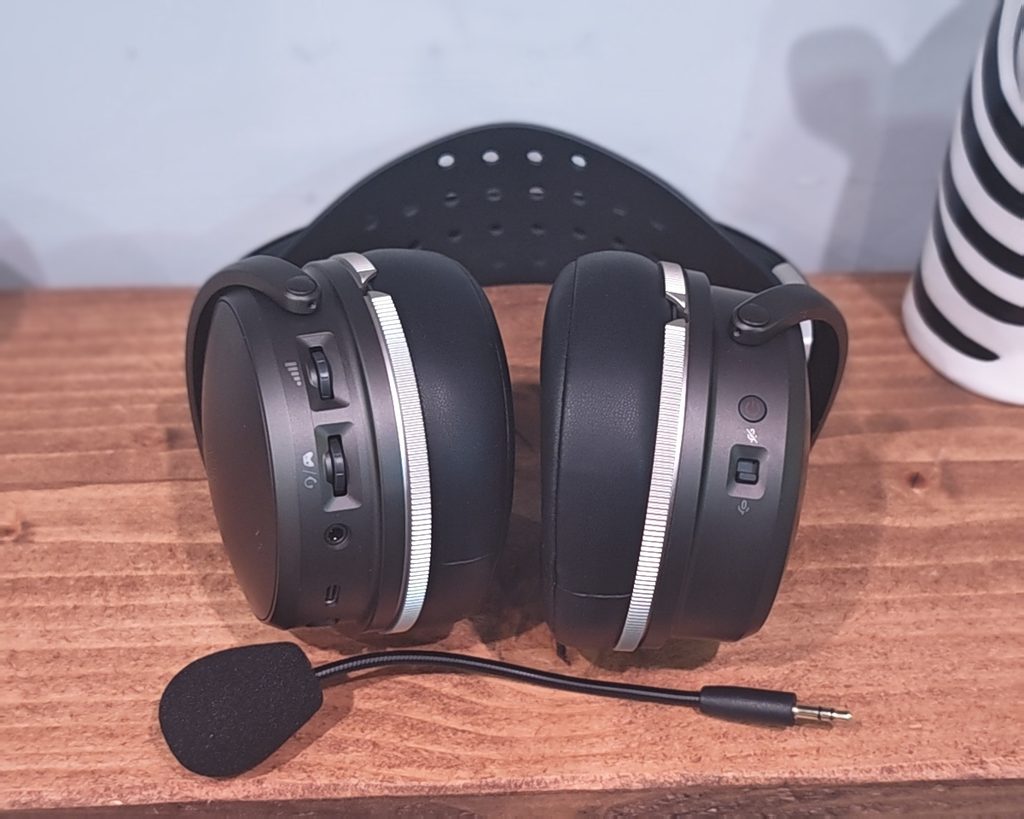
All the controls are on the earcups. The left cup has two wheels, one for volume and one for the game and chat mix, along with the button for the microphone noise removal, the USB-C port and the 3.5 mm ports. The right cup has the power button and a slide switch to mute the microphone. Pressing the volume wheel cycles through the EQ presets, which is handy when moving between calls, music and games.
You may notice in my photos that there are two 3.5 mm ports, one recessed and another surface-level for the wired analogue connection. I stupidly plugged the microphone into the wired connection and had all sorts of problems. So, don’t do this. The microphone belongs in the recessed port.
In terms of comfort, these are mostly good thanks to the very large earcups with soft, thick padding. I have large ears, and these don’t sit on my ears at all, reducing fatigue and pain from wearing them for long periods.
The clamping force is quite firm. This helps the earcups seal properly, which the ANC relies on, and it stops the headset from shifting when I look down at my keyboard. People who wear glasses or prefer a loose fit may find it a little tight at first.
On the downside, these are very heavy headphones; while I haven’t personally had a problem with the weight, I imagine some people would find it fatiguing. At 560 g, they are 70 g heavier than the standard Maxwell 2 and considerably heavier than the SteelSeries and Turtle Beach alternatives. The wide strap does a good job of spreading the load, but if you are used to a lightweight headset, the difference is obvious as soon as you pick them up.
The leatherette pads also get warm over a long day in the office. It is not uncomfortable, but I do take them off between calls more often than I would with an on-ear headset. There is also no carry case or pouch in the box, which is disappointing at this price, as I carry these between home and the office.
Set Up & App
Oddly, the headset is not pre-paired with the dongle; you need to download the Audeze app and then go through the pairing process. This failed for me a few times, until I realised the microphone was plugged into the wrong port. Once I corrected that, pairing completed on the first attempt, and I have not had any connection problems since.
The app is available for Windows, macOS, Android and iOS. It does not require an account and has no adverts, which is refreshing compared with some gaming software suites that insist on a login and run several background services.
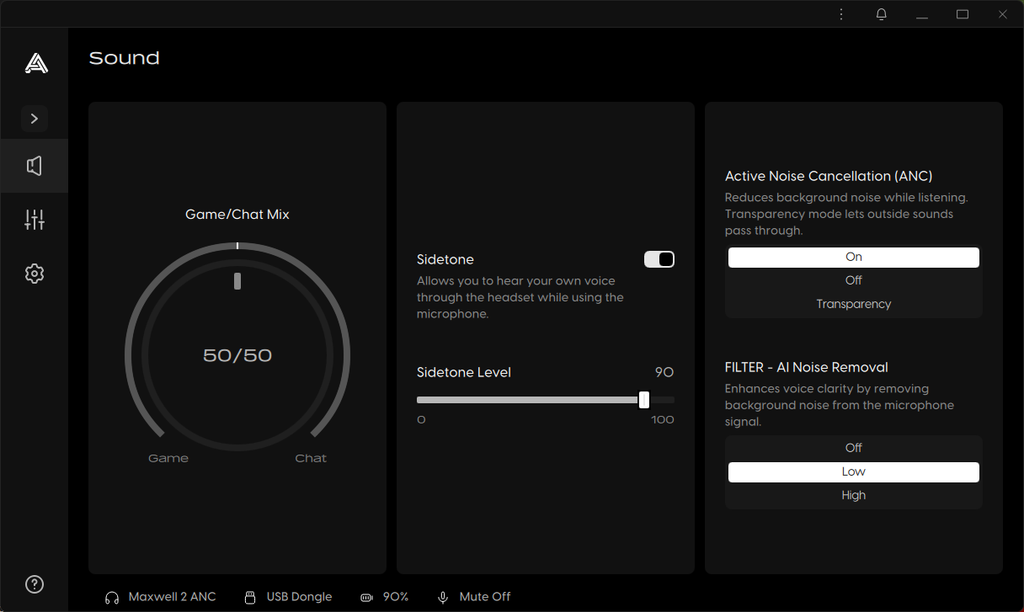
The app itself is basic but functional. You have a handy game and chat dial, allowing you to shift the focus to more chat or more game audio and music. On a PC, the headset appears as two separate audio devices, one for game and one for chat. For the dial to work properly, I had to set my softphone to use the chat device and leave everything else on the game device. After that, I could turn my music down and callers up from the wheel on the earcup without touching Windows.
These also have a sidetone feature, which I find essential when working in my office, as it avoids me being too shouty on the phone from not hearing my own voice. This matters more on a closed-back headset with ANC, because you are so isolated from your own voice. The level is adjustable in the app, and I settled at around 30%. It can also be toggled by holding the noise removal button on the headset for a few seconds.
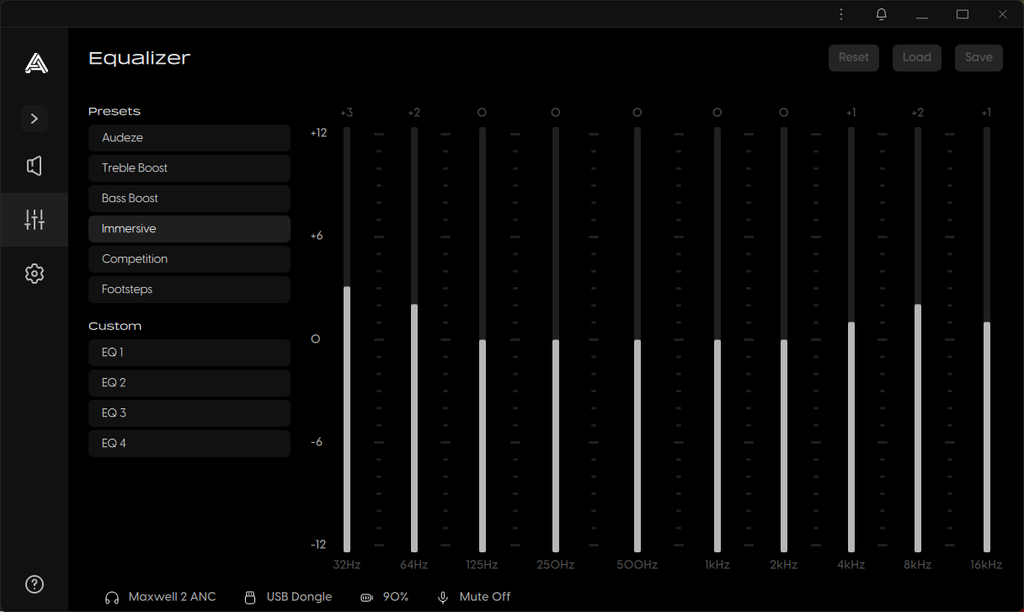
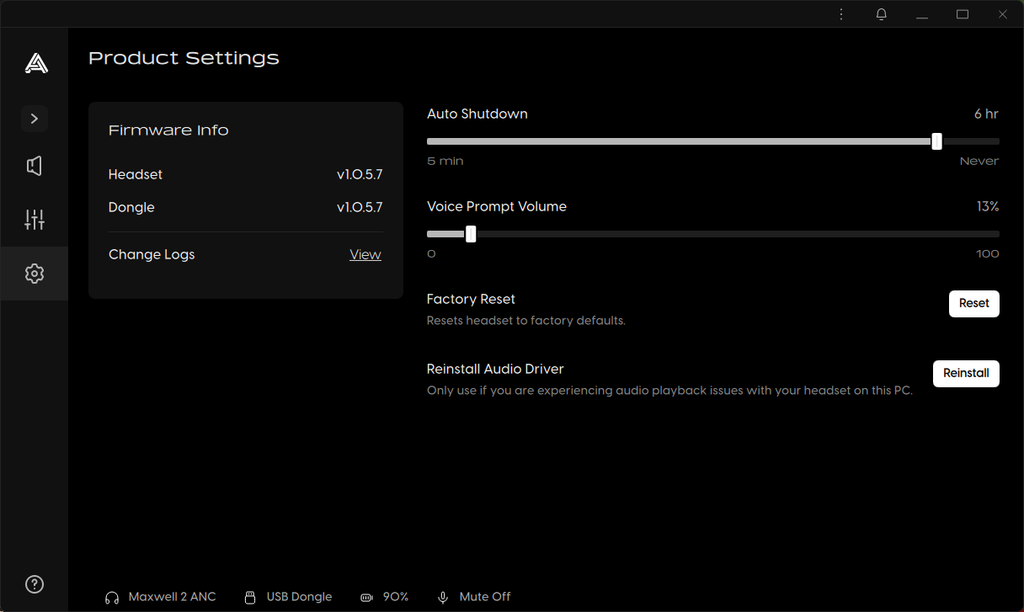
The same screen has controls for noise cancellation, with on, off and transparency options, and the AI noise removal for the microphone, which can be set to off, low or high. A separate equaliser tab offers a 10-band EQ with a range of plus or minus 12 dB, five presets and four custom slots that can be saved to the headset. The settings page covers firmware updates for both the headset and dongle, dongle pairing, the auto power-off timer and the volume of the voice prompts.
There is no parametric EQ, and I would like to see more control over button mapping, but everything that I need day to day is there. Settings are stored on the headset, so they carry over to a console or phone.
Connectivity Limitations
The headset supports the 2.4 GHz dongle, Bluetooth 5.3, USB-C wired and 3.5 mm analogue. The dongle supports audio at up to 24-bit/96 kHz, and Bluetooth includes LDAC for Android phones, along with multipoint and LE Audio.
The one frustration is that the dongle and Bluetooth cannot be used at the same time. I would like to stay connected to my work PC via the dongle and still take calls from my mobile over Bluetooth, but you have to switch between them. Bluetooth can be mixed with a wired connection, so it is possible if you are prepared to plug in a cable, but most competing headsets at this price handle simultaneous wireless connections without it. Sadly, this applies to both the ANC and standard versions of the Maxwell 2.
Sound Quality
While I have tested these in gaming, my day job is in IT support, and I am on the phone all day with a softphone, so I have used these extensively for the past couple of weeks on the help desk.
For gaming, I am a casual and not very good player, and for multiplayer games, I tend to only play FPS games like COD.
Initially, I wasn’t sure about the sound quality; the default Audeze profile is a little flat for my liking. It is tuned to be neutral, which suits critical listening, but coming from more consumer-tuned headphones, I found the bass a little light and the upper frequencies slightly sharp, particularly with ANC switched on.
After reading a comment online, I tried the immersive profile and found it much more pleasant, providing a pleasingly rich sound profile without being too bass-heavy. This preset lifts both the low and high frequencies, and it is the one I have left the headset on for music and games. If you find the treble a touch bright with ANC enabled, pulling the 4 kHz band down by 2 dB or 3 dB in a custom profile helps.
What impressed me most is the clarity. With music, there is a level of detail and separation between instruments that I have not heard from any other headset, gaming or office. Bass goes very deep, and it stays tight rather than booming, which is the main benefit of the planar drivers. It reminds me a lot of the MM-100 in this respect, although the MM-100 is an open-back design and sounds more spacious as a result.
In COD, footsteps and gunfire are easy to place, and explosions have plenty of weight without drowning out everything else. I am not good enough for it to improve my results, but the positional audio is clear and I never struggled to tell where shots were coming from. There are also competition and footsteps presets for players who want to prioritise those cues over a full sound.
The PlayStation version I was sent supports Tempest 3D audio on the PS5, while the Xbox version includes a Dolby Atmos licence. The Maxwell 2 ANC also has built-in head tracking, which works with supported software, including Embody’s Immerse Gaming Hive and the Dolby Atmos Renderer. Immerse Gaming Hive is a paid subscription, and I have not tested it for this review, so I can’t comment on how well it works.
Call / Chat Quality
Call quality is excellent. I have been using the EPOS Impact 500 Hybrid ANC Headset and the newer EPOS Impact 1000 for the past year in the office, which are good, but I much prefer the Maxwell 2 ANC.
For me, perhaps the main benefit is the large earcups and audio quality combined with the ANC. It makes hearing people much easier than the EPOS headset. While the EPOS has ANC, its on-ear design limits the benefit, whereas the Maxwell eliminates most office noise. Quiet callers and people on poor mobile connections are noticeably easier to understand, which makes a difference over a full day of support calls.
The boom microphone is a hypercardioid design, meaning it mainly picks up sound from directly in front of it and rejects noise from the sides. On top of that, there is Audeze’s FILTER AI noise removal, which has off, low and high settings. Colleagues and customers have told me my voice sounds clear and natural. In my open-plan office, I use the low setting, which removes most of the keyboard noise and background chatter. The high setting is more aggressive, but it makes my voice sound a little more processed. The noise removal also raises the microphone level, so if you speak loudly, it is worth moving the microphone slightly further from your mouth.
My main gripe is that the microphone placement is not as good as the EPOS. I seem to struggle to get the bendable arm in the best position; too close to my face and it picks up breathing noises, but if I push it down a bit, it often catches on the collar of my top. The EPOS is just set and forget, thanks to its thin plastic microphone arm.
The boom microphone is detachable, and there are internal microphones for when it is removed. These are fine for a quick call on the move, but the boom is clearly better, and I would always use it at a desk.
Not related to the call quality, but I also like the Maxwell 2 ANC because I can listen to my music comfortably with great audio in between calls. With the EPOS headsets, music is passable at best, so I used to swap to a different pair of headphones. Now I use one headset for everything.
Active Noise Cancellation
The Maxwell 2 ANC uses a hybrid system with microphones on both the outside and inside of each earcup, and it adapts to the surrounding noise. Audeze rates it for up to 35 dB of noise reduction.
ANC seems to be excellent. With it enabled and no audio playing, it blocks out a considerable amount of background noise. I can still hear people talking, but it is far less intrusive than with non-ANC headphones or the EPOS Impact 500. It is most effective on constant low-frequency noise such as air conditioning, server fans and road noise. Voices and sudden sounds get through more easily, which is normal for any ANC system.
With music playing at a moderate volume, I was able to comfortably work without hearing my colleagues talking loudly, which is a huge benefit for me.
That being said, I think the full ear coverage and very thick padding do a good enough job of passive noise isolation that I could comfortably work in my office without ANC on. That raises the question of whether the standard Maxwell 2 would be enough for many people, and for home use in a quiet room, I suspect it would be.
There are a couple of things to be aware of. With ANC on and nothing playing, there is a faint background hiss. I can only hear it in a quiet room, and it disappears as soon as any audio is playing, but people who are sensitive to this may notice it. ANC also changes the sound slightly, making the treble a little brighter than with it switched off.
Transparency mode lets you hear your surroundings without removing the headset. It works well enough for a quick conversation with a colleague, but voices sound a little processed, and it is not as natural as the best transparency modes on consumer ANC headphones from Sony or Apple. For anything longer than a few sentences, I still take the headset off.
Battery Life
Battery life is more than good enough for my needs; they are rated for 35 hours with ANC on and 40 with it off, so they more than cover a full day in the office.
I typically set them to auto-switch off after 6 hours, avoiding them powering down when not in use in the office, while also avoiding the battery draining by forgetting to turn them off.
I generally charge overnight, or every other day (when I forget to charge), so I can’t see the battery life ever being a problem. In my use, a full working day with ANC on, a mix of calls and music, uses roughly a quarter of the battery.
Fast charging provides around 25% in 20 minutes, and a full charge takes about two hours. The headset can also be used while charging over USB-C, so a flat battery won’t stop you from working.
The battery life does need some context, though. The standard Maxwell 2 is rated for over 80 hours from the same 1,800 mAh battery, so the ANC hardware more than halves the runtime, even with ANC switched off. Audeze’s figures are also based on Bluetooth playback, and the dongle is likely to use a little more power. For comparison, the SteelSeries Arctis Nova Pro Omni gets around this with hot-swappable batteries. I don’t think 35 hours is a problem for most people, but if you are choosing between the two Maxwell models and don’t need ANC, the standard version will last around twice as long between charges.
Price and Alternative Options
The Audeze Maxwell 2 ANC is available in two variants: one for PlayStation / PC / Mac and mobile with no Dolby Atmos, which is £429.
The other option is for Xbox / PC / Mac / Mobile and is available for £449.
The Xbox version costs more because it includes the Xbox wireless licence and Dolby Atmos. It will also work on a PlayStation, so if you own both consoles, it is the one to buy. The PlayStation version will not work wirelessly with an Xbox. On a PC, both are identical apart from the Dolby Atmos licence.
The standard Audeze Maxwell 2 has an RRP of £339 for the PlayStation version and £369 for the Xbox version. You get the same drivers, the same microphone and more than double the battery life in a lighter headset. If you mainly game at home in a quiet room, I think it is the better value option. The ANC model makes more sense if you work or play in a noisy environment, as I do.
The SteelSeries Arctis Nova Pro Omni is £350 and is probably the most obvious competitor. It has ANC, simultaneous 2.4 GHz and Bluetooth, hot-swappable batteries and a desktop base station, and it is far lighter. Its dynamic drivers can’t match the detail of the Audeze, but it is the more convenient headset to live with.
The Turtle Beach Stealth Pro II is £300 and also has ANC, Dolby Atmos and swappable batteries, with a transmitter that can handle multiple sources. Again, it is the more practical and affordable option, but sound quality is not at the same level.
Sony’s Inzone H9 II is another ANC option worth considering if weight is a priority, as it is one of the lightest headsets in this class and has a very good ambient sound mode.
For office use, the EPOS Impact 1000 is a more sensible choice for most people. It is light, has a better microphone arm, is certified for Teams and is designed for all-day calls. It is nowhere near as good for music or games, though, and the on-ear design blocks far less noise.
At £429, the Maxwell 2 ANC is one of the most expensive gaming headsets on the market, and the RRP is a touch high when the standard model is £90 less. What you are paying for is audio quality that none of the alternatives match, combined with ANC that makes it usable in noisy places.
Overall
Overall, I have grown to love the Audeze Maxwell 2 ANC. I think the standout feature of these is that not many headsets, gaming or office, are really geared towards great audio quality.
The planar magnetic drivers produce a level of detail and bass control that I have not heard from any other headset, and once I switched to the immersive profile, they became my preferred headphones for music as well as calls and games. The ANC is very effective in my open-plan office, call quality is excellent in both directions, and the build quality is superb. Being able to use one headset for support calls, music between calls and gaming in the evening is the main reason I have kept using them.
The main downsides are that the weight of the headset could be fatiguing for some for long sessions, the microphone positioning takes a bit of experimentation, and because it is a bendy arm, it is easy to knock it out of place, and then of course, the £430/450 price tag makes these one of the most expensive gaming headsets on the market.
I would add that the lack of simultaneous dongle and Bluetooth is frustrating at this price, the battery life is much shorter than the standard Maxwell 2, and the default sound profile needs a change of preset or some EQ to get the best from it.
If you don’t need ANC, the standard Maxwell 2 offers the same sound for less money. If you do, and you care about audio quality more than weight and convenience, the Maxwell 2 ANC is the best-sounding wireless headset I have used, and it works just as well in the office as it does for gaming.
Audeze Maxwell 2 ANC Wireless Gaming Headset Review
-
Overall - 90%90%
Summary
The Audeze Maxwell 2 ANC is the best-sounding wireless gaming headset I have used, with outstanding detail, controlled bass and excellent noise cancellation. I have found it equally impressive for gaming, music and office calls, making it a genuinely versatile headset. The 560 g weight, lack of simultaneous Bluetooth and dongle connectivity, and £429 starting price are significant drawbacks, though. If you don’t need ANC, the standard Maxwell 2 offers much better value with the same excellent audio quality. However, if sound quality is your priority and you regularly work or game in noisy environments, the Maxwell 2 ANC is an excellent choice.
Pros
- Outstanding audio quality from the 90 mm planar magnetic drivers
- Very effective ANC with strong passive isolation
- Excellent call quality with adjustable AI noise removal
- Large, deep earcups that fit around big ears
- Superb build quality
- Sidetone and game/chat mix dial are useful for office work
- Simple app with no account or adverts
- Wide connectivity, including LDAC and LE Audio
Cons
- Very heavy at 560 g
- Expensive, and £90 more than the standard Maxwell 2
- Dongle and Bluetooth cannot be used at the same time
- Flexible microphone arm is awkward to position and easy to knock
- Battery life is less than half that of the standard Maxwell 2
- Default sound profile is a little flat
- Not pre-paired with the dongle, and no carry case included

I am James, a UK-based tech enthusiast and the Editor and Owner of Mighty Gadget, which I’ve proudly run since 2007. Passionate about all things technology, my expertise spans from computers and networking to mobile, wearables, and smart home devices.
As a fitness fanatic who loves running and cycling, I also have a keen interest in fitness-related technology, and I take every opportunity to cover this niche on my blog. My diverse interests allow me to bring a unique perspective to tech blogging, merging lifestyle, fitness, and the latest tech trends.
In my academic pursuits, I earned a BSc in Information Systems Design from UCLAN, before advancing my learning with a Master’s Degree in Computing.
I’m proud to share that Vuelio has consistently ranked Mighty Gadget as one of the top technology blogs in the UK. With my dedication to technology and drive to share my insights, I aim to continue providing my readers with engaging and informative content.
I work directly with the companies I review products for or their chosen PR agency.
For Social Media, you can find me on: