Garmin Fenix 9 vs Fenix 8: Specification Comparison
Garmin’s Fenix 9 launched on 25 August 2026 as the successor to the Fenix 8, which remains on sale in the UK. The Fenix 9 range spans three tiers: the base Fenix 9, the Fenix 9 Pro, and the Fenix 9 Pro Solar, each offered across 43mm, 47mm and 51mm case sizes. This article compares the base Fenix 9 against the Fenix 8 AMOLED using the 47mm case size for both watches, so the figures line up directly, and separately sets out how the base Fenix 9 differs from the Pro and Pro Solar tiers. Figures are drawn from Garmin’s own product pages and from the independent specification database published by the5krunner.com.
Availability and pricing
Fenix 9 launched on 25 August 2026. The 43mm and 47mm versions are priced at GBP 859.99, and the 51mm at GBP 949.99. Garmin’s UK site listed the 43mm titanium model as available to order from 28 August 2026, with a built in inReach satellite connectivity option offered at checkout on the Pro tier.
Fenix 8 launched on 27 August 2024. Its AMOLED version launched from GBP 869.99, and the Solar version also launched from GBP 869.99. Garmin’s UK site currently lists a 47mm AMOLED titanium model at GBP 749.99, below its original launch price, which is typical for a watch that has been on sale for two years.
Design and materials
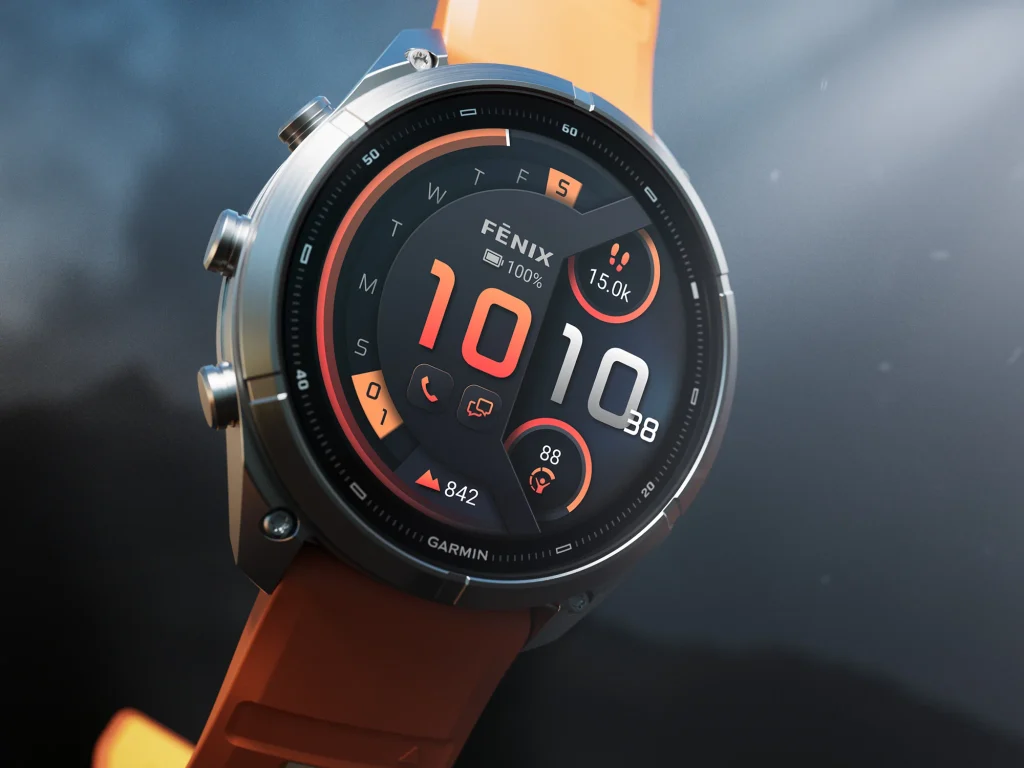
Compared like for like at 47mm, Fenix 9 and Fenix 8 AMOLED share identical case dimensions of 47 x 47 x 13.8mm, and a similar titanium weight, 75g fitted against 73g for Fenix 8. Both are tested to the MIL-STD-810 military standard.
Fenix 9 fits a titanium rear cover across every model in the range, where Fenix 8 AMOLED used a metal rear cover, and every Fenix 9 uses a sapphire crystal lens, where Fenix 8 AMOLED limited sapphire to its pricier Sapphire edition and used Corning Gorilla Glass on cheaper versions. The Fenix 9 case is fibre reinforced polymer with a titanium bezel, while Fenix 8 AMOLED offered a stainless steel or titanium bezel depending on edition.
Colour choice has narrowed at launch. The Fenix 9 47mm is available in Titanium/Pebble Gray or Carbon Gray DLC Titanium/Black, while Fenix 8 AMOLED launched in five colourways: Silver/Whitestone, Soft Gold/Fog Grey, Carbon Grey DLC/Black, Titanium/Spark Orange and Slate Grey/Black.
Both watches share a 22mm QuickFit band mount, leakproof inductive buttons, and a built in speaker and microphone for wrist based calls and voice notes.
Display
Garmin’s AMOLED panel on Fenix 9 reaches approximately 2,000 nits, roughly twice the brightness of the Fenix 8 AMOLED panel. At 47mm, both watches use the same 1.4 inch, 35.56mm, AMOLED display at 454 x 454 pixels, so the brightness increase comes from the panel itself rather than a change in size or resolution. Both displays are colour touchscreens with an always on option, a large font option, and red shift and colour shift modes for low light.
Battery and storage
Compared at the same 47mm case size, the headline smartwatch battery figure is unchanged at up to 16 days for both watches, and Fenix 8’s always on smartwatch figure of 7 days is not published separately for Fenix 9. Low power watch mode improves slightly, from 23 days on Fenix 8 to 24 days on Fenix 9, and expedition mode improves from 17 days to 18 days. The maximum battery GPS figure is identical at up to 81 hours on both watches.
Garmin renamed several of the GPS tracking modes between generations, so not every row maps exactly, but the closest equivalents show a small decrease in typical GPS tracking time: Fenix 9’s Activity Mode Normal is rated at up to 30 hours, against up to 38 hours for Fenix 8’s All Satellite Systems mode. GPS tracking with music playback improves slightly, from up to 10 hours to up to 12 hours.
Onboard storage doubles from 32GB on Fenix 8 to 64GB on Fenix 9, adding room for offline maps, stored music and Connect IQ apps.
Sensors and health tracking
The heart rate sensor is unchanged: both watches use the Garmin Elevate Gen 5 optical sensor. The rest of the sensor package is also matched, with GPS, GLONASS, Galileo, QZSS and BeiDou satellite systems, SatIQ multi-band optimisation, a pulse oximeter, barometric altimeter, compass, gyroscope, accelerometer, thermometer, ambient light sensor and skin temperature sensor, plus a depth sensor rated to 40 metres and a 10 ATM water rating on both watches.
Health monitoring tools are matched too, including sleep coach, sleep score and stages, HRV status, body battery energy monitoring, all day stress tracking, respiration rate, jet lag advisor, heat and altitude acclimation, women’s health tracking, hydration tracking, and the Garmin ECG app for AFib detection.
Training and sports features

Training tools are broadly unchanged, covering training readiness, training status, VO2 max for running and trail running, real time stamina, endurance score, race predictor, PacePro pacing, ClimbPro ascent planning, and Garmin Coach plans for running, cycling, strength and triathlon. Diving features are also matched, with single gas and apnea diving, a Buhlmann ZHL-16c decompression model, and a dive planner on both watches, each rated to 40 metres.
A small number of running and performance metrics move from requiring a compatible accessory on Fenix 8 to working from the wrist alone on Fenix 9. Lactate threshold, in particular, is now available on the base model without an accessory, where Fenix 8 required one for the equivalent reading.
Indoor rowing gains a full new set of metrics on Fenix 9: VO2 max, functional threshold power, a power curve and zones, and lactate threshold, each requiring a compatible rowing machine. This did not appear on the Fenix 8 specification.
The archery activity profile is replaced by ArcheryX, which adds real time shooting timing and aiming indicators. Fenix 9 also adds a Gaming Activity profile compatible with Garmin’s GameOn app, along with mixed session multisport, manual multisport activities, and a dedicated rucking workout type distinct from the existing rucking activity profile.

Software and mapping
Garmin fitted a new processor to Fenix 9, which the manufacturer says makes the mapping engine around 40 percent faster to pan and to build routes, along with a more responsive compass heading. TopoActive maps are preloaded as standard across the Fenix 9 range, where Fenix 8 limited preloaded maps to its Sapphire editions.
The following features are new to Fenix 9 and do not appear on the Fenix 8 specification:
- Garmin Epic, which records a trip across multiple days, weeks or months and combines the activities, photos and health or performance statistics into a single, shareable story
- ArcheryX, replacing the Archery profile with real time shooting timing and aiming indicators
- Gaming Activity, compatible with the GameOn app
- A full indoor rowing suite: VO2 max, functional threshold power, a power curve and zones, and lactate threshold, each needing a compatible rowing machine
- Mixed session and manual multisport activities
- A dedicated rucking workout type, separate from the existing rucking activity profile
- Grade adjusted pace based running workouts
- A Perspective View option added to the mapping tools
- Lactate threshold now available on the base model without a separate accessory
Choosing between Fenix 9, Fenix 9 Pro and Fenix 9 Pro Solar
All three tiers run the same software and share the same core sensors and features. The differences are in case material, screen brightness, screen type, and connectivity options.
The base Fenix 9 uses a fibre reinforced polymer case with a titanium rear cover and a titanium bezel, and an AMOLED display at approximately 2,000 nits. It does not offer solar charging or a built in satellite messaging option. It is available in 43mm, 47mm and 51mm, priced from GBP 859.99.
Fenix 9 Pro uses a full titanium case throughout and an AMOLED display rated up to 3,000 nits, brighter than the base model. It is available in 43mm, 47mm and 51mm, and adds the option of solar charging, in 47mm and 51mm only, or built in inReach satellite messaging, available at any size. UK pricing for the Pro tier had not been confirmed at the time of writing, though Australian dollar pricing already published put the Pro AMOLED above the base Fenix 9. The Pro is also the first Fenix to offer a 43mm size with satellite messaging: the equivalent Fenix 8 Pro tier came only in 47mm and 51mm.
Fenix 9 Pro Solar fits the Pro tier with a transflective MIP solar display instead of AMOLED, and is available in 47mm and 51mm only, not 43mm. The screen is less sharp and less bright than AMOLED but reads clearly in direct sunlight and drives a substantially longer battery life. At 47mm, smartwatch battery rises to up to 21 days, or up to 34 days with sufficient sun exposure, against 18 days for the Pro AMOLED at the same size. At 51mm, smartwatch battery rises to up to 30 days, or up to 57 days with sun, against 31 days for the Pro AMOLED. Fenix 9 Pro Solar can also be paired with inReach satellite messaging, the same as the Pro AMOLED.
The inReach option, where fitted, adds two way satellite and LTE messaging, satellite SOS alerts, satellite weather, and Garmin Locate, which lets a chosen contact request the wearer’s position. It requires a paid subscription, and the person being messaged also needs to use the Garmin Messenger app.
| Feature | Fenix 9 | Fenix 9 Pro | Fenix 9 Pro Solar |
|---|---|---|---|
| Case material | Fibre reinforced polymer, titanium rear cover | Full titanium | Full titanium |
| Screen | AMOLED, approx 2,000 nits | AMOLED, up to 3,000 nits | Solar MIP |
| Sizes offered | 43mm, 47mm, 51mm | 43mm, 47mm, 51mm | 47mm, 51mm only |
| Solar charging | No | No | Yes |
| Satellite (inReach) option | No | Optional, any size | Optional |
| Smartwatch battery, 47mm | Up to 16 days | Up to 18 days | Up to 21 days (34 with sun) |
| Smartwatch battery, 51mm | Up to 29 days | Up to 31 days | Up to 30 days (57 with sun) |
| UK price from | GBP 859.99 | Not confirmed at time of writing | Not confirmed at time of writing |
Fenix 9 vs Fenix 8: specification comparison table
The table below compares the base Fenix 9 and the Fenix 8 AMOLED at the same 47mm case size, using each watch’s headline specification page.
| Specification | Fenix 9 (47mm, base) | Fenix 8 AMOLED (47mm) |
|---|---|---|
| Price at launch | GBP 859.99 | GBP 869.99 (currently listed at GBP 749.99) |
| Release date | 25 August 2026 | 27 August 2024 |
| Case dimensions | 47 x 47 x 13.8mm | 47 x 47 x 13.8mm |
| Weight, titanium | 75g (53g case only) | 73g (52g case only) |
| Case material | Fibre reinforced polymer, titanium rear cover | Fibre reinforced polymer, metal rear cover |
| Bezel material | Titanium | Stainless steel or titanium, by edition |
| Lens material | Sapphire crystal, all editions | Corning Gorilla Glass or sapphire, by edition |
| Display type and size | AMOLED, 1.4in (35.56mm) | AMOLED, 1.4in (35.56mm) |
| Display brightness | Approx 2,000 nits | Approx half of Fenix 9 |
| Resolution | 454 x 454 pixels | 454 x 454 pixels |
| Heart rate sensor | Garmin Elevate Gen 5 | Garmin Elevate Gen 5 |
| Onboard storage | 64GB | 32GB |
| Smartwatch battery | Up to 16 days | Up to 16 days (7 days always on) |
| Low power watch mode | Up to 24 days | Up to 23 days |
| Typical GPS tracking | Up to 30 hours (Activity Normal) | Up to 38 hours (All Satellite Systems) |
| GPS tracking with music | Up to 12 hours | Up to 10 hours |
| Maximum battery GPS mode | Up to 81 hours | Up to 81 hours |
| Expedition mode | Up to 18 days | Up to 17 days |
| Water rating | 10 ATM | 10 ATM |
| Dive depth rating | 40m (EN13319) | 40m (EN13319) |
| Preloaded TopoActive maps | Standard, all editions | Sapphire editions only |
| Mapping engine | New processor, approx 40% faster | Previous generation processor |
| Garmin Epic | Yes | Not listed |
| Indoor rowing performance suite | Yes (VO2 max, FTP, power curve, lactate threshold) | Not listed |
| Archery activity | ArcheryX, with real time shooting timing | Archery (profile only) |
| Gaming Activity | Yes, GameOn app compatible | Not listed |
| Built in satellite (inReach) option | Not on base model | Not on base model |
Fenix 9 Model Comparison Table
Via Reddit
| Model | 9 | 9 | 9 | 9 Pro | 9 Pro | 9 Pro | 9 Pro | 9 Pro | 9 Pro | Pro Solar | Pro Solar | Pro Solar | Pro Solar | Coros Apex 4 | Coros Apex 4 |
| Size | 43 | 47 | 51 | 43 | 43 | 47 | 47 | 51 | 51 | 47 | 47 | 51 | 51 | 42 | 46 |
| InReach | No | No | No | Yes | No | Yes | No | Yes | No | Yes | No | Yes | No | No | No |
| Price | 1000 | 1000 | 1100 | 1200 | 1100 | 1200 | 1100 | 1300 | 1200 | 1200 | 1100 | 1300 | 1200 | 430 | 480 |
| Display | AMOLED | AMOLED | AMOLED | 3000 nits AMOLED | 3000 nits AMOLED | 3000 nits AMOLED | 3000 nits AMOLED | 3000 nits AMOLED | 3000 nits AMOLED | MIP | MIP | MIP | MIP | MIP | MIP |
| Display Size | 1.3 (33) | 1.4 (35.6) | 1.4 (35.6) | 1.3 (33) | 1.3 (33) | 1.4 (35.6) | 1.4 (35.6) | 1.5 (38.1) | 1.5 (38.1) | 1.3 (33) | 1.3 (33) | 1.4 (35.6) | 1.4 (35.6) | 1.2 (30.5) | 1.3 (33) |
| Smartwatch Days | 10 | 16 | 29 | 10 | 10 | 18 | 18 | 31 | 31 | 21-34 | 21-34 | 30-57 | 30-57 | 15 | 24 |
| GPS Hours | 18 | 30 | 54 | 18 | 18 | 32 | 32 | 56 | 56 | 54-81 | 54-81 | 75-124 | 75-124 | 34 | 53 |
| Weight (g) | 61 | 75 | 91 | 62 | 62 | 78 | 78 | 99 | 99 | 84 | 84 | 102 | 102 | 44 | 51 |
Summary of changes
Compared like for like at 47mm, the core hardware changes between Fenix 8 and Fenix 9 are a titanium rear cover and sapphire lens fitted as standard, roughly double the display brightness, and double the onboard storage. Battery life at matched case size is close to unchanged, with the same 16 day smartwatch figure and the same 81 hour maximum battery GPS figure on both watches, though low power and expedition modes each gain a day and typical GPS tracking time drops slightly under Garmin’s renamed mode structure. The heart rate sensor, the core satellite and health sensor package, the dive computer, and the great majority of training tools carry over unchanged.
Software brings the larger set of changes: Garmin Epic, a full indoor rowing metrics suite, ArcheryX, Gaming Activity, a faster mapping engine with a Perspective View option, and lactate threshold now available without an accessory. Built in satellite messaging and solar charging remain exclusive to the Fenix 9 Pro tier, which also fits a full titanium case and a brighter display than the base Fenix 9, while the Fenix 9 Pro Solar trades some display sharpness for substantially longer battery life.

I am James, a UK-based tech enthusiast and the Editor and Owner of Mighty Gadget, which I’ve proudly run since 2007. Passionate about all things technology, my expertise spans from computers and networking to mobile, wearables, and smart home devices.
As a fitness fanatic who loves running and cycling, I also have a keen interest in fitness-related technology, and I take every opportunity to cover this niche on my blog. My diverse interests allow me to bring a unique perspective to tech blogging, merging lifestyle, fitness, and the latest tech trends.
In my academic pursuits, I earned a BSc in Information Systems Design from UCLAN, before advancing my learning with a Master’s Degree in Computing.
I’m proud to share that Vuelio has consistently ranked Mighty Gadget as one of the top technology blogs in the UK. With my dedication to technology and drive to share my insights, I aim to continue providing my readers with engaging and informative content.
I work directly with the companies he reviews products for or their chosen PR agency.
For Social Media, you can find me on: